







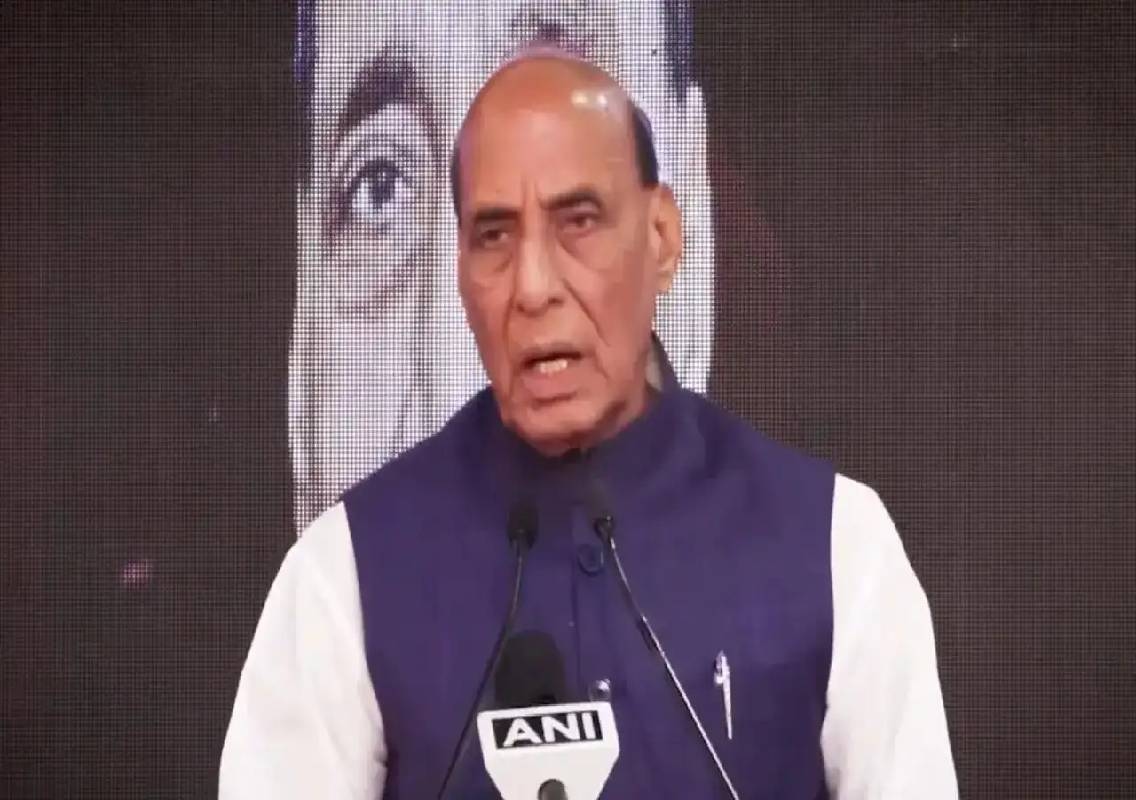


New Delhi: Defence Minister Rajnath Singh on Thursday said India voluntarily halted Operation Sindoor on its own terms, asserting that the country remains fully prepared for a prolonged conflict against terrorism if required.
Speaking at the ANI National Security Summit 2.0, Singh described Pakistan as the “epicentre of international terrorism” and stressed that India would not differentiate between terrorists and those who support them.
Operation halted on India’s terms
Clarifying the decision to stop Operation Sindoor, Singh said the move was not due to any limitation in India’s capabilities. Instead, it was a strategic decision taken independently by the country.
“We stopped it voluntarily, on our own terms. If necessary, we were fully prepared for a long war,” he said, adding that India possesses strong “surge capacity” the ability to scale up military operations swiftly in times of need.
He emphasised that India’s defence preparedness remains robust and has further strengthened since the operation.
Background of Operation Sindoor
Operation Sindoor was launched on May 7 last year in response to the April 22 Pahalgam terror attack. As part of the operation, Indian armed forces carried out targeted strikes on terror infrastructure across Pakistan and Pakistan-occupied Jammu and Kashmir (PoJK).
According to the Defence Minister, nine major terror launchpads were destroyed during the operation. These included facilities linked to terror outfits such as Lashkar-e-Taiba, Jaish-e-Mohammed, and Hizbul Mujahideen.
He noted that the operation demonstrated precision targeting by Indian forces, focusing specifically on those responsible for attacks against the country.
Joint military strength highlighted
Singh described Operation Sindoor as a strong example of coordination among India’s armed forces. He said the Army, Navy, and Air Force operated under a unified strategy, showcasing a new level of integration.
“India’s military power no longer operates in silos. It has emerged as a joint, integrated, and global force,” he said.
The Defence Minister also highlighted the role of India’s growing military-industrial capabilities, stating that the country is equipped to meet both peacetime and wartime requirements efficiently.
‘No distinction between terrorism and its sponsors’
In a strong message to the international community, Singh reiterated that India will treat terrorism and its sponsors as one and the same.
He also referred to past threats during the operation, stating that India did not succumb to “nuclear bluff” and acted firmly in the national interest.
“This is the new India. We did what was necessary without being deterred by threats,” he said.
Pakistan labelled ‘epicentre of terrorism’
Singh criticised Pakistan’s long-standing role in supporting terrorism, contrasting it with India’s global reputation in sectors like information technology.
“Both countries gained independence at the same time, but today India is known for IT, while Pakistan is seen as the epicentre of international terrorism,” he said.
He further explained that terrorism thrives on ideological and political support systems, stressing the need to eliminate these root causes.
Using a metaphor, Singh said the ideological backing of terrorism is like the “nectar in Ravana’s navel” that allows it to regenerate, underlining the importance of addressing its source.
Call for global action
The Defence Minister urged the international community to take stronger action against terrorism by targeting not just the perpetrators but also the systems that sustain them.
He emphasised that eliminating terrorism requires dismantling its ideological and political foundations, not just responding to individual attacks.
Conclusion
Rajnath Singh’s remarks reinforce India’s firm stance on terrorism and its sponsors, while underlining the strategic intent behind halting Operation Sindoor. With a focus on preparedness, coordination, and global cooperation, India continues to position itself as a strong and decisive force in the fight against terrorism.