







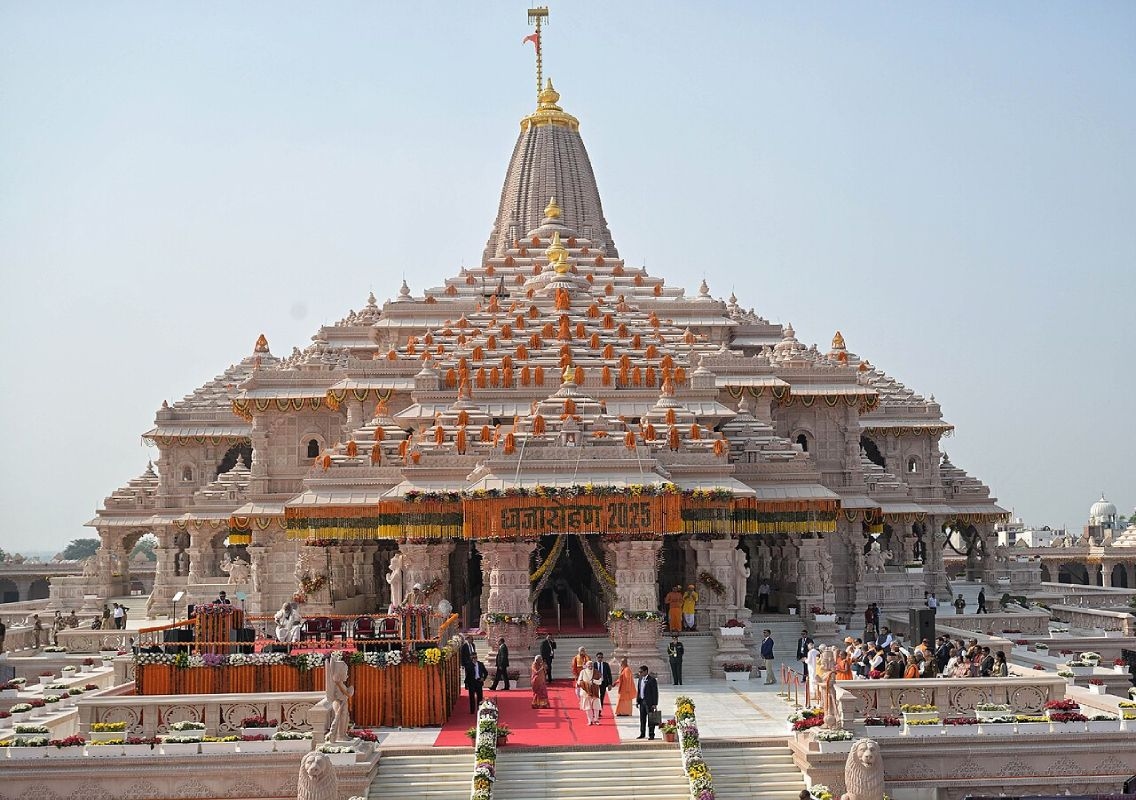


Lucknow: The Shri Ram Janmabhoomi Teerth Kshetra Trust, which oversees the construction and management of the Ram Temple in Ayodhya, is not answerable to the government and holds the authority to make independent decisions, according to recent statements made in official and legal contexts. The clarification comes amid ongoing discussions regarding the administrative autonomy and functioning of the trust.
Trust’s independent status clarified
The Ram temple trust was constituted following the Supreme Court’s landmark verdict in the Ayodhya land dispute case in 2019. The court had directed the Central Government to establish a trust to oversee the construction of the temple at the disputed site. Consequently, the Shri Ram Janmabhoomi Teerth Kshetra Trust was formed as an autonomous body.
Officials have reiterated that the trust operates independently and is not under direct government control. This means that it is empowered to take its own decisions regarding temple construction, administration, finances, and other related matters without requiring approval from any government authority.
Legal experts point out that the trust functions as a private entity, albeit one created through a government initiative in compliance with the Supreme Court’s directive. Its independence ensures that religious and administrative decisions remain free from political interference, maintaining the sanctity of the institution.
Government’s role limited to facilitation
While the government played a key role in setting up the trust, its involvement is largely limited to facilitation rather than governance. Authorities clarified that the Centre’s responsibility was to ensure the formation of the trust and the transfer of land, as mandated by the apex court.
Beyond that, the trust has been granted full autonomy to carry out its functions. This includes decisions related to temple architecture, construction timelines, donation management, and overall operations. The government does not have a supervisory or controlling role in these matters.
This distinction is significant as it addresses concerns raised in certain quarters about potential governmental influence over the temple’s affairs. Officials emphasised that such concerns are unfounded, given the trust’s independent legal status.
Powers to take key decisions
The trust’s authority extends to various crucial aspects of the temple project. It can independently appoint contractors, manage funds collected through donations, and make policy decisions regarding temple operations and visitor management.
The autonomy also allows the trust to respond swiftly to logistical and administrative challenges without bureaucratic delays. This has been particularly important in ensuring that the temple construction progresses smoothly and efficiently.
Moreover, the trust has the power to frame its own rules and regulations, provided they are in compliance with applicable laws. This flexibility has enabled it to adopt modern management practices while respecting traditional religious customs.
Transparency and accountability measures
Despite its independence, the trust is expected to maintain transparency and accountability in its operations. As a public religious institution receiving significant donations, it is subject to financial scrutiny and must adhere to established norms of governance.
Periodic disclosures and audits are seen as essential to maintaining public confidence. Officials have indicated that while the trust is autonomous, it remains accountable to the broader public and legal framework within which it operates.
Experts note that such a model—where a religious trust functions independently but within a regulated environment—helps strike a balance between autonomy and accountability.
Broader implications
The clarification regarding the trust’s independence has broader implications for similar institutions across the country. It reinforces the principle that religious bodies, even when established through government action, can function autonomously without direct state control.
This separation is viewed as crucial in a diverse country like India, where maintaining a clear boundary between governance and religious affairs is essential for preserving secular values.
At the same time, the trust’s functioning continues to attract attention due to the significance of the Ram Temple project, which holds deep cultural and religious importance for millions of devotees.