







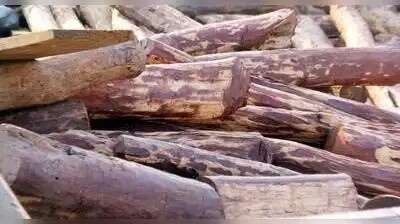


Pileru : Forest officials in Andhra Pradesh’s Annamayya district seized red sandalwood logs valued at around ₹10 lakh and two cars following a high-speed chase near Pileru, officials said.
The operation is part of continuing efforts by authorities to curb the illegal felling, transportation and smuggling of red sandalwood, a valuable forest resource found in the region.
The seizure followed information about the movement of suspected smugglers and their vehicles. Forest personnel moved to intercept the vehicles, leading to a chase in the Pileru area.
The occupants managed to evade capture, but officials were able to seize the vehicles and the red sandalwood logs allegedly being transported.
High-speed chase leads to seizure
According to the report, forest officials attempted to stop vehicles suspected to be involved in the illegal transportation of red sandalwood.
Instead of stopping, the vehicles reportedly sped away, prompting officials to give chase.
The pursuit eventually resulted in the suspected smugglers abandoning the vehicles.
Officials subsequently searched the vehicles and recovered red sandalwood logs estimated to be worth ₹10 lakh.
The suspects were not immediately apprehended, and efforts are expected to continue to identify and trace those involved in the alleged smuggling operation.
Red sandalwood remains a valuable target
Red sandalwood, scientifically known as Pterocarpus santalinus, is native to parts of southern India and is particularly associated with the forests of Andhra Pradesh.
The wood is highly valued because of its distinctive colour and properties.
Its international demand has historically contributed to organised smuggling networks operating through forest areas and transport routes.
The high value of the timber makes red sandalwood particularly vulnerable to illegal felling and trafficking.
Authorities in Andhra Pradesh have consequently maintained sustained enforcement operations to protect forest resources and prevent the illegal movement of the wood.
Pileru region under focus
Pileru and surrounding areas in Annamayya district are located close to forested areas associated with red sandalwood.
The terrain can provide opportunities for smugglers to move illegally felled timber through less accessible routes.
Forest and law-enforcement agencies have therefore continued surveillance and vehicle checks in vulnerable areas.
The latest seizure demonstrates how enforcement teams can intercept suspected consignments before they reach larger transport networks.
The recovery of two vehicles is also significant because vehicles are frequently used to move illegally harvested forest produce from remote areas towards roads and other destinations.
No immediate arrests reported
The available report did not provide details of any arrests following the chase.
The suspects reportedly managed to escape while the vehicles and logs were seized.
Investigators are likely to examine the vehicles and other evidence recovered during the operation to establish who owned or operated them and where the timber originated.
Further investigation could also help authorities determine whether the consignment was part of a larger smuggling network.
Importance of protecting forest resources
Illegal logging can have consequences beyond the immediate loss of valuable timber.
Unauthorised felling can damage forest ecosystems and affect wildlife habitats.
Red sandalwood grows naturally in a limited geographical range, making the protection of its natural habitat particularly important.
The species has also faced significant pressure from illegal harvesting over the years.
Seizures such as the latest operation are therefore aimed not only at stopping individual consignments but also at disrupting the broader illegal trade.
Continuing crackdown on smuggling
Andhra Pradesh authorities have carried out numerous operations against red sandalwood smugglers over the years.
Earlier seizures have involved large quantities of logs, vehicles and other equipment used in alleged illegal transportation.
The latest operation in Annamayya comes amid continuing enforcement activity in the state’s red sandalwood belt.
In one recent operation reported in the state, authorities seized a substantial quantity of red sandalwood and arrested suspected smugglers, underlining the continuing scale of the challenge.
Why the timber is smuggled
The high commercial value of red sandalwood has made it a lucrative target for illegal traders.
Demand in international markets has historically encouraged smugglers to harvest the timber from protected forest areas and move it through complicated supply chains.
The illegal trade can involve several stages, from cutting trees inside forests to transporting logs, storing them and eventually moving them towards domestic or international markets.
This makes enforcement particularly challenging.
Stopping a vehicle carrying logs can therefore provide investigators with an opportunity to identify other people involved in the supply chain.
Vehicles become important evidence
The seizure of two cars could prove useful in the continuing investigation.
Authorities can examine vehicle ownership records, registration details and other evidence to determine how the vehicles were being used.
Such evidence can potentially help investigators trace the movement of the suspected consignment and identify people connected with the operation.
The vehicles may also provide clues about where the logs were collected and where they were intended to be transported.
Need for stronger forest surveillance
The latest incident highlights the importance of continued surveillance in forest areas where red sandalwood grows.
Forest departments increasingly rely on intelligence gathering, patrols, vehicle checks and coordination with police and other enforcement agencies to detect illegal activity.
Quick action can be particularly important because smugglers may attempt to move timber through remote roads and change routes to avoid checkpoints.
The successful seizure of the vehicles and logs demonstrates the value of field-level enforcement.
Environmental cost of illegal felling
The illegal removal of mature trees can take a significant environmental toll.
Trees play an important role in maintaining soil stability, supporting biodiversity and regulating local ecosystems.
When valuable species are selectively removed from forests, the ecological impact can extend beyond the individual trees that are felled.
Protecting red sandalwood therefore has both economic and environmental significance.
Investigation expected to continue
With the suspected smugglers having escaped, the next stage will be to identify those responsible.
Officials can use the seized vehicles and the recovered timber as evidence while investigating the origin and intended destination of the consignment.
The valuation of the seized logs at approximately ₹10 lakh underlines the economic incentive behind the alleged operation.
However, the seizure also represents a loss to those attempting to profit from illegal forest exploitation.
Another warning to smugglers
The operation sends another warning to those involved in the illegal red sandalwood trade that enforcement teams remain active in Annamayya district.
High-speed escapes may help suspects evade immediate arrest, but abandoned vehicles and seized timber can provide investigators with valuable leads.
Authorities are likely to continue efforts to trace the people involved and determine whether the latest consignment was connected to a wider network.
Protecting Andhra Pradesh’s red sandalwood
Red sandalwood is closely associated with Andhra Pradesh’s forest landscape and remains one of the state’s most closely protected forest resources.
The continued seizure of illegally transported logs shows that demand remains a challenge despite enforcement measures.
The latest recovery of ₹10 lakh worth of logs and two cars in Annamayya is therefore significant both as an enforcement success and as another indication of the pressure faced by the state’s forests.
For authorities, the immediate priority will be to trace the suspects and investigate the origin of the timber.
For conservation efforts, the larger objective remains clear: prevent valuable red sandalwood trees from being illegally felled and ensure that the forests supporting the species remain protected for future generations.