







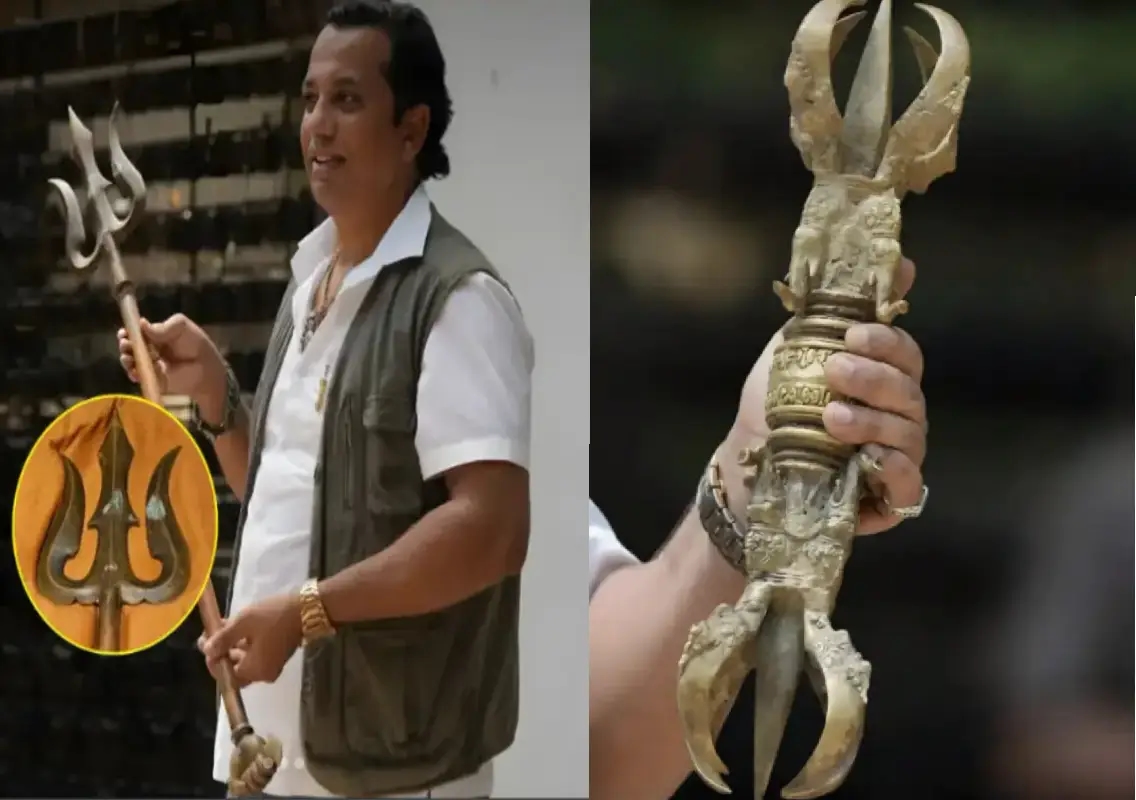


New Delhi: Indian researcher and businessman Syed Shameer Hussain has claimed that symbols associated with Sanatan Dharma — a Trishul and a Vajra — were discovered during a mining expedition in the Philippines. According to him, the artefacts could date back thousands of years and may be connected to ancient Indian civilisation.
The researcher unveiled the items during a press conference in New Delhi, stating that the Trishul may be about 10,000 years old, while the Vajra could be roughly 3,000 years old. He believes the objects correspond to the symbolic weapons associated with Shiva and Indra respectively.
Discovery during mining activity
According to Hussain, the artefacts were discovered in May 2015 when he was involved in copper and gold mining work in the Philippines. He had been working in the country since 2012 and collaborating with local residents at mining sites.
During the mining operation, a labour supervisor reportedly alerted him after noticing unusual objects unearthed from the ground. When Hussain inspected the items, he found two metallic artefacts that appeared unusual and different from typical objects found during mining.
One object resembled a trident, while the other had a shape similar to a Vajra — the thunderbolt weapon described in Hindu mythology. Hussain later concluded that the items might be associated with religious symbolism from ancient Indian traditions.
Artefacts brought to India for research
After the discovery, Hussain said he transported the objects to India in 2016 to conduct further examination and research. He spent several years studying the artefacts and consulting experts, including archaeologists and religious scholars.
According to his claims, the Trishul may date back around 10,000 years, while the Vajra may be approximately 3,000 years old. He believes these items reflect early cultural links between regions of Southeast Asia and ancient Indian civilisation.
Hussain said he discussed the artefacts with experts and also approached authorities in India to register them. According to reports, the items were later documented with the office of the Archaeological Survey of India.
Cultural significance of the symbols
In Sanatan Dharma traditions, the Trishul is widely recognised as the divine weapon of Lord Shiva. The three prongs of the trident symbolise various philosophical concepts, including creation, preservation and destruction.
The Vajra, on the other hand, is associated with Lord Indra, the Vedic deity linked to thunder, rain and storms. In ancient texts, the Vajra is described as a powerful weapon symbolising strength and divine authority.
Because of their strong mythological associations, the discovery of such artefacts outside the Indian subcontinent has sparked interest among those studying ancient cultural exchanges across Asia.
Debate over authenticity
While Hussain maintains that the artefacts are genuine antiquities linked to ancient traditions, independent archaeological verification has not yet been widely reported in academic literature.
Experts generally note that establishing the age and origin of artefacts requires extensive scientific testing such as metallurgical analysis, carbon dating of associated materials and documented excavation records.
Without such peer-reviewed verification, claims regarding the precise age or cultural origin of artefacts usually remain preliminary.
Possible historical links across Asia
Despite the debate, historians acknowledge that Indian cultural and religious influence historically spread across Southeast Asia through trade, migration and religious exchange.
Ancient kingdoms in regions such as Indonesia, Cambodia, Thailand and parts of the Philippines adopted elements of Indian culture, including Sanskrit inscriptions, Hindu-Buddhist iconography and temple architecture.
If the artefacts discovered in the Philippines are authenticated through further research, they could contribute to understanding early cultural interactions between South Asia and Southeast Asia.
Future plans for the artefacts
Hussain has said he has not yet decided what should be done with the Trishul and Vajra. He has received offers from individuals interested in purchasing the artefacts but claims he declined them.
Instead, he says he is seeking guidance from scholars, historians and cultural organisations about preserving the items and presenting them to the world.
For now, the discovery remains a subject of curiosity and debate among researchers and enthusiasts of ancient history.