







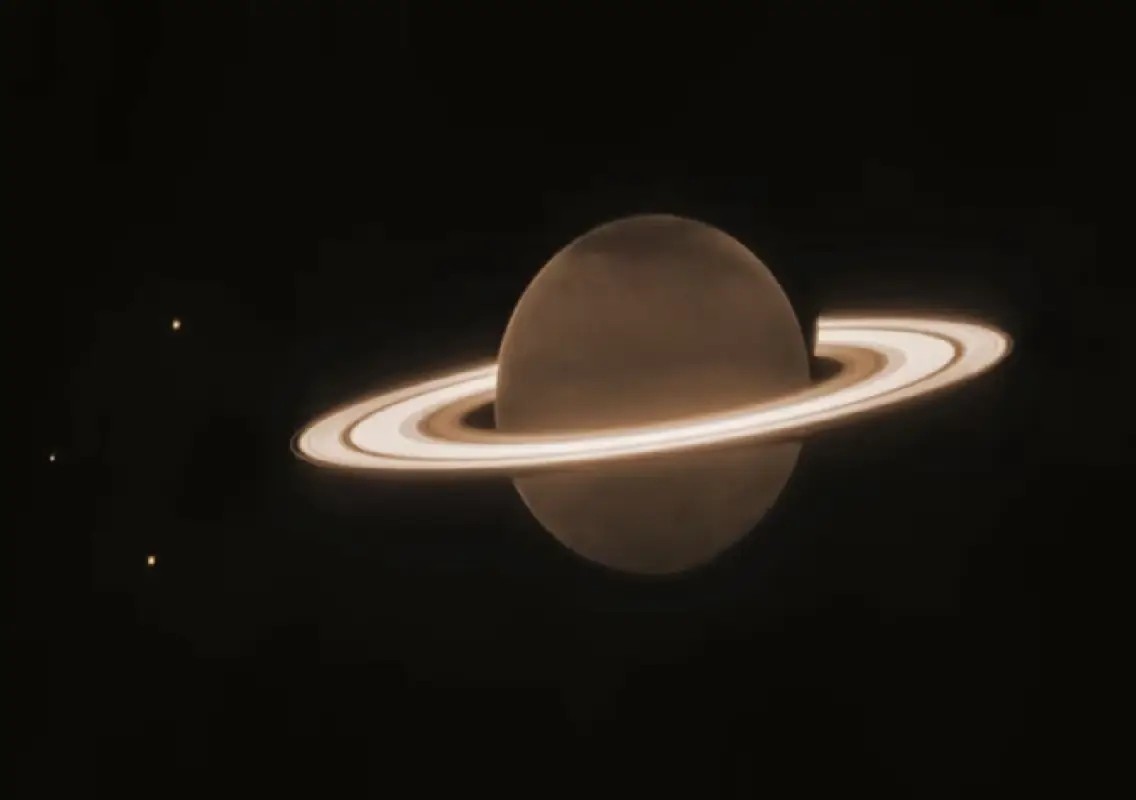


New Delhi: A glowing sphere encircled by magnificent rings, Saturn has fascinated astronomers and skywatchers for centuries. Now, breathtaking new footage has offered a remarkably detailed glimpse of the Solar System’s second-largest planet, showcasing its iconic rings and golden appearance like never before.
Orbiting approximately 1.4 billion kilometres away from Earth, Saturn remains one of the most distant planets visible to the naked eye. Despite its immense distance, advances in telescope technology and imaging techniques have enabled astronomers to capture extraordinary views of the gas giant.
A planet unlike any other
Saturn is renowned for its spectacular ring system, which stretches hundreds of thousands of kilometres into space. The rings are primarily composed of countless particles of ice, rock and dust, ranging in size from tiny grains to objects several metres across.
The planet itself is a massive gas giant, made up predominantly of hydrogen and helium, and is nearly nine times wider than Earth. However, because of its low density, Saturn would theoretically float if there were an ocean large enough to contain it.
Its distinctive appearance and bright rings have made Saturn one of the most recognisable celestial bodies in the Solar System.
Light from Saturn takes more than an hour to arrive
The new footage also serves as a reminder of the enormous distances involved in observing the cosmos.
Saturn lies nearly 1.4 billion kilometres from Earth, meaning that even light travelling at around 3 lakh kilometres per second takes more than an hour to reach our planet.
As a result, every image or video of Saturn essentially shows the planet as it existed more than an hour in the past.
Despite this delay, modern imaging technology allows astronomers to capture astonishing levels of detail, revealing subtle features in the planet’s cloud bands and ring structures.
Technological advances transforming astronomy
Recent improvements in digital sensors, image processing and high-powered telescopes have dramatically enhanced humanity’s ability to observe distant worlds.
By combining thousands of individual frames and using sophisticated software to eliminate atmospheric distortions, astronomers can produce images of Saturn with unprecedented clarity.
These techniques have enabled both professional observatories and skilled amateur astronomers to capture stunning visuals that were unimaginable just a few decades ago.
The latest footage highlights not only Saturn’s beauty but also the remarkable progress made in astronomical observation.
A world that continues to inspire
Saturn has captivated human imagination since ancient times and remains one of the most studied planets in the Solar System.
Past missions, including Cassini–Huygens, transformed scientific understanding of the planet, its rings and its numerous moons, revealing a dynamic and complex system.
Scientists continue to study Saturn to better understand the formation and evolution of giant planets, both within our Solar System and beyond.
The newly released footage serves as a striking reminder that even worlds located billions of kilometres away can still inspire wonder and curiosity, bringing one of the universe’s most iconic planets a little closer to Earth.