


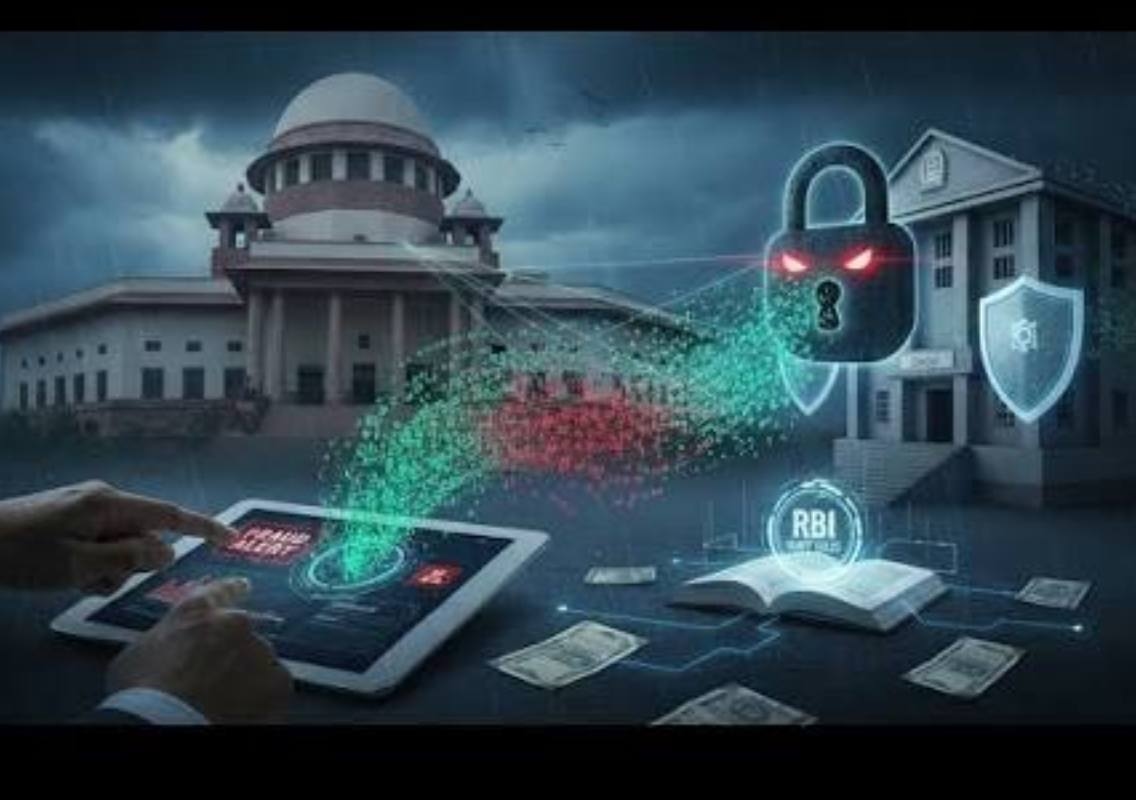


New Delhi: The Supreme Court has asked WhatsApp and other online intermediaries to spell out the safeguards they propose to introduce to prevent digital arrest scams and related cybercrimes, while reiterating that banks must compensate customers who lose money to fraud because of failures in due diligence.
The court has directed the platforms to submit their proposals to the Indian Cybercrime Coordination Centre (I4C) and place the details before the Supreme Court. The matter will be taken up again on November 23.
The directions were issued by a bench headed by Chief Justice of India Surya Kant and comprising Justices Joymalya Bagchi and V Mohana. The order, uploaded to the Supreme Court’s website, relates to the October 29 hearing in a suo motu case titled In Re: Victims of Digital Arrest Related to Forged Documents.
The proceedings indicate that the court wants a coordinated response involving social media platforms, banks, the Reserve Bank of India (RBI) and law enforcement agencies. Its focus is not limited to identifying fraudsters after an offence has occurred but also includes preventing suspicious transactions and ensuring that victims are not left without financial recourse when institutional negligence is established.
WhatsApp says it has acted against 9,400 accounts
During the hearing, senior advocate Kapil Sibal, appearing for WhatsApp, informed the bench that the messaging platform had already taken preventive action against 9,400 accounts allegedly linked to suspicious activity.
Sibal said WhatsApp would file an affidavit detailing the measures it had implemented to tackle digital arrest scams. He also told the court that the company was developing software to identify suspicious accounts and alert users.
The Supreme Court has asked WhatsApp LLC, a Meta company, and other concerned intermediaries to explain what additional measures they intend to adopt to prevent digital arrest scams and associated cybercrimes.
The bench directed the platforms to submit their proposals simultaneously to the court and the I4C.
The requirement could place greater emphasis on the responsibility of online platforms to identify suspicious activity, warn users and cooperate with agencies working to prevent cybercrime. The court is expected to examine the proposals when the matter returns on November 23.
Digital arrest scams typically involve fraudsters impersonating police officers, investigators or other government officials. They threaten victims with arrest or legal action and use fabricated allegations, documents and video calls to make their claims appear genuine. Victims are often pressured into transferring money under the pretext of verification, investigation or avoiding immediate arrest.
Supreme Court wants banks to compensate victims
The court’s scrutiny also extends to the banking system. During the October 29 hearing, the bench stressed that financial institutions must be held accountable when their failure to exercise due diligence contributes to cyber fraud.
It reiterated that RBI’s proposed regulatory measures should include provisions requiring banks and other financial institutions to indemnify victims and provide suitable compensation when negligence is established.
The bench said compensation should not be less than the amount lost by the customer if an investigation establishes that the fraud occurred because the financial institution failed to take appropriate preventive or reporting measures.
In its order, the court stated that regulatory provisions must ensure that victims receive compensation where the failure of a financial institution to exercise due diligence is found to have enabled or failed to prevent the fraud.
The observation is significant because it places the question of financial liability alongside the responsibility of investigating and prosecuting cybercriminals. However, the court’s direction is linked to cases where institutional failure is established; it does not amount to an automatic guarantee of compensation for every cyber fraud victim.
Banks asked to flag unusual transactions
Chief Justice Surya Kant questioned why banks could not intervene when customers suddenly attempted to transfer unusually large amounts that were inconsistent with their normal transaction patterns.
The bench suggested that banks should use the transaction history and account information already available to them to identify potential fraud before money is transferred.
The court has highlighted several safeguards that could be made mandatory for financial institutions. These include temporarily suspending unusual or suspicious transactions that do not match an account holder’s past banking behaviour.
It also suggested that such transactions should automatically be reported to the nearest police station, followed by physical verification to establish whether the transfer is genuine.
The bench said these preventive measures should be incorporated into the regulatory framework being considered by the RBI.
The Chief Justice described banks as a “protective umbrella” for vulnerable customers, emphasising that financial institutions have access to information about account holders and their usual transaction patterns.
The court’s concern is that banks should not merely process transactions and respond after money has disappeared. Instead, they should be equipped to identify warning signs and intervene when a transfer appears inconsistent with a customer’s established banking behaviour.
RBI asked to submit list of authorised financial institutions
To ensure that the proposed safeguards are implemented across the banking system, the Supreme Court has directed the RBI to submit a list of all authorised financial institutions at the next hearing.
The bench wants to examine the central bank’s proposed regulatory framework before allowing the process to move forward.
In particular, it said it would first consider the RBI’s proposed Know Your Customer Amendment Directions, 2026. These directions are proposed to be notified by November 30 and brought into effect by December 31.
The court has indicated that the regulatory framework must contain enforceable provisions rather than remain limited to general recommendations. Compensation for victims, preventive intervention in suspicious transactions and institutional accountability are among the key areas it wants addressed.
Attorney General R Venkataramani, appearing for the Centre and other authorities, informed the bench that considerable work had already been undertaken to improve the detection of suspicious transactions and strengthen safeguards in the banking system, according to news agency Press Trust of India.
The court will examine the RBI’s proposed measures in the context of the broader effort to prevent digital fraud and reduce the financial losses suffered by customers.
States asked to report digital arrest cases
The Supreme Court has also sought detailed information from law enforcement agencies across states and Union territories.
It directed the agencies to submit reports on the first information reports registered in digital arrest scam cases and the investigations that followed. They have also been asked to recommend measures to prevent, detect and prosecute such offences.
Directors general of police in all states and Union territories have been instructed to ensure compliance with the directions.
The reports must be submitted to the inter-departmental committee coordinating the government’s response to digital arrest scams. Reports already filed before the Supreme Court must also be forwarded to the committee.
The exercise is intended to give the court and the government a clearer picture of the scale of the problem, the action taken by police agencies and the gaps that may be allowing such crimes to continue.
A coordinated assessment could also help identify differences in the way digital arrest complaints are registered and investigated across jurisdictions.
Court flags Rs 800 crore in cyber fraud losses
During the proceedings, the bench observed that although cybercrimes had declined by 50 per cent, victims had still lost around Rs 800 crore so far this year.
The observation underlined the continuing financial impact of cyber fraud despite improvements in detection and enforcement.
The court’s approach seeks to address the problem at several levels: online platforms must propose safeguards against suspicious accounts and communications; banks must strengthen transaction monitoring; the RBI must frame enforceable regulations; and police agencies must improve reporting and investigation.
The November 23 hearing will be an important stage in this process, with the Supreme Court expected to review the proposals submitted by WhatsApp and other intermediaries, the RBI’s regulatory measures and reports from law enforcement agencies.
The proceedings could have wider implications for how digital platforms and financial institutions respond to cybercrime in India. While the court has not announced a blanket compensation scheme, its emphasis on institutional accountability signals that customers should not automatically bear the entire financial burden when a fraud is linked to a bank’s failure to exercise due diligence.