







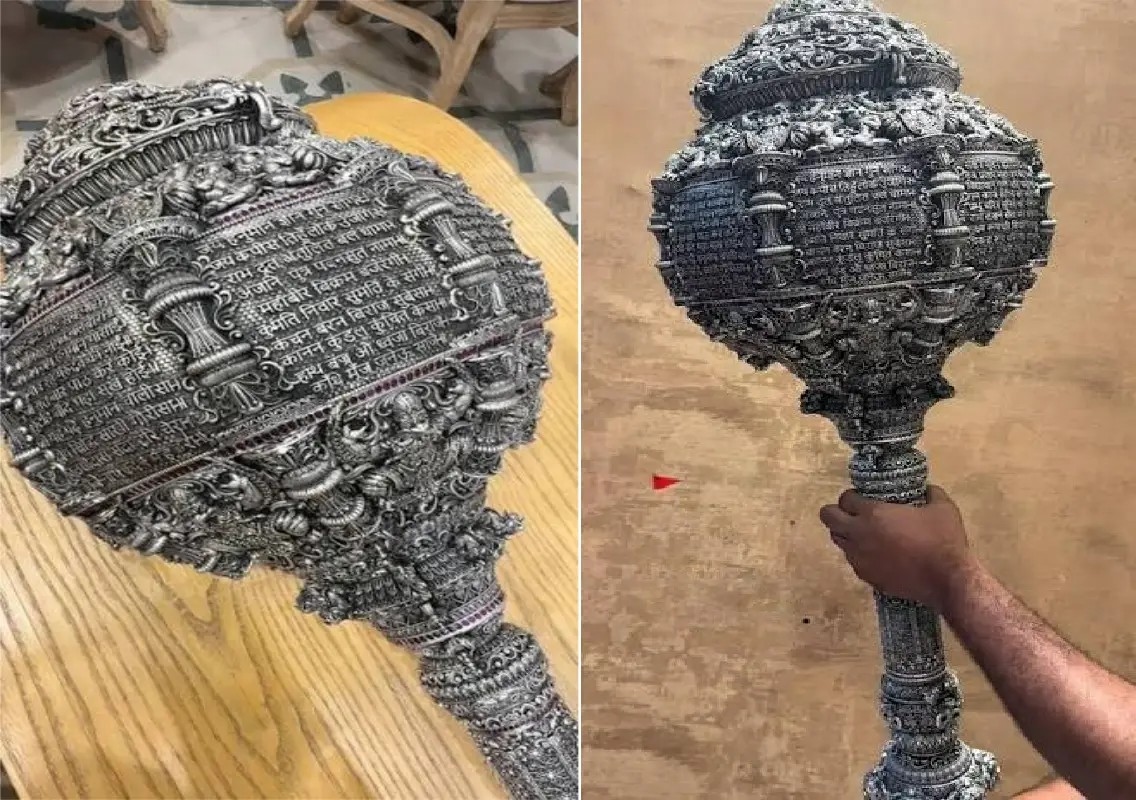


A remarkable blend of devotion, artistry and traditional craftsmanship has captured the attention of devotees and art enthusiasts alike. A specially crafted 6.5-kg silver Hanuman Gada, intricately engraved with the entire Hanuman Chalisa, has emerged as a striking example of the skill and dedication of Indian silver artisans.
The unique creation has drawn admiration for its detailed workmanship and spiritual significance. Combining religious devotion with fine metal engraving, the silver mace pays tribute to Lord Hanuman, one of the most revered deities in Hindu tradition, while showcasing the exceptional capabilities of traditional craftsmen.
Unique fusion of faith and craftsmanship
The Hanuman Gada, symbolising strength, courage and devotion, holds special significance in Hindu mythology as the weapon associated with Lord Hanuman.
What makes this silver creation extraordinary is the intricate engraving of the complete Hanuman Chalisa across its surface. The sacred 40-verse hymn dedicated to Lord Hanuman has been meticulously inscribed on the mace, transforming it into both a devotional artefact and a work of art.
Crafting such a piece requires not only artistic expertise but also immense patience and precision. The delicate lettering, executed on a curved metallic surface, demonstrates a high level of craftsmanship rarely seen in contemporary silverwork.
Devotees who have viewed the piece have praised the effort involved in combining sacred scripture with intricate metal artistry.
Master artisans showcase exceptional skill
Experts in traditional silver craftsmanship note that engraving lengthy religious texts onto metal surfaces is a highly specialised art form.
The process involves careful planning, precision measurement and detailed handwork to ensure that every verse is accurately inscribed without compromising the overall aesthetic appeal of the artefact.
The 6.5-kg silver gada reflects countless hours of dedication and attention to detail. Artisans must maintain consistency in lettering, spacing and design while working with valuable precious metal.
Such creations not only preserve traditional craftsmanship techniques but also demonstrate how ancient artistic skills continue to thrive in modern times.
The growing appreciation for handcrafted devotional artefacts has encouraged artisans to create innovative works that combine spirituality with artistic excellence.
Hanuman Chalisa holds deep spiritual significance
The Hanuman Chalisa, composed by the 16th-century poet-saint Goswami Tulsidas, remains one of the most widely recited devotional hymns in Hinduism.
Devotees believe that reciting the Chalisa invokes Lord Hanuman’s blessings, providing strength, courage, protection and spiritual guidance. The hymn is particularly popular among worshippers seeking relief from difficulties and obstacles in life.
By engraving the entire Hanuman Chalisa onto the silver gada, the creators have transformed a religious symbol into a spiritual manuscript that can be admired both for its sacred content and artistic value.
The combination of scripture and symbolism enhances the devotional appeal of the artefact and makes it a unique expression of faith.
Growing interest in devotional art
India has a long tradition of producing religious artefacts crafted from precious metals, including silver and gold. Temples, collectors and devotees often commission such works to celebrate important religious occasions or to preserve cultural heritage.
In recent years, there has been increasing interest in customised devotional art pieces that showcase both traditional craftsmanship and innovative design concepts.
The silver Hanuman Gada reflects this evolving trend, where artisans create spiritually meaningful objects that also serve as masterpieces of craftsmanship.
Many observers believe such creations help keep traditional art forms alive by introducing them to younger generations and encouraging appreciation for handmade craftsmanship.
Symbol of cultural heritage
Beyond its religious significance, the silver gada also represents India’s rich artistic and cultural heritage.
The country has a centuries-old tradition of metal engraving, temple art and handcrafted decorative objects. Skilled artisans continue to pass down these techniques through generations, preserving valuable knowledge and craftsmanship.
Creations such as the engraved Hanuman Gada highlight the enduring relevance of these traditional skills in contemporary society. They demonstrate how cultural heritage can be preserved through innovation while retaining its original spiritual essence.
Art lovers and devotees alike have described the piece as a rare example of how faith, culture and craftsmanship can come together to create something truly extraordinary.
Inspiring admiration among devotees
The intricate silver gada has generated widespread admiration among those who have seen it, with many praising the dedication required to complete such a detailed project.
For devotees, the artefact serves as a reminder of Lord Hanuman’s virtues of strength, humility and unwavering devotion. For craftsmen, it stands as an example of the heights that traditional artistry can achieve when combined with passion and skill.
Its unique design and meticulous execution have made it a talking point among religious and artistic circles, further highlighting the enduring appeal of handcrafted devotional works.
Conclusion
The 6.5-kg silver Hanuman Gada engraved with the entire Hanuman Chalisa is a remarkable tribute to both spirituality and craftsmanship. By combining sacred scripture with intricate silver artistry, the creation celebrates India’s rich cultural heritage while inspiring admiration among devotees and art enthusiasts alike. It stands as a shining example of how traditional craftsmanship continues to flourish through dedication, creativity and faith.