







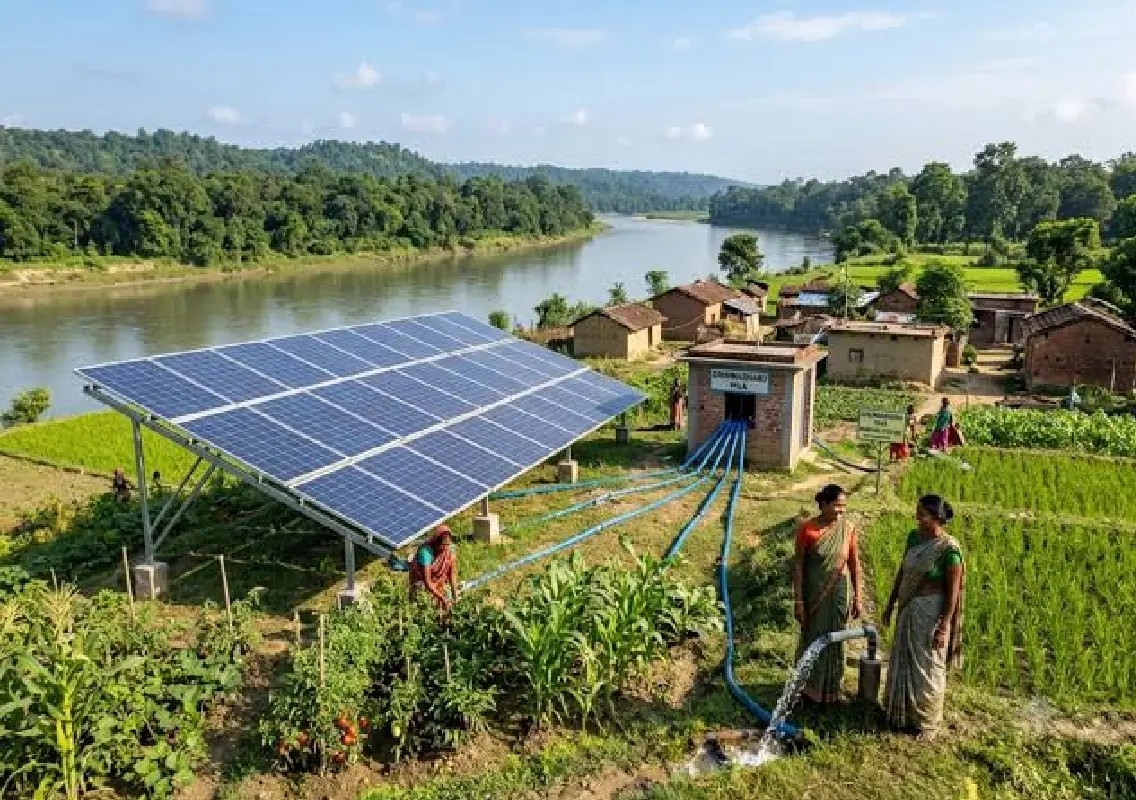


Mokhada : A community-led solar irrigation project in Tulyachapada village of Maharashtra’s Palghar district has transformed farming by bringing year-round water access to fields that once depended almost entirely on the monsoon. The initiative has expanded cultivated land from just four to five acres before 2019 to 95.77 acres, while enabling farmers to grow second crops, increase incomes and reduce seasonal migration.
The project uses 10 shared solar pumps and a 10-kilometre pipeline to provide irrigation to farmer groups and 108 households in the village. The system is combined with drip irrigation, allowing farmers to make more efficient use of available water.
The experience of Tulyachapada shows how decentralised renewable energy and community-based water management can address several rural challenges at the same time — from agricultural productivity and food security to livelihood opportunities and migration.
Water was nearby, but farmers could not access it
Tulyachapada, a small tribal hamlet in Mokhada block, has long faced a paradox. The village is close to the Morchondi dam, also known as the Tulyachapada dam, which has an effective storage capacity of 1.93 million cubic metres. Yet farmers struggled to bring that water to their fields.
For years, agriculture largely revolved around rain-fed paddy and millets. Once the kharif season ended, farming opportunities declined sharply.
The problem was not simply the absence of water. It was the lack of infrastructure to transport available water from its source to agricultural land.
Farmer Pandurang Lahare, who owns two acres, previously had to make a daily two-kilometre journey to access water. Today, his farm produces groundnut, mango and cashew with the help of the irrigation system.
The change has allowed farmers to depend less on rainfall and use their land for longer periods of the year.
Migration was once a seasonal necessity
Before the irrigation project, many farmers left the village after the monsoon in search of wage work.
Farmer Ramdas Jadhav recalled travelling to Nashik or Mumbai around November because there were few earning opportunities in the village after the kharif season. He said workers could earn between Rs 300 and Rs 500 a day doing construction-related work, but the work was physically demanding and disconnected from their agricultural livelihoods.
The migration also affected family life.
Some farmers travelled alone while their wives and children remained in the village. Women were also responsible for fetching water for household needs, adding another burden to families already dealing with seasonal unemployment.
The introduction of solar-powered irrigation in 2019 began to change that pattern.
With water available for farming beyond the monsoon, farmers could remain in the village and generate income from additional crops instead of relying entirely on temporary urban employment.
Ten pumps created a shared irrigation model
The project was implemented by non-profit organisation Pragati Pratishthan, with technical support from energy-access provider Gram Oorja Private Solutions. The initiative received support from Bank of America Merrill Lynch.
The model was based on groups of farmers sharing the cost and use of an irrigation system.
Ten farmer groups were formed, with each group using a solar pump. This approach was important because individual smallholders often cannot afford an irrigation system designed for larger farms.
According to Gram Oorja, each farmer’s share of the irrigation system cost around Rs 80,000, funded initially through corporate social responsibility support. The expectation was that income from an additional crop would eventually make the model financially sustainable.
Farmers use the shared system at different times according to their irrigation needs.
This makes the infrastructure more practical for small landholdings while allowing the benefits of a larger pumping system to be distributed across several farmers.
Groundnut became the breakthrough crop
Moving from traditional paddy to a second crop required farmers to take a risk.
Groundnut was identified as a suitable crop for the area, but farmers initially had reservations.
For Pandurang Chaudhary, paddy had long been a dependable crop. Groundnut was unfamiliar and represented an investment in a new farming model.
The results eventually changed his outlook.
Chaudhary said his seasonal income had previously been around Rs 25,000. After adopting groundnut cultivation, it rose to around Rs 60,000 per season and sometimes reached Rs 1 lakh.
The success encouraged other farmers to diversify.
Groundnut cultivation expanded from roughly four to five acres before the irrigation system to 48 acres in 2019 and 57.3 acres in 2025.
Vegetable cultivation added another income stream
The farmers began growing vegetables from 2021, including onions, bitter gourd, cucumbers and chillies.
Vegetable cultivation, which was virtually absent in 2019, had expanded to 38.47 acres by 2025. In 2024 alone, approximately 19.7 tonnes of vegetables and fruits were produced.
Fruit trees were also planted along field boundaries, creating a longer-term source of income.
Farmers planted an average of 58 fruit trees per farmer, allowing them to combine seasonal crops with perennial plants.
This diversification has reduced dependence on a single crop and created multiple potential sources of agricultural income.
Farm incomes show steady growth
The expansion of cultivation has translated into measurable economic gains.
According to a report prepared by Pragati Pratishthan, total income from agricultural activities increased from Rs 18.33 lakh in 2021 to Rs 31.08 lakh in 2024.
Vegetable and fruit sales generated an additional Rs 8.09 lakh between 2021 and 2024.
The change is significant for a community where farming once provided limited income outside the monsoon season.
The irrigation system has effectively extended the agricultural calendar, allowing farmers to use land that would otherwise remain underutilised after the main crop.
Solar energy reduces dependence on conventional power
The irrigation system uses solar pumps to lift water and distribute it through a pipeline network.
The arrangement is particularly useful in remote agricultural areas where electricity infrastructure may be limited or unreliable.
Farmers in Tulyachapada also received training in using the pumps and maintaining the system. Project organisers worked with them to understand irrigation requirements, crop selection and marketing.
The initiative even addressed a smaller but practical challenge: farmers lacked electricity in their fields. Solar lamps were provided so that they could work after dark when necessary.
Farmers received training alongside infrastructure
The project’s success was not based on installing pumps alone.
Pragati Pratishthan worked with farmers to build confidence in the new system and introduce new agricultural practices.
Farmers received guidance on groundnut cultivation, irrigation and marketing. They also learnt about organic farming practices, including preparation and use of jeevamrit, organic fertilisers and manure made from livestock waste.
This combination of infrastructure and knowledge helped farmers make practical use of the water made available through the solar pumps.
Project officials said building trust was particularly important because many farmers initially had questions about the reliability of solar-powered irrigation, especially during cloudy weather or in the event of technical problems.
Migration reportedly falls sharply
One of the most significant social outcomes has been the reduction in seasonal migration.
Project data indicate that migration from Tulyachapada has fallen by 90 per cent. Before the project, around 60 per cent of farmers reportedly migrated for work after the monsoon.
For families, the change means that farming can provide income closer to home.
The benefits extend beyond financial earnings. Reduced migration can allow parents to remain with their children, reduce the disruption caused by temporary urban employment and strengthen village-based livelihoods.
Lahare said the additional income also helped him secure admission for his daughter to a BSc course at a good college.
A model for small farmers
The Tulyachapada experience offers a possible model for other villages where water sources exist but cannot easily be used for irrigation.
Instead of building large individual systems for small landholdings, a group-based approach allows farmers to share infrastructure and manage water according to their needs.
The project also demonstrates how solar energy can support irrigation without depending entirely on conventional electricity networks.
Gram Oorja says its wider work has reached about 35,000 people through more than 100 pumps and 55 microgrids across several districts, while group irrigation projects have helped more than 1,700 small landholding farmers and their families grow second and third crops on previously unirrigated land.
Water access can reshape rural livelihoods
Tulyachapada’s transformation is ultimately about more than solar panels.
The technology became meaningful because it solved a practical problem: getting water from a nearby source to farmers’ fields.
Once that barrier was removed, farmers could extend cultivation beyond the monsoon, experiment with new crops, increase agricultural income and reduce their dependence on migration.
The experience also highlights the importance of combining renewable energy with efficient irrigation methods such as drip systems. Instead of treating water access, clean energy, agriculture and rural employment as separate issues, the project addressed them together.
For a small tribal village in Palghar, the result has been a dramatic expansion in cultivation — from a handful of acres to nearly 96 acres — and a renewed possibility of earning a livelihood from farming throughout the year.
The Tulyachapada model demonstrates that when local water resources are paired with appropriate technology, farmer participation and sustained handholding, even remote communities can turn previously inaccessible water into a foundation for more secure and diversified livelihoods.