


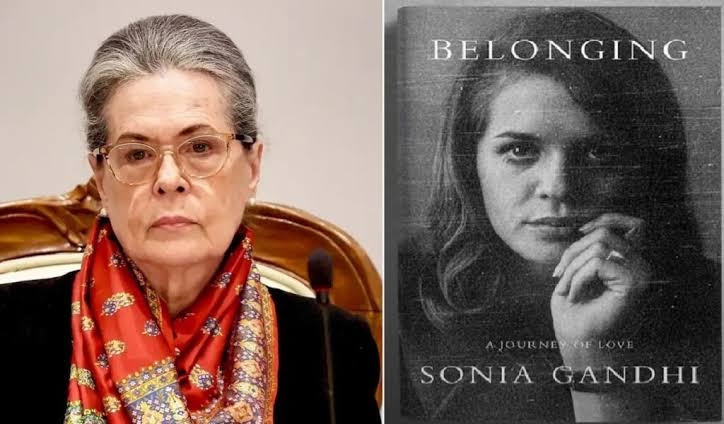


New Delhi: Congress Parliamentary Party chairperson Sonia Gandhi has described her upcoming memoir, Belonging: A Journey of Love, as a personal account of family, loss, love and her journey towards finding a home in India, rather than a political book.
In an article published in The Hindu ahead of the memoir’s Indian release on November 10, Gandhi said she wanted to present her family as she had known them, including their motivations, struggles and flaws.
“This is not a political book. It is a personal one,” she wrote, explaining that much had been written about her family without offering a deeper understanding of the people behind the public image.
The memoir traces Gandhi’s journey from a small Italian town to India, where she built a family with former Prime Minister Rajiv Gandhi and eventually became one of the country’s most influential political figures. It also reflects on the personal tragedies that shaped her life, including the assassinations of her mother-in-law, former Prime Minister Indira Gandhi, and her husband.
Gandhi said love and loyalty connected the different stages of her life. She also acknowledged that entering public life was not something she had initially wanted, but her experiences and sense of responsibility eventually brought her into politics.
From Italy to a life in India
In her article, Gandhi recalled how her journey towards India began with her meeting Rajiv Gandhi in England. She described herself as a 19-year-old woman from a small Italian town when she met the young Indian student.
“It all began in England, where a 19-year-old woman from a small Italian town met a young Indian student,” she wrote.
The relationship eventually brought her to India, where she became part of the Nehru-Gandhi family. Her life in the country included her relationship with Indira Gandhi, raising her children and adapting to a new culture and environment.
Gandhi’s account also reflects the personal relationships that shaped her understanding of family and belonging. Her bond with Indira Gandhi, in particular, formed an important part of her life in India.
However, the family experienced profound tragedies over the years. Gandhi recalled losing her mother-in-law and later her husband to political violence.
“It also carried me through the unbearable, when I lost first my mother-in-law and then my husband to violence,” she wrote.
Indira Gandhi was assassinated in October 1984 by two of her bodyguards. Rajiv Gandhi was assassinated in May 1991 during an election campaign in Tamil Nadu.
Gandhi said her love for Rajiv and India helped her endure these losses. The experiences also contributed to the sense of duty that eventually drew her into public life, despite her initial reluctance.
Sonia Gandhi reflects on privacy and public life
The memoir also explores the contrast between Gandhi’s private life and her eventual role in Indian politics.
She said she had generally kept her inner world private, even after becoming involved in public affairs. Writing openly about personal experiences was therefore a difficult decision.
“For most of my life, I kept my inner world to myself. Even after grief pulled me into politics, I held on to whatever privacy I could, and writing openly about my life felt almost unthinkable,” she wrote.
Her remarks suggest that the memoir is intended to offer readers a perspective on the personal experiences behind her public identity.
Gandhi entered active politics in the late 1990s, several years after Rajiv Gandhi’s assassination. She subsequently became president of the Congress and played a central role in the party’s political strategy and national leadership.
Her political career has often attracted public attention, but Gandhi said the book was not intended as a conventional political account. Instead, she wanted to document the experiences, relationships and changes that shaped her life.
She also reflected on the transformation of India during the more than five decades she has lived in the country.
“I watched a country transform, at first from the margins and later from its very centre,” she said.
Gandhi described the memoir as her account of that journey and of how India became the place she came to call home.
Memoir covers family tragedies and political milestones
While Gandhi has emphasised the personal nature of the book, Belonging: A Journey of Love also covers several major events in the history of the Nehru-Gandhi family and the Congress party.
The memoir recounts the death of Sanjay Gandhi, Rajiv Gandhi’s younger brother, in a plane crash in June 1980. Sanjay was an influential political figure and was widely seen as a key member of the Congress leadership at the time.
It also addresses Indira Gandhi’s assassination in 1984 and Rajiv Gandhi’s assassination in 1991. Both incidents had a profound impact on the family and India’s political landscape.
Another important period covered in the book is the Congress-led alliance’s victory in the 2004 general election.
After the United Progressive Alliance (UPA) secured a majority, Gandhi declined to become Prime Minister despite being widely expected to lead the government. She instead supported Manmohan Singh for the post and continued to lead the Congress and the coalition.
The UPA government remained in power for two consecutive terms, from 2004 to 2014, with Gandhi playing a central role in the alliance’s leadership.
These events provide the broader historical context for the personal journey described in the memoir. The book therefore brings together family experiences, personal losses and moments that shaped Gandhi’s public life.
HarperCollins India to publish memoir on November 10
HarperCollins India will publish Belonging: A Journey of Love in India on November 10.
The announcement ends uncertainty surrounding the book’s domestic publication after an impasse between Gandhi’s representatives and Penguin Random House India.
The change in publisher had raised questions about when the memoir would become available to Indian readers. HarperCollins India’s release will now bring the book to the domestic market.
Gandhi’s article in The Hindu offers an insight into the approach she has taken towards the memoir. Rather than presenting it primarily as a record of political events, she has described it as an effort to document the relationships and experiences that shaped her life.
The book’s coverage of major political milestones is likely to draw interest from readers familiar with India’s recent history. However, Gandhi’s stated focus remains on the personal dimensions of those events and how they affected her family.
A personal account of love, loss and belonging
For Gandhi, the memoir represents an opportunity to tell her story in her own words after decades in public life. Her account moves between her early years in Italy, her relationship with Rajiv Gandhi, her life within the Nehru-Gandhi family and the tragedies that eventually brought her into politics.
Her reflections also touch on the changes India underwent during her years in the country and her evolving sense of belonging.
By describing Belonging: A Journey of Love as a personal rather than political book, Gandhi has indicated that its central theme is not simply her career or the Congress party’s history. It is also about the family relationships, grief, loyalty and experiences that shaped her identity.
The memoir is scheduled to reach Indian readers on November 10 through HarperCollins India.