


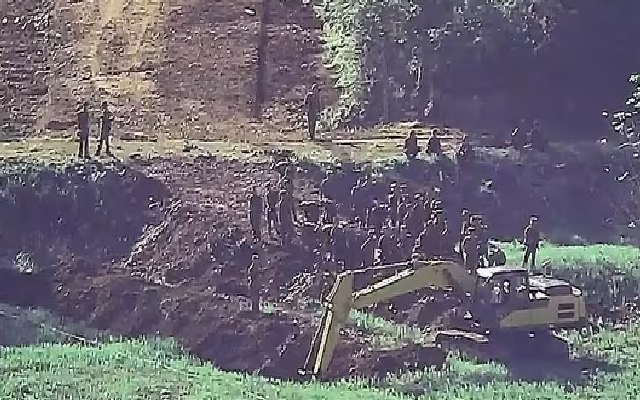


South Korean soldiers fired warning shots to deter North Korean soldiers who crossed the border on Tuesday, marking the second such incident this month, according to South Korea’s military.
South Korean officials reported increased construction activities by North Korea along the heavily fortified border, including suspected installation of anti-tank barriers, road reinforcements, and land mine planting. Despite mine explosions that caused casualties among North Korean soldiers, the construction continued unabated, as confirmed by South Korea’s Joint Chiefs of Staff.
The incident on Tuesday involved approximately 20 to 30 North Korean soldiers crossing the military demarcation line while conducting unspecified construction on the northern side of the border at 8:30 a.m. Upon receiving warnings and warning shots from South Korea, the North Korean soldiers withdrew without engaging in further suspicious activities, according to the Joint Chiefs of Staff.
A similar incident occurred on June 11 in a different area along the central frontline region, where South Korea also fired warning shots. The South Korean military clarified that it does not believe these border crossings were intentional acts of provocation, and confirmed that North Korea did not return fire.
South Korean authorities attributed the border crossings partly to dense vegetation that may obscure visibility for North Korean soldiers. They expressed concerns that North Korea’s ongoing border construction, initiated around April, aims to tighten control over its people, potentially hindering defections to South Korea.
These developments unfold amid escalating tensions between the two Koreas, characterized by recent psychological warfare reminiscent of the Cold War era and mutual disregard for their 2018 military agreement aimed at easing tensions.
The Demilitarized Zone (DMZ), a 248-kilometer-long and 4-kilometer-wide heavily fortified border, remains a site of occasional confrontations between the rival nations. It is laden with an estimated 2 million mines, barbed wire fences, tank traps, and stationed combat troops—a legacy of the Korean War’s unresolved armistice.