







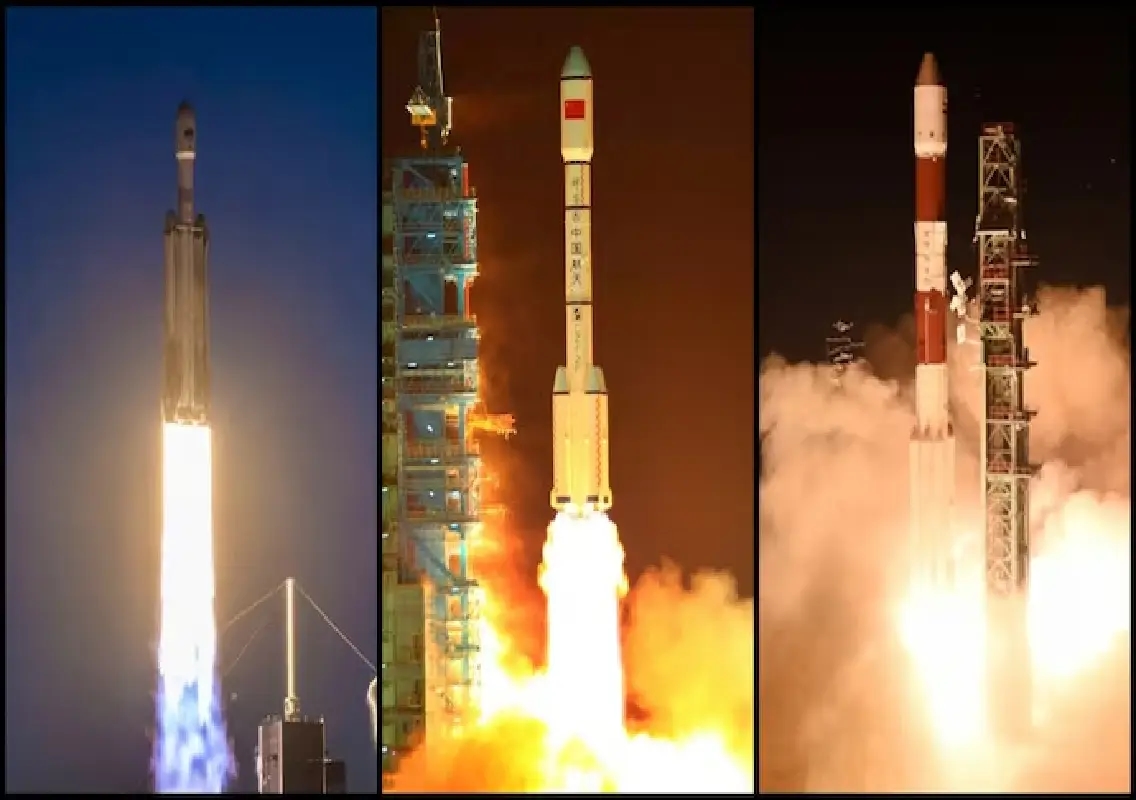


New Delhi: SpaceX has rewritten global spaceflight records in 2025 by carrying out an unprecedented 165 orbital launches so far this year, with two more Falcon 9 missions scheduled before December ends. The achievement underlines the Elon Musk-led company’s unmatched launch cadence and growing dominance in the global space sector, even as India’s Indian Space Research Organisation (Isro) pursues a measured but ambitious plan to scale up its own launch capacity over the coming years.
According to industry data, SpaceX’s launch count could rise to 167 by December 31 if both planned missions — a Starlink satellite batch on December 27 and a national security payload on December 31 — are successfully completed. This would surpass its own 2024 record of 134 orbital launches and further widen the gap with global competitors.
SpaceX’s rapid reusability drives dominance
SpaceX’s record-breaking year has been powered largely by the rapid reusability of its Falcon 9 boosters. The company has routinely reflown boosters within 10 to 20 days of recovery, enabling near-weekly launches from its pads in Florida and California.
In 2025 alone, SpaceX has deployed hundreds of Starlink satellites to expand its global broadband network, conducted Nasa crew rotation missions to the International Space Station, and launched a wide range of commercial and government payloads. By mid-December, SpaceX accounted for over 90 per cent of all US orbital launches and nearly two-thirds of launches worldwide.
In addition to Falcon 9 operations, suborbital test flights of the fully reusable Starship system have added to the company’s momentum, reinforcing its long-term ambition of deep-space missions, including Mars exploration.
Reacting to the milestone, Elon Musk said, “Great work by the SpaceX team,” crediting the achievement to engineering efficiency and relentless execution.
Global impact of SpaceX’s scale
SpaceX’s dominance has significantly reshaped global access to space. With launch costs reportedly reduced to around $2,700 per kilogram, the company has put pressure on other spacefaring nations and commercial providers, including China, which conducted over 60 launches in 2025, and Russia, whose launch numbers continue to decline.
Lower launch costs have enabled smaller nations, startups and research institutions to access orbit more easily, accelerating satellite deployment, Earth observation projects and communications infrastructure worldwide.
Isro’s 2025 launch profile
India’s Isro, while operating on a vastly different scale, has continued to make steady progress in 2025. As of December 19, the country has carried out four major orbital launch missions this year, according to official records.
These include the GSLV-F15/NVS-02 mission on January 29, which successfully placed a navigation satellite into orbit; the PSLV-C61/EOS-09 mission on May 18, which ended in a mission failure; the GSLV-F16/NISAR mission on July 30, a joint Nasa-Isro Earth observation satellite; and the LVM3-M5/CMS-03 mission on November 2, which deployed India’s heaviest communication satellite to date.
India is also set to launch an LVM-3 mission carrying a commercial satellite before the end of 2025, adding another milestone to the year’s achievements.
Long-term vision: 50 launches a year
Science and Technology Minister Dr. Jitendra Singh has reiterated Isro’s long-term vision of reaching around 50 launches annually by 2029–30. This expansion is aimed at supporting flagship programmes such as Gaganyaan (human spaceflight), Chandrayaan lunar missions, future planetary exploration, and the growth of India’s private space sector.
At present, Isro’s launch infrastructure at Sriharikota supports around 15 to 20 launches per year. Scaling beyond this will depend on the development of new solid-fuel launch vehicles, advances in reusable launch technology, and the growing participation of private players such as Skyroot Aerospace and Agnikul Cosmos.
Dr. Singh has noted that Gaganyaan is nearing the integration phase, though he acknowledged that India’s turnaround time between launches remains significantly longer than SpaceX’s.
Technology gap and differing philosophies
A key difference between SpaceX and Isro lies in their operational philosophy. SpaceX prioritises high-frequency launches enabled by automation, vertical integration and aggressive reuse of hardware. Its boosters routinely fly multiple times a year with minimal refurbishment.
Isro, by contrast, focuses on reliability, cost-effectiveness and scientific outcomes. Its human-rated GSLV Mk-III (LVM-3) requires extensive post-flight checks, particularly due to its cryogenic stages, which limit immediate reuse. While Isro has reduced PSLV preparation time to about 20 days in recent years, it still trails SpaceX’s days-long turnaround.
Experts point out that India’s conservative approach has delivered consistently high mission success rates at relatively low cost, but scaling up will require increased private investment, stronger supply chains and regulatory support.
Conclusion
SpaceX’s record-setting year underscores a new era of high-cadence, low-cost space access that is reshaping the global space economy. For India, the challenge is not merely to match launch numbers, but to expand capacity while maintaining reliability and supporting long-term national goals such as the Bharatiya Antariksh Station and human spaceflight.
While SpaceX looks outward towards Mars, Isro’s steady climb reflects a multipolar future in space exploration — one where different models coexist. The coming decade will determine whether India can bridge the cadence gap while preserving its reputation for dependable and affordable space missions.