







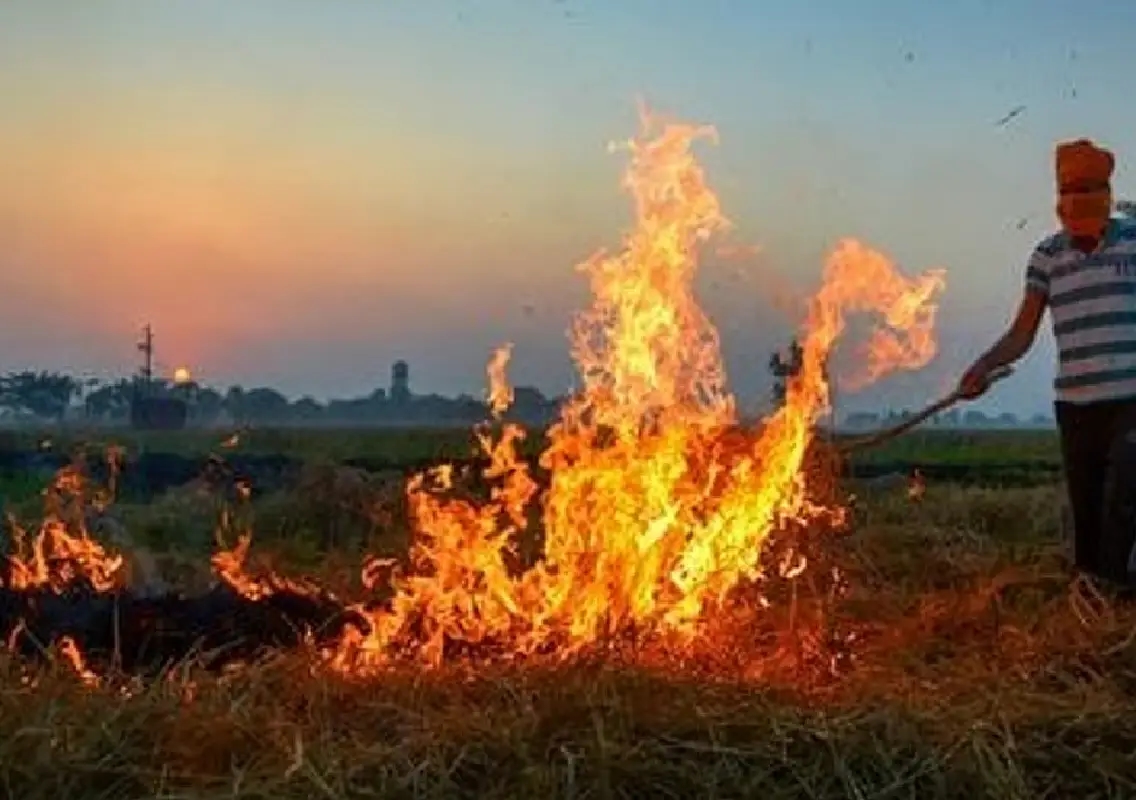


The stubble burning season has officially begun, with 64 farm fire incidents recorded in neighbouring states of Delhi between September 15 and 21, 2025, according to satellite data compiled by the Indian Agricultural Research Institute (IARI). While experts say the current numbers are too low to impact Delhi’s air quality, trends indicate a sharp spike in farm fires from October onwards, coinciding with the withdrawal of the monsoon from northwest India.
Punjab leads in early farm fire cases
Of the total 64 reported cases, Punjab alone accounted for 56, while Haryana recorded three, Uttar Pradesh four, and Rajasthan one. Within Punjab, Amritsar topped the list with 35 cases, followed by Patiala with seven and Tarn Taran with five. Interestingly, despite flood-related challenges this year, Punjab has already reported slightly more cases than the same period last year (56 in 2025 compared to 52 in 2024).
Negligible impact on Delhi air quality for now
Experts note that the early numbers are not significant enough to affect Delhi’s air quality. “Since the fire counts are currently low, the impact on Delhi’s air is negligible. But preparations must be in place, as October usually marks the peak of the burning season,” said Anumita Roychowdhury, Executive Director, Centre for Science and Environment.
She also stressed the importance of providing farmers timely access to crop residue management machines and ensuring proper collection of waste stubble, especially in flood-affected areas where logistics pose additional challenges.
Seasonal trends and future concerns
The peak stubble burning period is typically from late October to mid-November, coinciding with the onset of winter. During this time, pollutants from farm fires combine with unfavourable meteorological conditions, such as calm winds and low temperatures, leading to severe deterioration in Delhi’s air quality.
According to Gufran Beig, founder of the System of Air Quality and Weather Forecasting and Research (SAFAR), Delhi might see a relatively better scenario this year. “Unlike previous years, the monsoon is withdrawing on time and festivals are being celebrated earlier in October, before severe winter conditions set in. This will likely reduce the overlapping impact of stubble burning and festive pollution,” he said.
Farm fire data from past years
Data highlights the fluctuating trend in stubble burning cases:
- Punjab: 10,909 cases (2024), 36,663 (2023), 49,922 (2022)
- Haryana: 1,406 cases (2024), 2,303 (2023), 3,661 (2022)
- Uttar Pradesh: 6,142 cases (2024), 3,996 (2023), 3,017 (2022)
- Rajasthan: 2,772 cases (2024), 1,775 (2023), 1,268 (2022)
- Delhi: 13 cases (2024), 5 (2023), 10 (2022)
These figures show that while efforts to curb crop residue burning have had mixed results, Punjab continues to remain the largest contributor to farm fires.
The road ahead
As the monsoon withdraws and harvesting accelerates, farm fire incidents are expected to rise sharply in October and November. Experts underline that unless large-scale interventions in crop residue management are implemented, Delhi and surrounding states may again face severe smog episodes later this year.