







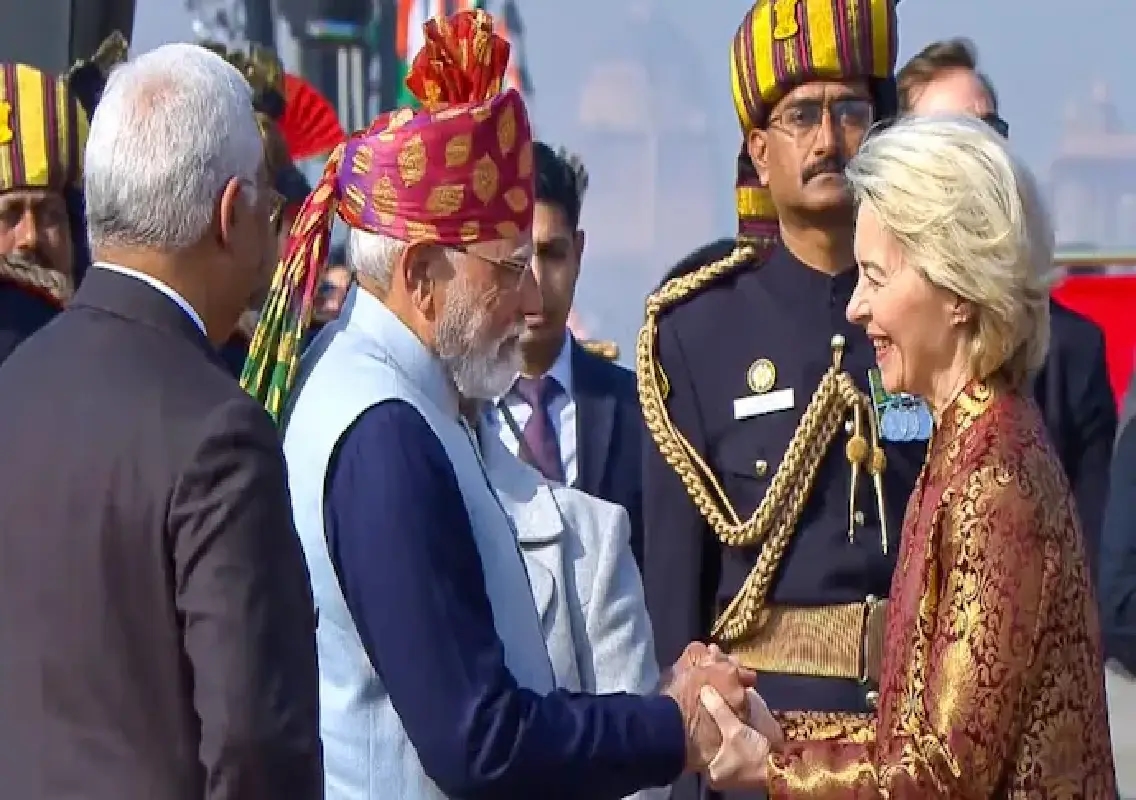


New Delhi: European Commission President Ursula von der Leyen on Monday said that a “successful India makes the world more stable, prosperous and secure” as she attended India’s 77th Republic Day celebrations, underscoring the growing strategic and economic partnership between India and the European Union amid momentum on a landmark free trade agreement.
Ursula von der Leyen, along with European Council President António Costa, attended the Republic Day parade as chief guests. President Droupadi Murmu took the salute after arriving in a traditional buggy accompanied by the two European leaders, marking a significant moment in India–EU diplomatic engagement.
Message of partnership and stability
Sharing her thoughts after the event, von der Leyen said it was “the honour of a lifetime” to be the chief guest at the Republic Day celebrations. She emphasised that India’s progress and success have global implications, benefiting not only its own citizens but also contributing to international stability, prosperity and security.
Her remarks reflected the European Union’s view of India as a key strategic partner in an increasingly complex global environment marked by economic uncertainty and geopolitical tensions.
India–EU summit and trade talks
The European Commission President’s visit comes ahead of high-level summit talks with Prime Minister Narendra Modi, during which both sides are expected to announce the conclusion of negotiations on the long-awaited India–EU free trade agreement. Officials from both sides have indicated that the agreement could be unveiled at the summit scheduled for January 27.
The proposed free trade agreement is expected to significantly enhance economic engagement between India and the 27-nation European bloc. Beyond increasing trade volumes, it is also seen as a step towards deeper cooperation across technology, sustainability, digital trade and supply chains.
Strong momentum for cooperation
European Union Vice-President Kaja Kallas, who also attended the Republic Day celebrations, highlighted the strong momentum in India–EU relations. She said the EU was actively seizing opportunities for closer cooperation with India across strategic sectors.
Kallas noted that personnel from EU naval operations Atalanta and Aspides participated in the Republic Day parade for the first time, describing it as a symbol of the deepening bond between India and Europe. She added that the upcoming summit would take the relationship forward through the signing of the EU–India Security and Defence Partnership, which aims to deliver tangible outcomes in areas such as maritime security, cybersecurity and counterterrorism.
Prime Minister’s response
Responding to the presence of the European leaders, Prime Minister Narendra Modi expressed appreciation for their participation in the Republic Day celebrations. He said their visit underscored the growing strength of the India–European Union partnership and reaffirmed a shared commitment to democratic values.
The Prime Minister added that the visit would add momentum to deepening engagement and cooperation between India and Europe across diverse sectors, including trade, security, innovation and people-to-people ties.
Trade ties and economic significance
The European Union is currently India’s largest trading partner. Bilateral trade in goods touched USD 135 billion in the financial year 2023–24, reflecting steady growth despite global economic challenges. Officials believe that the proposed free trade agreement could substantially boost this figure in the coming years.
The agreement is expected to bring not only quantitative growth in trade but also a qualitative shift in India–EU relations, particularly at a time when global commerce is being disrupted by protectionist policies and tariff-driven trade disputes in other parts of the world.
Long road to the FTA
India and the European Union first launched negotiations for a free trade agreement in 2007. However, talks were suspended in 2013 due to differences over market access, tariffs and regulatory standards. After nearly a decade-long pause, negotiations were revived in June 2022, reflecting renewed political will on both sides.
Recent reports suggest that as part of the proposed agreement, India may significantly reduce import tariffs on cars from the European Union. Sources familiar with the negotiations indicated that duties could be cut to 40 per cent from the current peak of 110 per cent on a limited number of high-value imported cars, with tariffs potentially falling to 10 per cent over time.
Conclusion
The presence of top European leaders at India’s Republic Day celebrations and the strong statements in support of India’s global role signal a new phase in India–EU relations. With a major trade deal and enhanced security cooperation on the horizon, both sides appear poised to elevate their partnership to a more strategic and comprehensive level in the years ahead.