







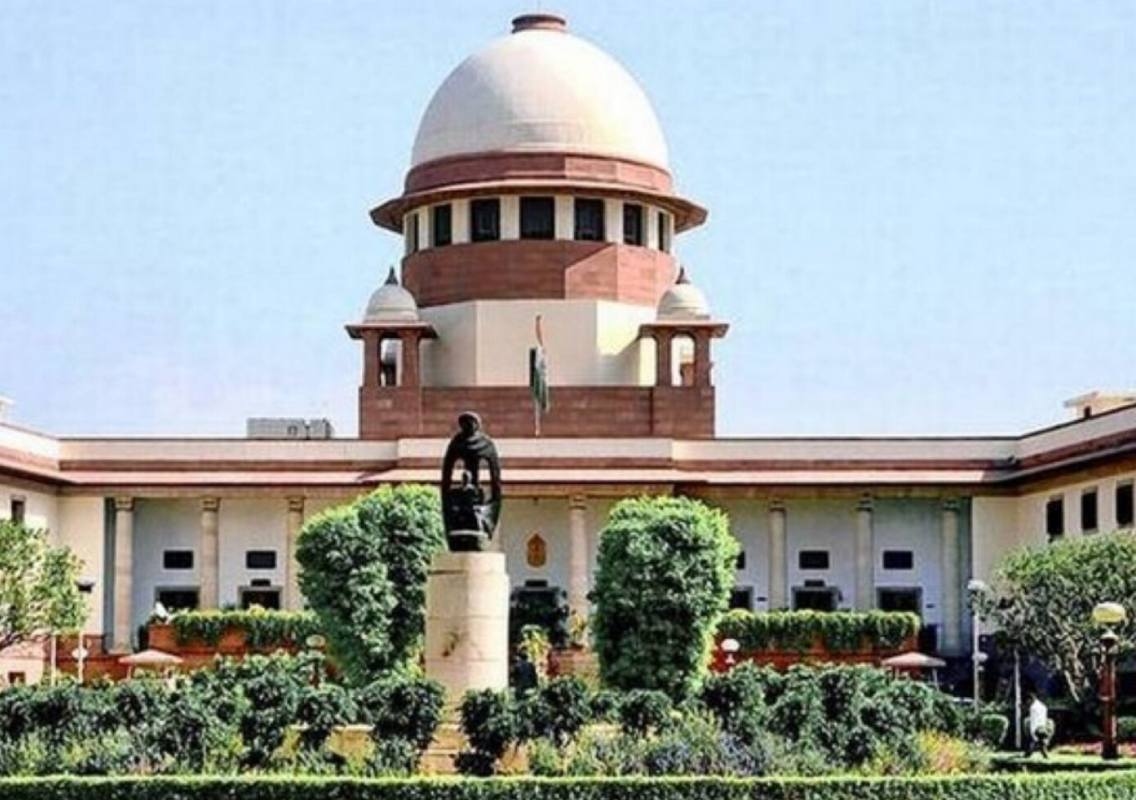


New Delhi: The Supreme Court on Wednesday delivered a split verdict on whether petitions challenging the constitutional validity of the 2023 law governing the appointment of the Chief Election Commissioner (CEC) and Election Commissioners (ECs) should be referred to a larger Constitution Bench.
A two-judge bench comprising Justices Dipankar Datta and Satish Chandra Sharma differed on the question of such a reference. Justice Datta held that the matter did not require a reference to a larger bench, while Justice Sharma was of the view that the constitutional questions raised by the petitions warranted consideration by a five-judge Constitution Bench.
The judges, however, agreed that the matter should be placed before the Chief Justice of India for administrative directions on constituting a bench of appropriate strength. The court indicated that sending the issue first to a three-judge bench could result in further delay.
What the petitions challenge
The petitions challenge the Chief Election Commissioner and Other Election Commissioners (Appointment, Conditions of Service and Term of Office) Act, 2023.
The law changed the selection mechanism for the CEC and ECs by replacing the Chief Justice of India on the selection panel with a Union Cabinet Minister nominated by the Prime Minister.
Under the current law, the selection committee comprises the Prime Minister, the Leader of the Opposition in the Lok Sabha and a Union Cabinet Minister nominated by the Prime Minister.
The petitions contend that removing the CJI from the panel affects the independence of the Election Commission and is inconsistent with the Supreme Court’s March 2023 judgment in the Anoop Baranwal case.
In that judgment, a five-judge Constitution Bench had directed that appointments to the Election Commission would be made on the recommendation of a committee comprising the Prime Minister, the CJI and the Leader of the Opposition until Parliament enacted a law governing the appointment process. Parliament subsequently enacted the 2023 legislation.
Justice Datta and Justice Sharma differ
Justice Datta declined to accept the request for a larger-bench reference, holding that a two-judge bench could examine the constitutional validity of the legislation.
His observations included concerns about the institutional independence of the Election Commission and the importance of public confidence in its impartiality. He said free and fair elections require an Election Commission that is not only independent but also seen to be independent.
Justice Sharma took a different view, holding that the constitutional questions arising from the challenge warranted authoritative consideration by a Constitution Bench under Article 145(3) of the Constitution.
The disagreement resulted in the split verdict on the reference question. It does not, by itself, amount to a final ruling on the constitutional validity of the 2023 Act.
Court raises concern over delays
During the proceedings, the bench also acknowledged concerns about the time taken by larger benches to decide constitutional references.
The court observed that petitioners had a point in arguing that references to larger benches can remain pending for years and described the issue as an area of concern.
The judges also requested the CJI to consider the possibility of establishing a permanent five-judge bench for deciding constitutional matters. The proposal is aimed at addressing delays in the adjudication of cases involving significant constitutional questions.
The bench had reserved its order on the reference issue on July 30. The matter will now proceed through the administrative process before the CJI for appropriate directions.
Petitioners’ arguments
The challenges were filed by the Association for Democratic Reforms (ADR), Jaya Thakur, Sanjay Narayanrao Meshram, Dharmendra Singh Kushwaha and advocate Gopal Singh.
The petitioners have argued that the appointment mechanism under the 2023 Act does not provide an adequately independent process for selecting members of the Election Commission.
They have specifically challenged Sections 7 and 8 of the Act, which deal with the appointment process, and have sought the inclusion of the CJI in the selection committee.
Their contention is that the Prime Minister and the Cabinet Minister nominated by the Prime Minister could exercise decisive influence over the appointments, potentially affecting perceptions of the Election Commission’s independence.
These are arguments advanced by the petitioners and remain subject to judicial determination.
No stay on appointments in 2024
The challenge to the 2023 law had earlier come before the Supreme Court in 2024, when the court declined to stay appointments made under the legislation.
The latest proceedings concern whether the constitutional challenge should be considered by a larger Constitution Bench. The split between Justices Datta and Sharma means that the next step will be determined administratively by the Chief Justice of India.
The Supreme Court’s eventual consideration of the petitions will determine whether the provisions changing the appointment mechanism are constitutionally valid.