







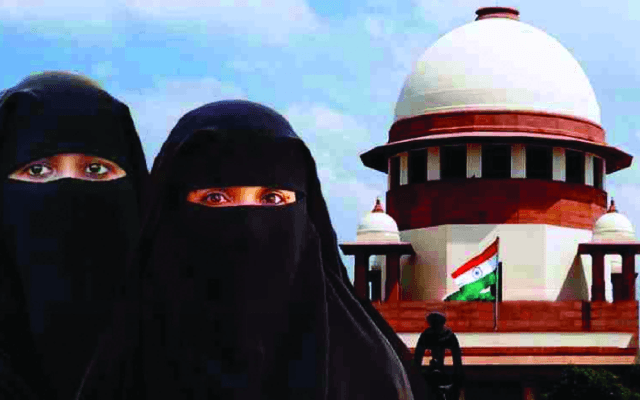


The Supreme Court of India has consistently demonstrated its commitment to safeguarding the rights of vulnerable groups, particularly Muslim women. In a recent landmark judgment in Mohd Abdul Samad v. State of Telangana, the apex court reaffirmed that Muslim women have the right to seek maintenance under Section 125 of the Criminal Procedure Code (CrPC), notwithstanding any other specific laws governing them, such as the Muslim Women (Protection of Rights on Divorce) Act, 1986.
Section 125 of the CrPC mandates that individuals with sufficient means must provide support to their wives, legitimate or illegitimate minor children, who are unable to sustain themselves financially. This support typically entails monthly financial assistance, and the section explicitly includes divorced women who have not remarried in its definition of “wife.”
The issue gained prominence with the landmark case of Shah Bano Begum in 1980, where the Supreme Court upheld her right to maintenance beyond the iddat period under Section 125, rejecting arguments that personal laws should exclusively apply. This decision underscored the secular nature of Section 125, which applies uniformly across religions, ensuring gender equality in matters of maintenance.
In response to challenges, such as those in the Danial Latifi case in 2001, the Supreme Court upheld the constitutional validity of the Muslim Women (Protection of Rights on Divorce) Act, 1986, while also affirming that Section 125 of the CrPC provides an additional recourse for maintenance, extending support to women until they remarry.
The recent case of Mohd Abdul Samad further solidifies these principles, with the Supreme Court emphasizing that Section 125 of the CrPC is rooted in constitutional values of social justice and gender equality. It reiterated that this provision serves as a crucial safeguard against destitution for women, including those divorced under personal laws, and does not bar them from seeking maintenance under its provisions.
Thus, the Supreme Court of India continues to uphold its role in ensuring comprehensive justice for women of all religions, particularly Muslim women, shielding them from the specter of destitution and affirming their rights to financial support under secular laws.