


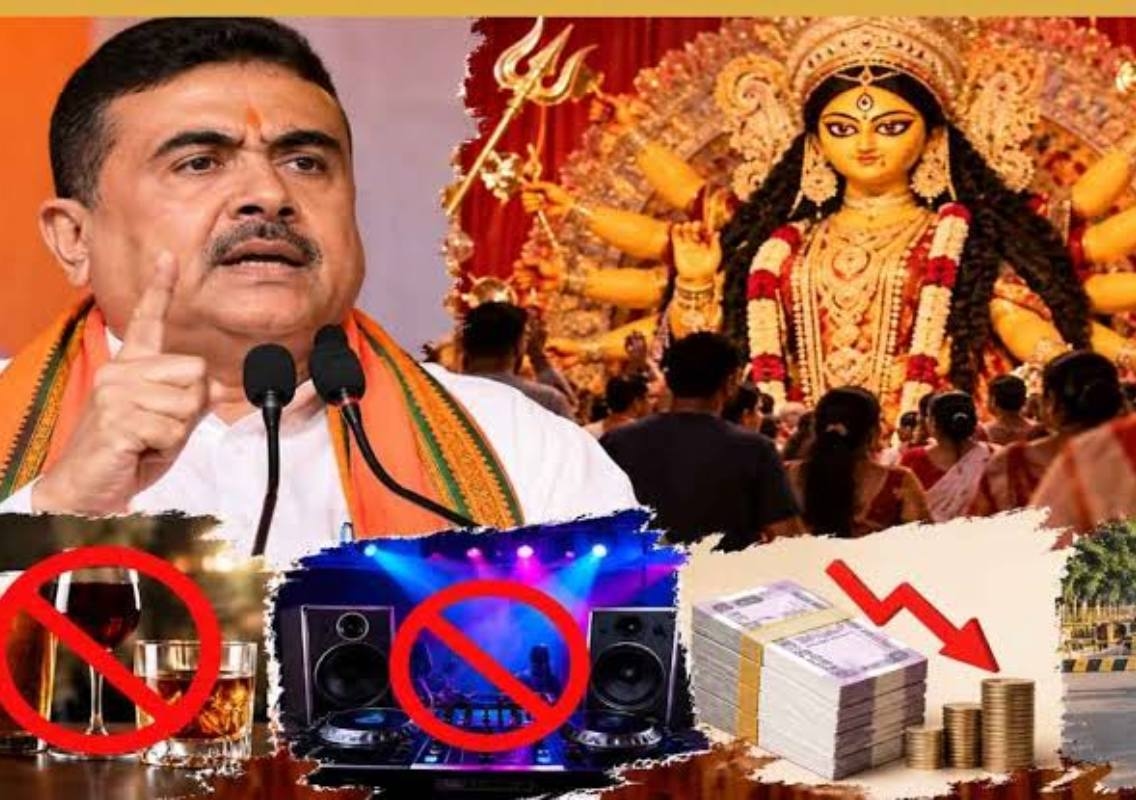


Kolkata: West Bengal Chief Minister Suvendu Adhikari has said that only people who believe in Sanatan Dharma will be allowed to touch Durga idols during immersion, triggering criticism from opposition leaders who questioned the religious restriction and its compatibility with constitutional principles.
Adhikari made the remarks on Wednesday while inspecting security arrangements at Baje Kadamtala Ghat in Kolkata, where arrangements were being made for Durga idol immersions. He rejected suggestions that the directive had a communal motive, saying it was intended to preserve the sanctity of traditional immersion rituals.
The chief minister said Kolkata Police Commissioner Ajay Nand had been instructed to maintain a record of people involved in the immersion process and ensure their identities were established.
“Only those who believe in Sanatan Dharma should touch the idols. I have told the CP to record the names of those who come here. They must also be identified,” Adhikari said.
He added that traditions, scriptures and practices followed over thousands of years should be respected to preserve the sanctity of the rituals.
The announcement has sparked a political debate in West Bengal, with opposition representatives challenging the criteria for identifying people who qualify as followers of Sanatan Dharma. The controversy comes alongside changes to immersion arrangements, including restrictions on DJ music and the introduction of mechanical systems at major ghats.
Opposition questions religious restrictions
The chief minister’s remarks drew criticism from opposition leaders, who accused him of promoting religious exclusion and questioned how the proposed identification process would work.
Former Communist Party of India (Marxist) MP Bikash Ranjan Bhattacharya challenged Adhikari to explain how authorities would distinguish between those who identify as Sanatanis and those who do not.
“Does he have a list of who is a ‘sanatani’ and who is not? Can he explain how someone becomes a ‘sanatani’? He has no answers,” Bhattacharya said.
He also alleged that the chief minister was acting in accordance with the agenda of the Rashtriya Swayamsevak Sangh (RSS).
West Bengal Congress leader Suman Roy Chaudhuri condemned the remarks, arguing that the directive conflicted with India’s constitutional commitment to pluralism and the coexistence of different religious beliefs.
The Trinamool Congress also criticised the chief minister’s position. Party leader Baiswanor Chatterjee said, “One cannot understand Hinduism with such a narrow mindset.”
The responses reflect a wider disagreement over whether participation in religious ceremonies should be governed by a formal identification process based on religious belief. While Adhikari has defended the proposal as a measure to uphold tradition, opposition leaders have questioned both its rationale and its practical implementation.
The available statements do not specify the criteria authorities would use to determine whether a person qualifies as a follower of Sanatan Dharma or how any disputes over identification would be resolved.
Adhikari defends traditional immersion practices
The proposed restriction on who may touch Durga idols forms part of a broader set of instructions issued by Adhikari concerning immersion arrangements.
Earlier, the chief minister had said that trolleys, rather than cranes, would be used to transport idols during immersion. He had also announced a ban on DJ music, citing the need to follow traditional practices.
The instructions were reflected in changes to arrangements at several immersion locations. In Hooghly, cranes were replaced by rail-mounted trolleys, while major ghats in Kolkata introduced mechanical equipment to facilitate the movement of idols.
The administration’s stated emphasis on traditional practices has therefore extended beyond religious participation to the equipment and sound systems used during immersion.
However, the restriction on who may touch the idols has become the most politically contentious element of the instructions because it involves identifying participants according to their religious beliefs.
Adhikari has maintained that the measures are intended to preserve the sanctity of the rituals. Opposition leaders, meanwhile, have argued that religious traditions should not be used to justify exclusion.
Mechanical systems replace cranes at major ghats
Immersion arrangements underwent visible changes at major locations, including Baje Kadamtala Ghat, Nimtala Ghat and Gwalior Ghat.
Special mechanical ramps, trolleys and conveyor systems were installed to help move idols towards the immersion points. Rail-mounted trolleys were also used in place of cranes at immersion sites in Hooghly.
The changes marked a shift in how idols were handled during the process. The equipment was intended to support the movement of structures towards the water, although the available information does not provide a detailed assessment of the systems’ operational performance.
The use of trolleys and mechanical ramps also brought the chief minister’s instructions on immersion methods into focus, as organisers and authorities adjusted arrangements at major locations.
In addition to changes in equipment, the absence of blaring loudspeakers was noticeable at several locations compared with previous years. Fireworks were still heard in some pockets, interrupting the relative quiet.
Environmental activist welcomes DJ music restrictions
The restrictions on DJ music received a positive response from at least one environmental campaigner.
Naba Dutta of Sabuj Mancha, an environmental organisation, said campaigners had repeatedly opposed the use of DJ music during immersion events.
“We have been protesting the use of DJ music, but for the first time, our wishes have been fulfilled,” Dutta said.
The comment highlighted the environmental concerns that have accompanied discussions around large public celebrations and immersion events. Restrictions on loud music have been welcomed by campaigners who have sought changes to sound levels during such occasions.
The implementation of the restrictions appeared to reduce the presence of loudspeakers at the sites observed on Wednesday. However, fireworks continued in some areas, suggesting that the sound environment was not entirely quiet.
The extent to which the restrictions will be enforced consistently across all immersion locations was not detailed in the information available.
Around 2,800 idols immersed on Wednesday
Sources at the Kolkata Municipal Corporation (KMC) confirmed that approximately 2,800 idols were immersed on Wednesday.
Doighat recorded around 700 immersions, while Baje Kadamtala Ghat accounted for approximately 560. Nimtala and Judges Ghat also witnessed an increase in immersion activity.
Despite the activity at several locations, a majority of puja organisers reportedly stayed away from immersions on Wednesday. The reasons for their absence were not specified in the available information.
The figures provide an indication of the scale of the immersion operations and the pressure on infrastructure at major ghats. The use of mechanical ramps and trolleys was part of the arrangements introduced to manage the movement of idols at these locations.
The large number of structures being brought to the ghats also created a challenge in clearing the immersion areas.
Low tide blamed for accumulation at Baje Kadamtala
On Thursday afternoon, a Times of India team observed heaps of idol structures at Baje Kadamtala Ghat.
A Kolkata Municipal Corporation official attributed the accumulation to low tide, saying authorities were waiting for high tide to clear the structures.
The situation highlighted the practical difficulties involved in coordinating large-scale immersions with changing water conditions. Even with mechanical equipment and designated immersion systems, the removal of accumulated structures can depend on the prevailing tide.
The official’s explanation suggested that the authorities expected the situation to improve when the tide changed. The available information did not specify how long the accumulated structures would take to clear or whether additional measures would be required.
Religious tradition and public policy remain under debate
Adhikari’s directive has placed religious participation at the centre of a wider political debate in West Bengal. The chief minister has defended the measures as efforts to preserve traditional practices, while opposition leaders have questioned the proposed identification of people permitted to touch Durga idols.
At the same time, changes to immersion arrangements have included the use of mechanical systems, restrictions on DJ music and efforts to manage large numbers of idols at major ghats.
The controversy over the religious restriction remains unresolved, particularly regarding how authorities would identify eligible participants and apply the directive. The competing responses underline the tension between the government’s stated emphasis on ritual traditions and opposition concerns about religious inclusion and constitutional pluralism.