







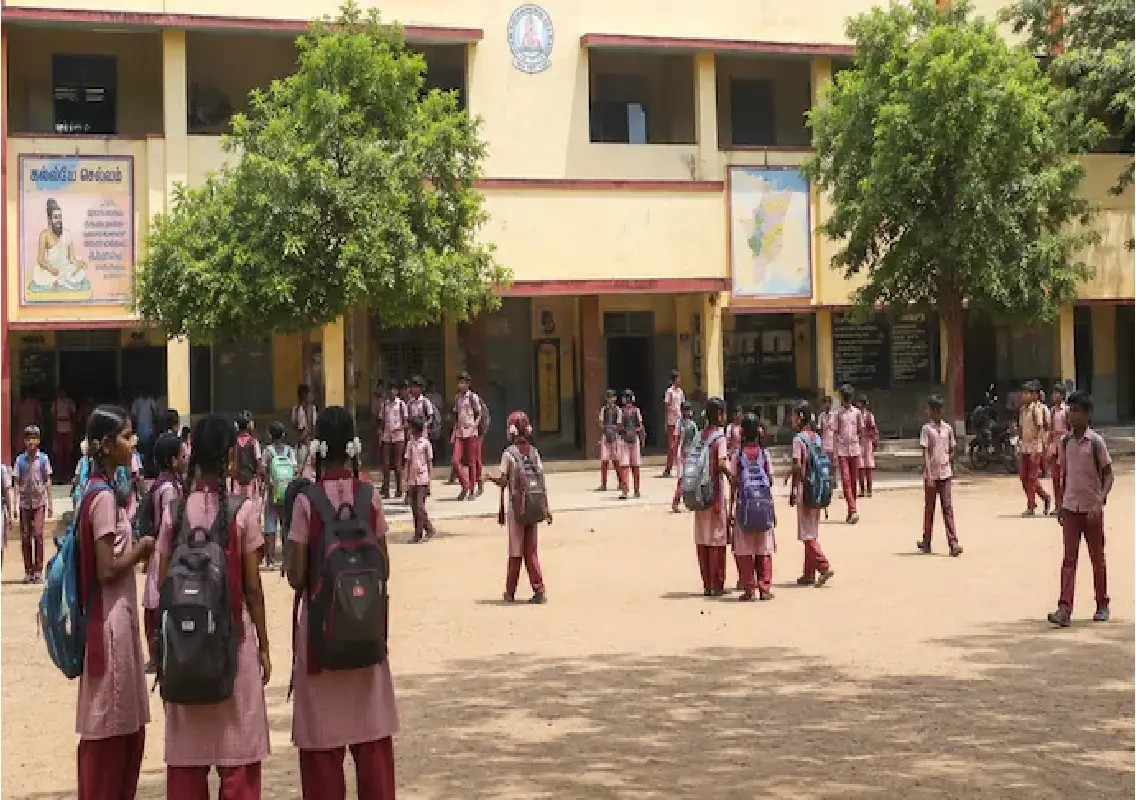


Chennai: The Tamil Nadu government has issued a circular prohibiting political party workers and private individuals from entering government school classrooms, reiterating that educational institutions are meant solely for learning and should remain free from political activities.
The directive, issued by the School Education Department under the leadership of School Education Minister Raj Mohan, states that only elected representatives attending official government programmes will be permitted to enter government schools and classrooms.
The move aims to preserve the neutrality of educational institutions and ensure that school campuses remain focused on academic activities.
Classrooms must remain free from political influence
The circular makes it clear that classrooms should not be used for activities intended to glorify political leaders or private individuals.
It emphasises that schools are spaces dedicated to education and not platforms for political messaging or personality promotion.
According to the government, educational institutions should provide an environment where students can learn without political influence or distractions.
Ban on birthday celebrations of political leaders
As part of the new directive, the government has prohibited the celebration of birthdays of political leaders within classrooms and school premises.
Officials said the decision is intended to maintain the educational character of schools and prevent political activities from becoming part of campus life.
The circular further states that programmes conducted in government schools must adhere to the principles of neutrality and educational relevance.
The School Education Department has also indicated that a detailed set of guidelines governing events and programmes in government schools will be issued shortly.
Entry permitted only for official government programmes
The circular specifies that elected representatives may enter schools only when attending official government functions.
Political party cadres, supporters and private individuals are not permitted to use school premises or classrooms for activities unrelated to education or officially sanctioned government programmes.
The government said the measure is designed to ensure that educational institutions remain impartial public spaces dedicated to students’ welfare.
Tamil Nadu highlights school education performance
The circular comes as the Tamil Nadu government highlighted the state’s performance in school education based on the latest data from the Unified District Information System for Education (UDISE).
According to the School Education Department, Tamil Nadu continues to perform above the national average across several key educational indicators, including enrolment, retention, teacher availability and educational infrastructure.
Strong enrolment and teacher availability
The department said Tamil Nadu accounts for nearly five per cent of India’s school-going children despite having only 3.9 per cent of the country’s schools.
The state currently has:
- 57,566 schools
- 1.24 crore students
- 5.69 lakh teachers
Tamil Nadu’s overall Pupil-Teacher Ratio (PTR) stands at 22, compared with the national average of 24.
On average, each school in the state has 215 students and 10 teachers, higher than the national average of 169 students per school.
Higher enrolment and lower dropout rates
According to the UDISE data, Tamil Nadu has recorded Gross Enrolment Ratios (GER) that exceed national averages across all school levels.
The state’s GER stands at:
- 92 per cent at the primary level.
- 95 per cent at the upper primary level.
- 97 per cent at the secondary level.
- 85 per cent at the higher secondary level.
The corresponding national averages are 89 per cent, 90 per cent, 82 per cent and 62 per cent, respectively.
The department also highlighted that Tamil Nadu has achieved zero dropout rates at both the primary and upper primary levels.
At the secondary level, the state’s dropout rate is 6.2 per cent, considerably lower than the national average of 9.5 per cent.
Focus on education
The latest circular reinforces the Tamil Nadu government’s emphasis on maintaining schools as politically neutral spaces dedicated to education.
Officials said the upcoming guidelines will further clarify the procedures for organising programmes and events in government schools, ensuring that all activities remain aligned with educational objectives and the interests of students.