







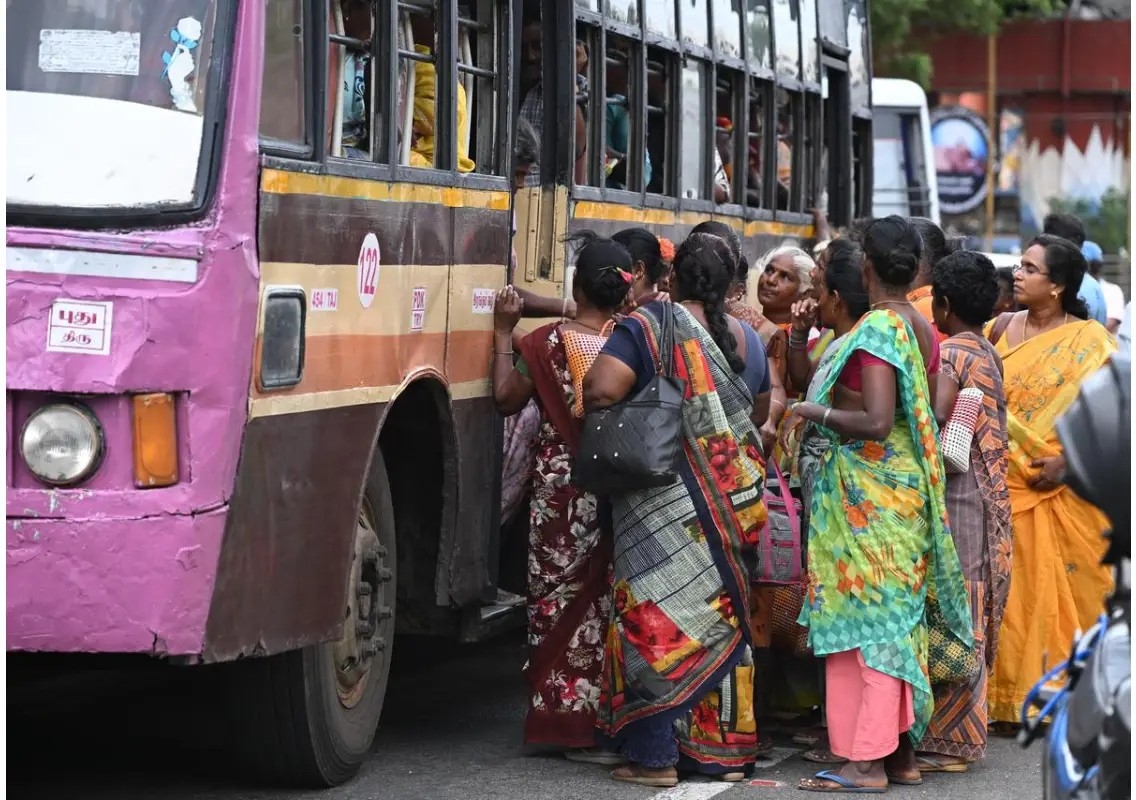


Chennai: Tamil Nadu will expand free bus travel for women and transgender persons to deluxe, express and limited-stop services in Chennai and other cities from October 2, Chief Minister C Joseph Vijay announced on Monday.
The expansion will add 4,641 buses to the Vettri Payanam scheme, earlier known as Vidiyal Payanam, and is expected to benefit another 25 lakh women.
Free travel reaches more services
Around 75 lakh women and transgender persons currently travel free every day on ordinary buses in Tamil Nadu. Officials expect the number to cross one crore after the expansion.
The annual allocation for the scheme is also expected to increase from around Rs. 4,400 crore to Rs. 6,000 crore.
The government has positioned the initiative as a measure to make public transport more affordable and accessible, particularly for women travelling to workplaces, educational institutions and healthcare facilities.
Free travel schemes spread across states
Tamil Nadu is among at least eight states and the national capital with free or festival-based bus travel initiatives for women.
Karnataka’s Shakti scheme provides free travel to women domiciled in the state, while Telangana’s Maha Lakshmi scheme covers women, girls and transgender persons on TSRTC buses.
Kerala’s Priyadarshini scheme allows women and transgender persons to travel free on ordinary KSRTC services. West Bengal also provides free travel to women on state-run buses.
Andhra Pradesh’s Stree Shakti scheme completed a year on August 15, recording around 87 crore free journeys and average daily travel by 24 lakh women.
Delhi provides free bus travel to women through its Pink Saheli smart card system.
Schemes bring benefits and questions
Governments have presented the initiatives as welfare measures that can improve women’s access to employment, education and healthcare. Several schemes have also formed part of election commitments.
However, the growing financial burden has prompted questions about sustainability. Tamil Nadu’s allocation alone is expected to rise to Rs. 6,000 crore, while Andhra Pradesh spent around Rs. 3,095 crore during the first year of its scheme.
Kerala has also faced concerns from private bus operators over revenue losses, while legal challenges have examined aspects including the scheme’s financial and operational impact.
Studies have produced mixed findings, but research cited in the report suggests women in cities with fully free travel were more likely to report being able to travel longer distances than those in cities offering only partial concessions.
As more states adopt such schemes, the debate is increasingly focused not only on making travel free but also on ensuring that the benefits remain financially and operationally sustainable.