







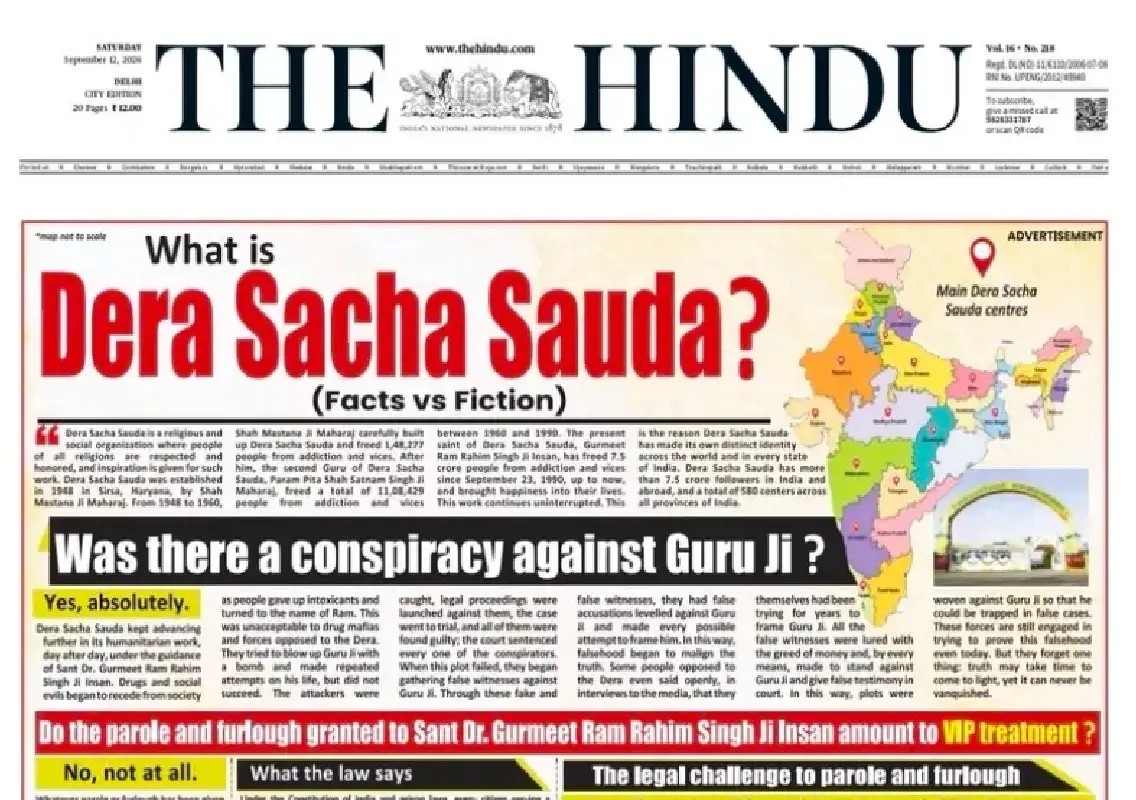


New Delhi: The Hindu has issued an unconditional apology after a controversial full-page advertisement defending Dera Sacha Sauda chief Gurmeet Ram Rahim Singh appeared on the front page of its September 12 editions in Delhi, Mohali and other parts of North India.
The advertisement, titled “What is Dera Sacha Sauda? (Facts vs Fiction)”, triggered widespread outrage because it presented arguments in support of Ram Rahim, who was convicted by a CBI court in 2017 for raping two women disciples and sentenced to 20 years in prison.
The advertisement also appeared in the Delhi edition of Dainik Bhaskar in Hindi.
Advertisement questions rape conviction narrative
The advertisement was presented as a series of rhetorical questions followed by predetermined answers, portraying Ram Rahim as the victim of a conspiracy.
One of the questions asked, “Was there a conspiracy against Guru Ji?” The advertisement answered: “Yes, absolutely.”
It went on to claim that false witnesses had been “lured with the greed of money” to implicate him.
The advertisement also sought to counter criticism over the number of temporary releases granted to the Dera chief.
It asked whether the 16 paroles granted to Ram Rahim amounted to VIP treatment and answered, “No, not at all.”
It further claimed that his parole and furlough had been upheld by the Punjab and Haryana High Court and the Supreme Court.
The contents of the advertisement drew criticism because of its attempt to present a favourable narrative about a person convicted of rape.
Ram Rahim currently out on furlough
Gurmeet Ram Rahim Singh was convicted in 2017 by a CBI court for raping two women disciples and was sentenced to 20 years in prison.
He is currently out of prison on a 21-day furlough.
According to a report published by The Hindu, as of June 28, 2026, Ram Rahim had spent a cumulative 435 days outside prison through paroles and furloughs. This amounted to roughly 13.5% of his sentence.
The issue of his repeated temporary releases has previously attracted public and political scrutiny.
The advertisement, however, described the releases as legally sanctioned and rejected the suggestion that they amounted to preferential treatment.
Newspaper issues unconditional apology
Following the backlash, The Hindu published an unconditional apology for carrying the advertisement.
In its statement, the newspaper described the advertisement as “offensive” and acknowledged that it contained allegations suggesting that there had been a conspiracy against Ram Rahim involving “drug mafias and forces opposed to the Dera”.
“The Hindu deeply regrets the publication in its Delhi, Mohali, and North India editions of an offensive front-page advertisement titled What is Dera Sacha Sauda (Facts vs Fiction),” the newspaper said in its apology.
It also acknowledged that the advertisement made claims concerning the convicted Dera chief and apologised to readers for publishing it.
“The Hindu tenders its unconditional apology to its readers for publishing this deeply offensive advertisement,” the statement added.
Identical advertisement in Dainik Bhaskar
The controversy was not limited to The Hindu. An identical advertisement in Hindi was also carried by the Delhi edition of Dainik Bhaskar.
The advertisements sought to put forward a defence of Ram Rahim and challenge the narrative surrounding his conviction, witnesses and repeated paroles.
The episode has raised questions about the publication of advocacy material in prominent newspaper advertising spaces, particularly when it concerns an individual convicted of a serious sexual offence.
While newspapers routinely publish paid advertisements from individuals, organisations and institutions, the controversy in this case centred on the content and prominent placement of the advertisement and the claims it made about a convicted rapist.
The subsequent apology from The Hindu acknowledged the nature of the material and sought to distance the newspaper from the claims made in the advertisement.