







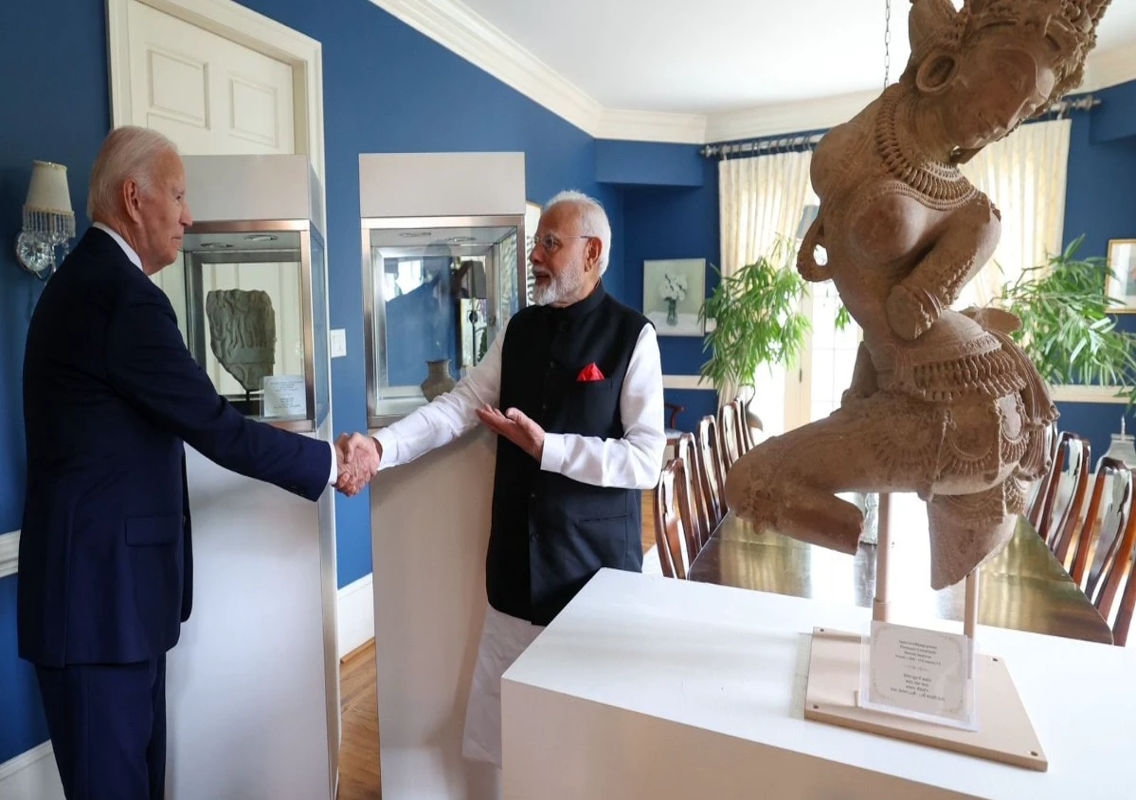


In a landmark meeting, U.S. President Joe Biden and Indian Prime Minister Narendra Modi have reaffirmed their dedication to enhancing the U.S.-India Comprehensive Global and Strategic Partnership. Dubbed the defining partnership of the 21st century, the discussions highlighted an unprecedented level of trust and cooperation, with both leaders focusing on shared values such as democracy, freedom, and the rule of law. The partnership is anchored in mutual respect for human rights and pluralism, establishing itself as a cornerstone for global security, peace, and innovation.
During their talks, President Biden commended Prime Minister Modi’s proactive role in global forums like the G-20 and his engagement with the Global South. Modi’s historic visits to Poland and Ukraine were noted as pivotal moments, reinforcing India’s diplomatic influence and showcasing its commitment to humanitarian efforts and international law. President Biden reiterated U.S. support for India’s permanent membership in a reformed United Nations Security Council, acknowledging India’s critical voice in global governance.
A significant highlight of the meeting was the initiative on Critical and Emerging Technology (iCET), which aims to enhance cooperation in key sectors such as space, semiconductors, and advanced telecommunications. Plans for a new semiconductor fabrication plant were announced, a joint venture involving Bharat Semi, 3rdiTech, and the U.S. Space Force. This collaboration signifies a crucial step towards fostering technological synergy.
The leaders also outlined plans for deeper cooperation in artificial intelligence, biotechnology, and clean energy. Focused on building resilient and secure supply chains, the U.S.-India Global Challenges Institute and an advanced materials research and development forum were inaugurated to drive joint research initiatives. Furthermore, seventeen new awards for binational research in artificial intelligence and quantum technology were unveiled, positioning both nations at the forefront of technological advancements.
In the realm of defense, President Biden celebrated India’s recent procurement of 31 General Atomics MQ-9B remotely piloted aircraft, which significantly bolster India’s intelligence, surveillance, and reconnaissance capabilities. Both leaders highlighted progress under the U.S.-India Defense Industrial Cooperation Roadmap, which includes co-production initiatives for jet engines, munitions, and unmanned surface vehicles.
The third INDUS-X Summit, held in Silicon Valley, marked significant advancements in the India-U.S. Defense Acceleration Ecosystem. New challenges, such as those focusing on undersea communications and space situational awareness, were introduced, further solidifying the defence ties between the two nations.
Cybersecurity collaboration also emerged as a key topic, with both leaders committing to enhance U.S.-India cyber cooperation. A bilateral cyber engagement is scheduled for November 2024, concentrating on threat information sharing and cybersecurity training. In the space sector, they welcomed the upcoming bilateral defense space table-top exercise and collaboration between NASA and ISRO on the International Space Station, set for 2025.
The leaders announced the launch of the U.S.-India Roadmap to Build Safe and Secure Global Clean Energy Supply Chains, aimed at unlocking $1 billion in multilateral financing for renewable energy and energy storage technologies. The U.S. International Development Finance Corporation (DFC) has already initiated loans to Tata Power Solar and First Solar to support India’s renewable energy ambitions through solar manufacturing facilities.
The Strategic Clean Energy Partnership (SCEP) also made headlines, with recent progress emphasised at a meeting in Washington, D.C. Initiatives such as the establishment of a National Center for Hydrogen Safety in India and a partnership between USAID and the International Solar Alliance were also unveiled, reinforcing the joint commitment to clean energy.
In terms of economic collaboration, the Indo-Pacific Economic Framework for Prosperity (IPEF) received praise, particularly following the signing of agreements aimed at bolstering resilience and economic competitiveness among nations representing 40% of global GDP. The first-ever U.S.-India Cancer Dialogue and a $50 million loan from the DFC to Panacea Biotech for vaccine production underscored both nations’ commitment to global health.
Leaders agreed to enhance collaboration in climate-smart agriculture and bilateral trade, focusing on productivity and risk protection.
The launch of the U.S.-India Global Digital Development Partnership aims to deploy responsible digital technologies in Asia and Africa, enhancing connectivity and promoting economic growth. Additionally, joint efforts with Tanzania to improve renewable energy access in the Indo-Pacific region were applauded.
With India holding the G20 presidency, the leaders acknowledged their shared commitment to global priorities, especially at the forthcoming G20 Summit in Rio de Janeiro. Discussions will focus on sustainable development, enhancing multilateral development banks, and improving sovereign debt restructuring processes.
As President Biden and Prime Minister Modi chart a bold agenda for the future, the U.S.-India partnership stands as a beacon of optimism, with both nations dedicated to elevating their collaboration to unprecedented heights in the years ahead.