







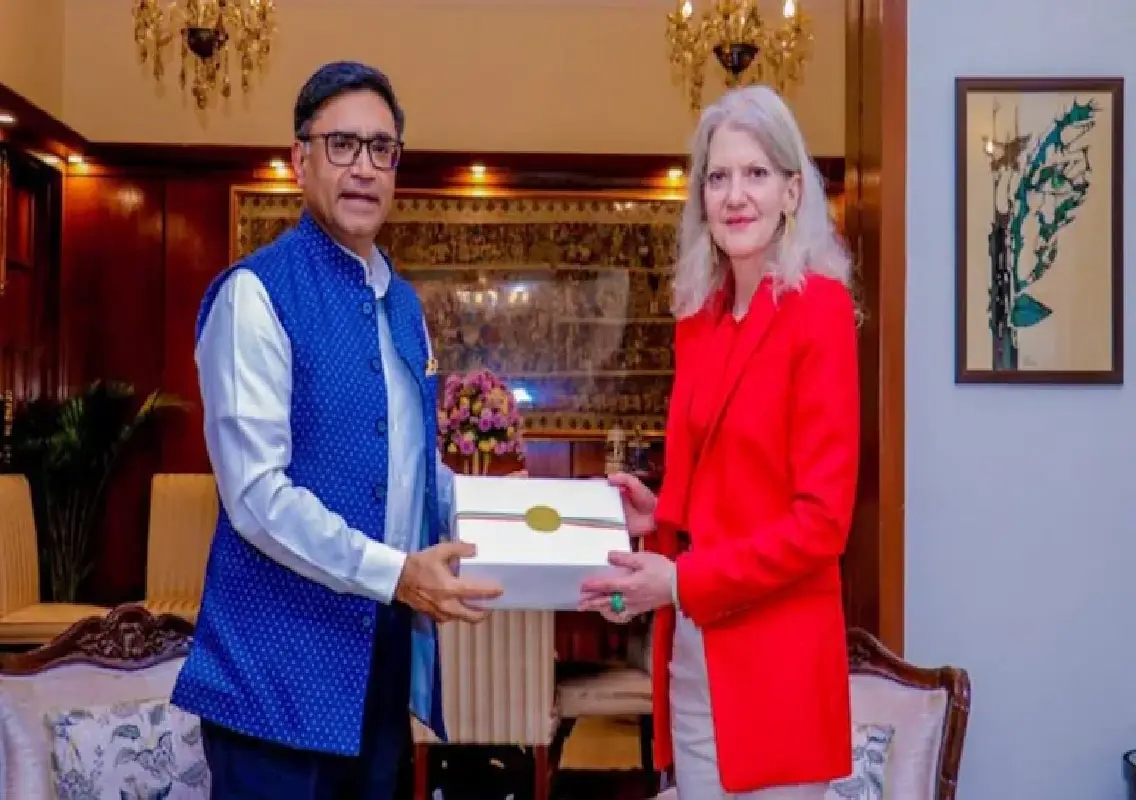


New Delhi: In a bid to arrest the recent downturn in bilateral relations, senior officials from India and the United States held wide-ranging talks in New Delhi on Tuesday, focusing on translating the strategic vision articulated by President Donald Trump and Prime Minister Narendra Modi during their February meeting into actionable outcomes. The discussions were led by US Under Secretary of State for Political Affairs Allison Hooker and Foreign Secretary Vikram Misri under the framework of foreign office consultations. Hooker is on a five-day visit to India aimed at advancing strategic, defence, and economic engagement between the two countries.
Push to stabilise ties after tariff escalation
The talks come at a delicate time, with the India–US relationship experiencing strain following President Trump’s decision in August to double tariffs on Indian goods to 50 per cent and impose an additional 25 per cent duty linked to India’s continued purchase of discounted Russian crude oil. The tariff measures, combined with consistent criticism of New Delhi by some members of the Trump administration, have dampened the momentum of an otherwise growing strategic partnership.
Officials from both sides described Hooker’s visit as part of ongoing efforts to repair the relationship. According to the US embassy, Hooker conveyed Washington’s intent to deepen cooperation in defence, energy, technology, space, and resilient supply chains. The meeting, it said, served as an opportunity to convert the leaders’ vision into “concrete progress” that could enhance US security, jobs, and competitiveness while supporting India’s long-term economic and technological goals.
Comprehensive review of strategic partnership
The Ministry of External Affairs (MEA) noted that the consultations facilitated a thorough review of the India–US Comprehensive Global Strategic Partnership. Discussions covered a broad range of bilateral areas, including trade and investment, defence collaboration, civil nuclear cooperation, critical minerals, emerging technologies, and the strengthening of trusted supply chains under the TRUST (Transforming Relationship Utilizing Strategic Technology) initiative launched in February.
Both sides underscored their shared commitment to ensuring a free, open, and inclusive Indo-Pacific region—an area where strategic cooperation has become a key pillar of India–US engagement. The consultations also touched upon regional and global developments of mutual interest.
Vision from February meeting shapes agenda
Prime Minister Modi’s visit to Washington DC in February set an ambitious roadmap for future ties. During his meeting with President Trump, India committed to expanding its import of American oil and gas as well as purchasing advanced defence platforms, including the F-35 fighter jet. Both nations also agreed to work towards a mega trade agreement and targeted achieving USD 500 billion in bilateral trade by 2030.
The US embassy emphasised that Hooker reiterated Washington’s intention to fuel innovation through deeper collaboration with India, particularly in high-technology sectors. She also conveyed appreciation for Foreign Secretary Misri’s continued partnership and India’s readiness to pursue shared priorities.
Russia oil imports remain point of tension
A key area of contention remains India’s procurement of Russian crude oil. The US has repeatedly urged India to scale down these imports, asserting that Moscow is using oil revenue to fund its war in Ukraine. Following Western sanctions imposed after Russia’s 2022 invasion of Ukraine, India began buying discounted Russian crude, significantly increasing Russia’s share in India’s oil basket—from just 1.7 per cent in 2019–20 to a substantial 35.1 per cent in 2024–25. Though imports have dipped in recent weeks due to American sanctions on major Russian oil companies, the issue continues to test the resilience of the partnership.
Next steps to accelerate cooperation
Both India and the US welcomed the “steady progress” across existing dialogue mechanisms and agreed to accelerate implementation of the COMPACT (Catalysing Opportunities for Military Partnership, Accelerated Commerce and Technology) framework, intended to advance defence, trade, and technology cooperation. Strengthening secure supply chains, building capacity in semiconductors and artificial intelligence, and enhancing collaboration in advanced technologies remain key focus areas.
While challenges persist, especially on the trade and energy fronts, Tuesday’s consultations marked a significant step toward rebuilding trust and restoring the momentum of one of the world’s most consequential bilateral relationships. Officials signalled optimism that both nations remain committed to aligning strategic priorities in a rapidly evolving geopolitical environment.