







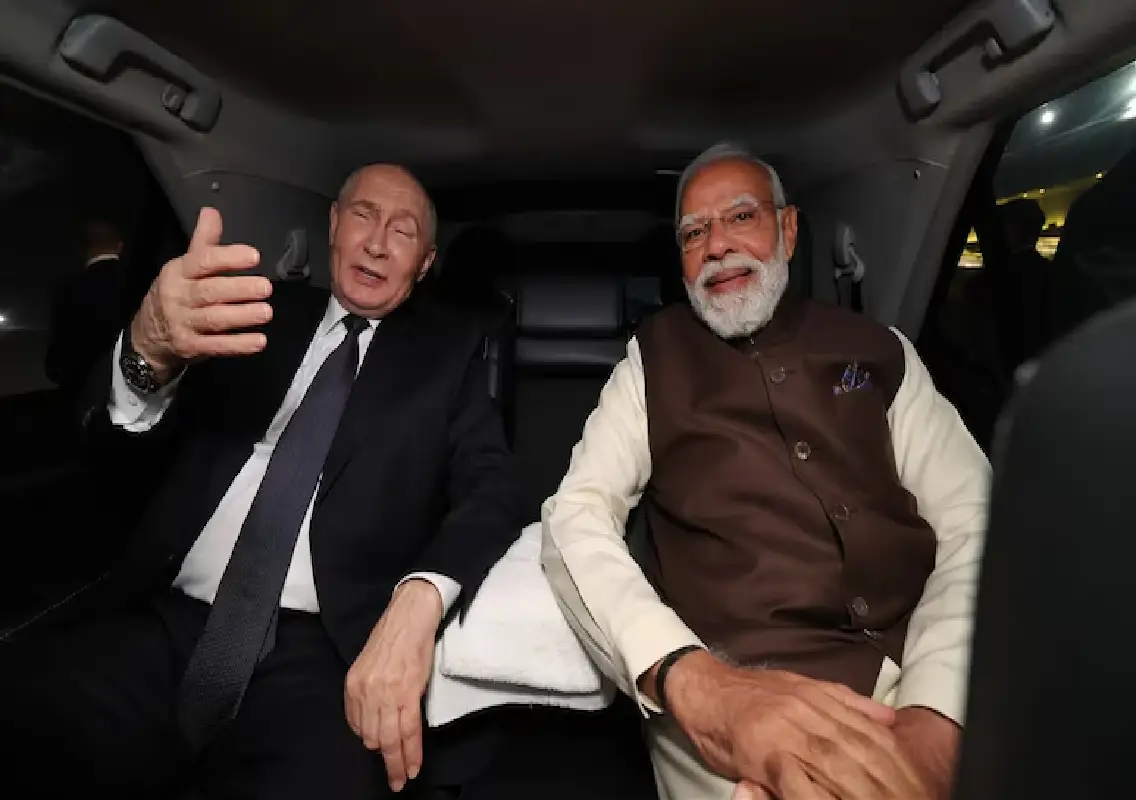


A viral photograph of Prime Minister Narendra Modi riding in a car with Russian President Vladimir Putin during the latter’s recent India visit has triggered a sharp political message in the United States Congress. The image unexpectedly appeared during a Congressional hearing, where a senior Democrat warned that President Donald Trump’s tariff policies and confrontational approach towards New Delhi risk pushing one of America’s most crucial strategic partners closer to Moscow.
Photo becomes symbol of strained ties
During a House Foreign Affairs Subcommittee hearing on the US–India strategic partnership, Democratic Ranking Member Sydney Kamlager-Dove held up a poster featuring the widely circulated Modi–Putin car image. She argued that it was Washington, not New Delhi, that was damaging the bilateral relationship.
“Trump’s policies towards India can only be described as cutting off our nose to spite our face,” she said, emphasising that the approach was inflicting “real and lasting damage” on decades of strategic trust. Pointing to the poster, she added, “Being a coercive partner has a cost, and this poster is worth a thousand words.”
The Democrat said Trump’s behaviour was undermining bipartisan progress and cautioned that the photo symbolised the consequences of pushing allies toward rival nations.
“You do not get a Nobel Peace Prize this way”
Kamlager-Dove accused Trump of dismantling what she described as one of the strongest bilateral frameworks handed over by the Biden administration. She highlighted key pillars such as the revitalised Quad grouping, growing defence technology cooperation and India’s role as a dependable supply-chain partner.
According to her, the tariff regime implemented by Trump—particularly the 25 per cent “Liberation Day tariffs” followed by an additional 25 per cent levy on India’s imports of Russian oil—had imposed an unsustainable 50 per cent tariff burden on Indian goods.
“The tariff rate on India is currently higher than the tariff rate on China,” she said, calling the move “self-defeating”.
She warned that, unless course correction happens, “Trump will be the American President who lost India,” adding that one “does not get a Nobel Peace Prize by driving strategic partners into the arms of adversaries.”
Modi–Putin meeting gets geopolitical attention
Putin’s recent two-day visit to New Delhi witnessed PM Modi personally receiving him at the airport—an unusual diplomatic gesture underscoring the strength of India–Russia relations. The two also shared a car ride to the Prime Minister’s residence at Lok Kalyan Marg, a moment interpreted internationally as a symbol of their political chemistry.
This was not the first time they shared a car; a similar moment occurred during the Shanghai Cooperation Organisation (SCO) Summit in China, when both leaders travelled in Russia’s Aurus sedan.
The Washington hearing made it clear that this visual geopolitics was being closely watched in US policymaking circles.
Concerns over tariffs and H-1B fees
Democratic representatives also criticised Trump for imposing a $100,000 fee on H-1B visas—70 per cent of which are held by Indian nationals—describing it as a “rebuke” to the Indian diaspora’s contributions to the American economy.
Experts testifying before the panel, including Dhruva Jaishankar of ORF America, indicated that trade negotiations had made significant progress earlier in the year. They suggested that a deal was “within reach” if the political climate in Washington were more conducive.
Witnesses also argued that the tariff confrontation risked overshadowing pressing shared priorities, including countering China’s assertiveness and securing global supply chains.
“This has been a low-cost, high-benefit partnership for the United States,” witness Smith said, adding that losing India would amount to “strategic malpractice of the highest order.”
Conclusion
The hearing reinforced that current US tariff measures have become the most contentious issue in the US–India relationship. With geopolitics evolving rapidly, lawmakers fear that escalating confrontation could drive India deeper into Russia’s strategic orbit—an outcome many in Washington hope to avoid.