


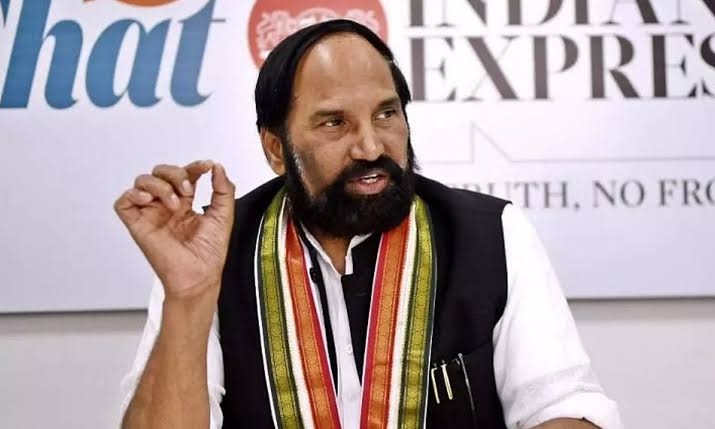


Hyderabad: Telangana Irrigation and Civil Supplies Minister N. Uttam Kumar Reddy has accused the previous Bharat Rashtra Samithi (BRS) government of leaving the state inadequately prepared to deal with drought conditions, arguing that delays in completing key irrigation projects have increased the difficulties faced by farmers.
Addressing a press conference on Saturday, October 24, Reddy also accused BRS leaders, including former chief minister K. Chandrashekar Rao, K. T. Rama Rao and T. Harish Rao, of spreading misinformation about the Congress government’s handling of irrigation and agricultural issues.
The minister’s remarks came amid a renewed political dispute over the Kaleshwaram Lift Irrigation Scheme, particularly the condition of the Medigadda, Annaram and Sundilla barrages. The debate has intensified as concerns over water availability affect agriculture and drinking-water security in Telangana.
Uttam Reddy accuses BRS of exploiting drought conditions
Reddy alleged that the BRS leadership was using the drought conditions associated with the El Niño phenomenon and concerns surrounding the Kaleshwaram project to attack the Congress government.
He accused Chandrashekar Rao and former ministers K. T. Rama Rao and T. Harish Rao of misleading the public about the state’s irrigation infrastructure and the government’s response to water shortages.
In a sharp attack on the opposition’s messaging, Reddy compared its campaign to Nazi propaganda, invoking Joseph Goebbels, Adolf Hitler’s propaganda minister. The comparison was part of the minister’s political criticism of the BRS leadership.
The remarks reflect the growing dispute between the ruling Congress and the BRS over responsibility for Telangana’s irrigation difficulties. Reddy has attributed the state’s vulnerability to a combination of El Niño-related rainfall challenges and what he described as shortcomings in the previous administration’s irrigation policies.
The minister’s claims about political motives and misinformation are allegations made by him and should be distinguished from independently established facts about rainfall, water storage and project performance.
Incomplete irrigation projects come under scrutiny
Reddy questioned the previous government’s record on completing major irrigation projects, arguing that delays had limited the state’s ability to respond to water shortages.
He named the Kalwakurthy, Nettempadu, Bhima, Srisailam Left Bank Canal (SLBC) and Sita Rama projects, saying that their timely completion could have improved water availability and reduced the impact of drought on farming communities.
According to the minister, better-developed irrigation infrastructure would have helped farmers cope with inadequate rainfall and provided greater support to agricultural activity during periods of water stress.
He maintained that the previous administration’s decisions on project implementation and expenditure needed to be examined in the context of the challenges facing farmers.
Reddy has made similar arguments in recent weeks, linking the state’s water difficulties to the combination of El Niño conditions and incomplete irrigation works. In September, he also cited low reservoir and tank levels as factors contributing to pressure on irrigation and drinking-water supplies.
However, the extent to which individual project delays have contributed to current water shortages depends on factors including rainfall, reservoir storage, the operational status of infrastructure and the availability of water in the relevant river basins.
Kaleshwaram project remains at the centre of the dispute
The Kaleshwaram Lift Irrigation Scheme has become a major point of contention between the Congress government and the BRS, which governed Telangana before the Congress came to power.
The Medigadda, Annaram and Sundilla barrages have faced scrutiny over structural concerns and their operational status. Questions about their condition have continued to shape political exchanges over the benefits delivered by the scheme and the steps needed to restore its functioning.
Reddy criticised the previous administration’s handling of the project and rejected allegations that the Congress government was allowing water to flow away without making adequate use of it.
The minister has maintained that the condition of the barrages and the instructions issued by technical authorities have to be considered when assessing the government’s ability to operate the scheme.
The National Dam Safety Authority has previously identified deficiencies in the design and construction of the Medigadda barrage, according to reports on Reddy’s latest remarks. The minister also referred to the barrage’s structural failure during the BRS government’s tenure.
The condition of the barrages remains central to the wider question of how the state can restore irrigation capacity and manage available water resources.
BRS raises questions over water utilisation
The opposition has also criticised the Congress government’s handling of the Kaleshwaram infrastructure.
On Saturday, BRS leaders visited the Kannepalli pump house and Medigadda barrage, drawing attention to Godavari water flowing downstream and eventually towards the sea while concerns about drinking-water availability were being raised in Hyderabad.
The BRS leaders alleged that the Congress government had failed to operate pumps at Kannepalli, thereby worsening the water situation. These claims form part of the opposition’s criticism of the current administration and differ from Reddy’s account, which places significant responsibility on the previous government and the condition of the infrastructure it developed.
The competing allegations underline the political disagreement over whether the present difficulties are primarily linked to the legacy of the previous administration, the current government’s management of available water or a combination of infrastructure and climatic factors.
The practical questions remain how much water can safely be stored and moved, which components of the irrigation system can operate and what restoration work is required before the barrages can be used effectively.
El Niño and low water storage add to farmers’ concerns
El Niño, a climate phenomenon associated with changes in Pacific Ocean temperatures and shifts in weather patterns, has been cited by Telangana officials as one factor affecting rainfall and water availability.
In September, Reddy told the state Assembly that storage in the Krishna and Godavari river basins was significantly below the level recorded during the corresponding period a year earlier. He said the combined storage stood at 241 thousand million cubic feet (TMC), against a live capacity of 585 TMC, as of September 17. The previous year’s storage for the same period was reported at 497 TMC.
Low storage can place pressure on decisions about water releases, particularly when authorities have to balance drinking-water requirements with irrigation needs.
For farmers, reduced water availability can complicate crop planning and increase uncertainty over whether irrigation supplies will be available at critical stages of cultivation.
Reddy has argued that completing more irrigation projects would have strengthened Telangana’s ability to withstand such conditions. The opposition, meanwhile, has focused on the current government’s management of the Kaleshwaram system and the water it believes could be put to use.
Irrigation debate likely to continue
The latest exchange adds to the continuing political dispute over Telangana’s irrigation infrastructure, project implementation and response to drought conditions.
Reddy has placed responsibility on the previous BRS government, citing incomplete projects and concerns surrounding Kaleshwaram. The BRS has questioned the Congress government’s handling of the existing system and its use of available water.
Resolving the wider water challenge will require more than political exchanges. The operational condition of the barrages, technical assessments, reservoir levels, rainfall patterns and progress on irrigation projects will all influence how much water can be made available for agriculture and other needs.
With farmers facing uncertainty over water supplies, the debate is likely to remain focused on both the legacy of major irrigation investments and the current administration’s ability to manage the state’s available resources.m