







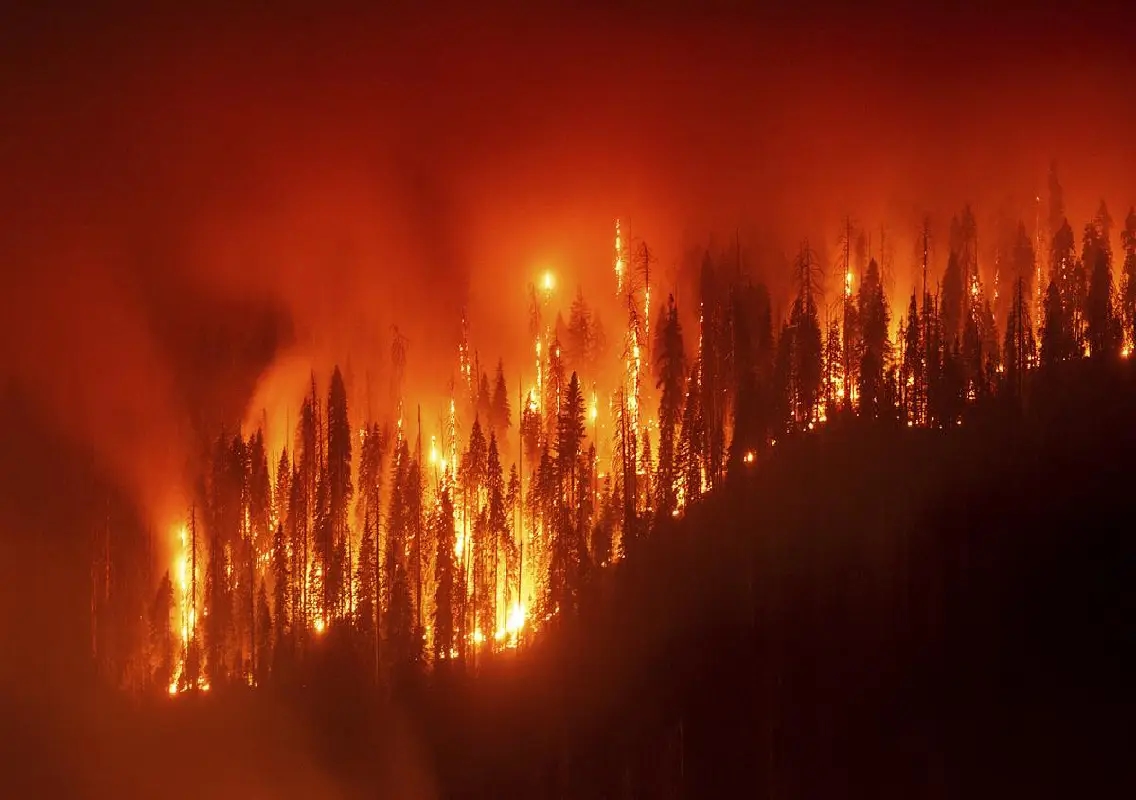


New Delhi: Around 15 million people (1.5 crore) in India were affected by wildfires during 2024–25, according to the latest State of Wildfires report published in the journal Earth System Science Data. The study identified Uttar Pradesh as the most severely impacted region, recording its worst wildfire season in history — fuelled by crop burning, prolonged heatwaves, and dry vegetation buildup.
India among worst-hit nations globally
The global analysis, conducted by researchers from the University of East Anglia, the UK Met Office, and other international institutions, highlighted that India ranks among the world’s worst-affected countries, alongside the Democratic Republic of Congo, Nigeria, China, Mozambique, and South Sudan.
Worldwide, nearly 100 million people were exposed to wildfires in 2024–25, and USD 215 billion worth of homes and infrastructure were located in proximity to fire-prone regions. India recorded the highest infrastructure exposure, valued at USD 44 billion, followed by the United States (USD 26 billion) and China (USD 17 billion).
Uttar Pradesh and Punjab top the exposure list
Within India, Uttar Pradesh saw the highest wildfire-related population exposure, affecting 4.6 million people, while Punjab followed with 3.5 million affected. The report attributed these numbers to widespread agricultural stubble burning, which continues to be a leading cause of fires in northern India.
The fires in these states not only devastated farmlands but also contributed to toxic haze episodes in New Delhi and surrounding regions. During November 2024, the national capital recorded PM2.5 levels exceeding 200 micrograms per cubic metre, which is 13 times higher than the daily limit recommended by the World Health Organization (WHO).
Global wildfire toll rises amid climate change
The study revealed that globally, 3.7 million square kilometres of land — an area larger than India — was burned during the 2024–25 fire season. The total carbon dioxide emissions exceeded eight billion tonnes, marking a 10 per cent rise compared to the long-term average since 2003.
The report noted that exceptionally large wildfires in South America and Canada were major contributors to the increase. Researchers attributed these to human-induced climate change, which has amplified the frequency and intensity of extreme fire events.
“Our annual reports provide unequivocal evidence that climate change is increasing the frequency and severity of extreme wildfires,” said Douglas Kelley, a land surface modeller at the UK Centre for Ecology and Hydrology and one of the lead authors.
“Without human-driven warming, many of these wildfires — in regions like the Pantanal and Southern California — would not have reached such extreme levels,” he added.
Fire season analysis and data sources
The study analysed NASA satellite observations of burned areas from March 2002 to February 2025, combined with carbon emission data from the European climate agency Copernicus for the 2024–25 fire season.
Researchers found that exposure to wildfires was highest in South and Southeast Asia, Central Africa, and East Africa. These regions not only witnessed widespread fire activity but also faced severe air pollution, threatening public health and local economies.
Growing risks for India
Experts warn that India’s growing wildfire vulnerability stems from a combination of climate variability, agricultural practices, and land-use changes. Rising temperatures, delayed monsoons, and prolonged dry spells are accelerating the frequency of fires across forest and agricultural zones.
The economic consequences are also significant. With an estimated USD 44 billion in infrastructure exposure, India faces mounting challenges in mitigating fire risks and rebuilding affected areas. The report calls for urgent policy measures, including stricter regulation of crop residue burning, improved forest management, and better early warning systems.
Conclusion
The 2024–25 wildfire season stands as a stark reminder of the climate crisis intensifying across India and the world. As scientists continue to link extreme fire events to human-induced warming, countries like India must strengthen their environmental and public health strategies to prevent future catastrophes.