







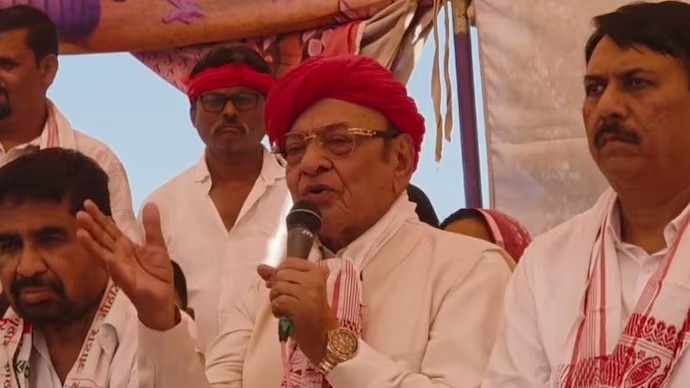


Narmada: Former Gujarat chief minister Shankarsinh Vaghela has triggered a political controversy after making remarks about Patels, Baniyas and Brahmins while defending reservation for Scheduled Castes (SCs), Scheduled Tribes (STs) and Other Backward Classes (OBCs).
Vaghela was speaking at a farmers’ conference in Khopi in the Sagbara area of Narmada district on Friday. The gathering was organised around the rights of tribal farmers to cultivate forest land and was attended by Gujarat Congress president Amit Chavda and other Congress leaders.
During his speech, Vaghela argued that reservation should not be viewed as a concession or favour. He linked affirmative action to the historical discrimination and hardships faced by communities covered by the reservation system.
He then directed his remarks at members of communities that he said oppose reservation, naming Patels, Baniyas and Brahmins. Vaghela said he would be willing to pay members of these communities Rs 50,000 a month to undertake manual scavenging and clean human waste.
The comments have drawn criticism from community representatives and political opponents, who accused the former chief minister of making divisive remarks at a public gathering.
Vaghela defends SC, ST and OBC reservation
Vaghela’s remarks came in the context of a wider argument in support of reservation for SC, ST and OBC communities.
He said reservation had not been provided as a favour and argued that communities benefiting from affirmative action had faced discrimination and hardship over generations.
“Reservation has not been given to anyone as a favour,” Vaghela said, according to reports of the speech.
He then said those who opposed reservation, including Patels, Baniyas and Brahmins, should understand the realities faced by disadvantaged communities.
Vaghela used manual scavenging as an example while making the point, saying he was prepared to pay members of the communities he named Rs 50,000 a month if they were willing to undertake such work.
The remarks have become the central point of the controversy surrounding the speech.
The issue of reservation has long been politically sensitive in Gujarat, particularly because of the state’s history of movements around quotas involving Patidar and other communities. Vaghela’s comments have therefore prompted reactions from community leaders as well as political opponents.
BJP leader Yagnesh Dave criticises remarks
BJP leader and Brahmin community representative Yagnesh Dave criticised Vaghela for specifically naming three communities in his speech.
Dave said Vaghela should undertake the work himself before making such a suggestion to members of other communities.
“Shankersinh Bapu should first begin this noble task at his own home,” Dave said, according to reports. He added that he would be willing to pay Vaghela Rs 5 lakh a month if the former chief minister agreed to clean his house.
Dave’s response added to the political exchange triggered by Vaghela’s remarks, with the BJP leader accusing him of unnecessarily targeting particular communities.
The criticism was directed at both the language used by Vaghela and his decision to identify specific caste groups while discussing opposition to reservation.
Patidar leader seeks unconditional apology
Patidar leader Alpesh Kathiriya also criticised Vaghela’s remarks and called for an unconditional apology.
Kathiriya said the comments were inappropriate, particularly because they were made by a former chief minister at a public gathering.
He also expressed concern that statements targeting specific communities could contribute to social tensions.
The reactions have placed the focus on the manner in which the reservation debate is being conducted, beyond the substantive question of affirmative action itself.
Vaghela’s supporters, meanwhile, have framed his comments as part of his broader argument that communities should understand the historical and social conditions that led to the reservation system.
Congress leaders attend tribal farmers’ conference
The farmers’ conference in Narmada district was attended by Gujarat Congress president Amit Chavda and several other Congress leaders.
The event focused primarily on demands concerning tribal farmers and their rights over forest land.
Vaghela used the gathering to call for greater political mobilisation among SC, ST and OBC communities. Referring to the combined population and political strength of these groups, he urged them to recognise their influence and exercise it in the next Gujarat Assembly election.
The presence of senior Congress leaders has added political significance to the event because Vaghela is currently in discussions with the Congress over a possible return to the party.
Chavda has publicly acknowledged that discussions are taking place between Vaghela and the Congress leadership. Any formal re-induction, however, would require approval from the party’s central leadership.
Vaghela’s possible Congress return
The controversy comes as Vaghela’s political future is once again being discussed in Gujarat.
Vaghela left the Congress in 2017 after differences with the party leadership. He subsequently formed the Janvikalp Morcha and contested the Gujarat Assembly election that year.
He later joined the Nationalist Congress Party before leaving it. In 2024, he announced the formation of the Praja Shakti Democratic Party.
Nearly nine years after leaving the Congress, Vaghela is now in talks over a possible return to the party.
His recent appearances alongside Congress leaders have fuelled speculation about a formal political re-entry, particularly as parties begin preparing for the 2027 Gujarat Assembly election.
The Congress has not yet formally announced Vaghela’s return.
His latest remarks could therefore become another issue for the party to navigate if discussions over his re-induction continue.
Vaghela also backs separate Bhilistan demand
The former chief minister also spoke about tribal political demands during the Narmada gathering.
Vaghela expressed support for the demand for a separate Bhilistan, a long-standing demand among sections of tribal activists in parts of western and central India.
“We support the demand for Bhilistan. I fully endorse the creation of a separate Bhilistan for the tribal community,” he said, according to reports.
The statement came alongside his appeal for greater political mobilisation among tribal communities.
The Bhilistan demand has historically involved tribal areas spanning parts of Gujarat, Rajasthan, Madhya Pradesh and Maharashtra, although political positions on the issue differ widely.
Reservation debate remains politically sensitive
Vaghela’s comments have once again highlighted the politically sensitive nature of reservation in Gujarat.
Supporters of affirmative action argue that reservations remain necessary to address historical discrimination and unequal access to education, employment and political representation. Opponents and sections of other communities have periodically demanded changes to the existing system or raised concerns about the distribution of reservation benefits.
Gujarat has also witnessed major movements over reservation, most notably the Patidar agitation that began in 2015.
Against that background, naming Patels, Baniyas and Brahmins while discussing opposition to reservation was likely to attract political and community reactions.
The controversy is now unfolding alongside discussions over Vaghela’s possible return to Congress. His participation in events with Congress leaders has increased attention on his political activities ahead of the 2027 Assembly election.
For now, the Congress has not formally confirmed his re-induction, while community representatives and political opponents have continued to demand clarification and an apology over the remarks.