







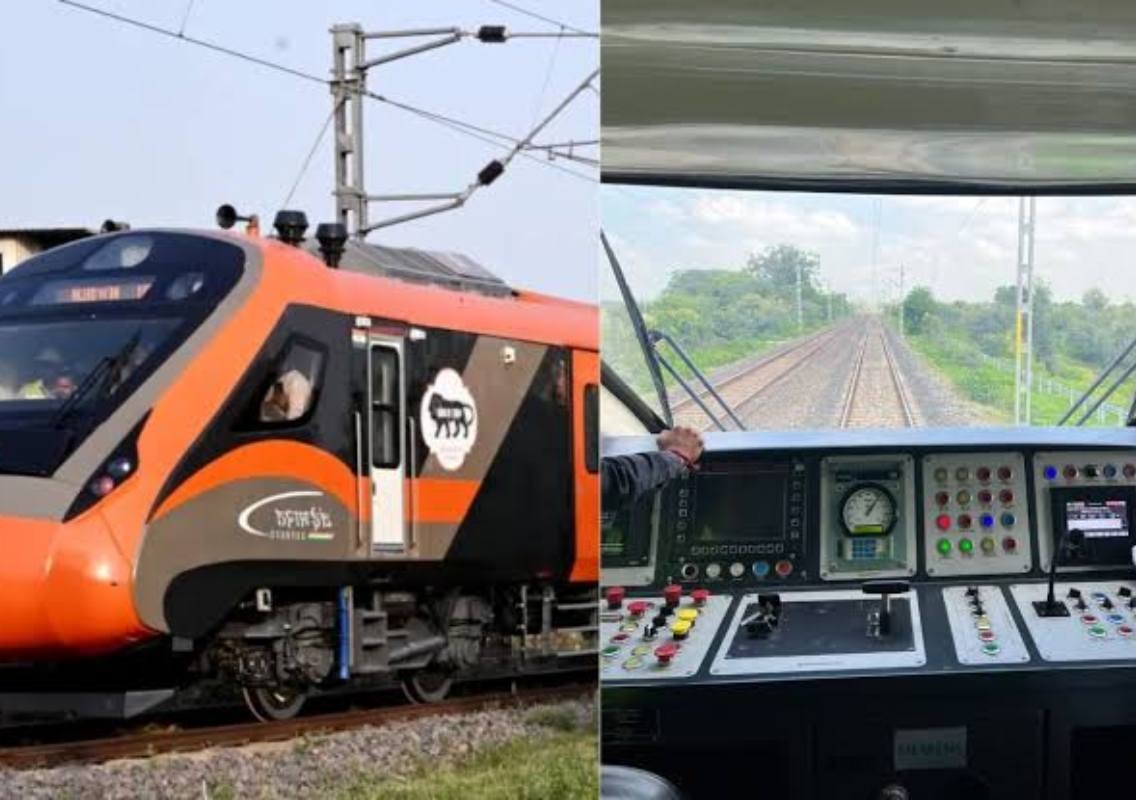


Ranchi: An empty Vande Bharat train travelled approximately 463 km from Jharkhand to Uttar Pradesh in October despite repeated warnings from railway staff about ineffective coach brakes, raising serious concerns over safety procedures and operational lapses. The rake was moved using a freight locomotive, and the braking systems of its coaches were reportedly not functioning during the journey.
The South Eastern Railway has ordered a detailed investigation into the October 24 incident to identify the failures that allowed the train to continue despite warnings from two loco pilots. A preliminary inquiry has pointed to negligence by maintenance personnel, railway controllers and members of the train crew.
The incident has drawn attention to the importance of brake-power checks and communication between railway staff before a train is permitted to operate. The railway zone has described running a train without adequate braking capacity as a serious safety concern that could endanger passengers, railway employees and other train operations.
The empty chair car rake was being transferred from Hatia in Jharkhand to Jhansi in Uttar Pradesh. According to the preliminary findings, it covered the distance using the locomotive’s brakes and regenerative braking, without the braking systems of the coaches being applied.
Vande Bharat rake moved despite poor brake performance
The empty Vande Bharat rake was scheduled to travel from Hatia to Jhansi on October 24. A freight locomotive was assigned to haul the coaches, with the braking system of the rake expected to be integrated with that of the locomotive.
This arrangement was necessary to ensure that the locomotive and coaches could respond appropriately when the train’s brakes were applied.
However, railway staff allegedly failed to ensure that the braking systems were properly integrated before the journey began.
According to an order issued by the South Eastern Railway on November 7, the loco pilot conducted a brake-feel and brake-power test after the train departed Hatia. The test was carried out in the Hatia-Ranchi section in accordance with the instructions then in force.
The order records that the loco pilot found the brake power to be very poor and ineffective.
Despite identifying the problem, the train was allowed to continue towards its destination.
The incident has raised questions about why the rake was not stopped for a detailed examination after the initial test indicated that its braking performance was inadequate.
Loco pilot reports braking failure at Ranchi
After reaching Ranchi station, the loco pilot submitted a written complaint about the poor brake power.
The complaint was sent to the section controller and the traction locomotive controller, informing them that the braking system was not functioning effectively.
However, the train was permitted to proceed in the same condition, according to the South Eastern Railway’s investigation order.
The problem was also reported by another loco pilot who took charge of operating the train from Muri station.
He informed the concerned railway controllers about the poor braking performance and specifically stated that the brakes could not be applied by reducing the brake pipe pressure.
The repeated warnings meant that railway personnel had been informed about the braking problem at different stages of the journey.
Despite these reports, the rake continued towards Uttar Pradesh without the underlying issue being resolved.
The sequence of events has become a central part of the investigation, which will examine why the warnings did not lead to the train being stopped and inspected.
Braking problem detected after train reached Uttar Pradesh
Railway staff took corrective action only after the rake reached Deen Dayal Upadhyaya station in Uttar Pradesh’s Chandauli district.
An inspection conducted at the station found that the braking systems of all the coaches had been isolated. This meant that the brakes fitted in the coaches could not be applied during the journey.
As a result, the rake had travelled approximately 463 km relying on the braking capability of the locomotive and its regenerative braking system.
The discovery highlighted the seriousness of the failure. The coaches were being hauled without their own braking systems functioning as intended, even though the train crew had reported the problem earlier.
The railway’s preliminary findings indicate that the failure was not limited to a single individual or one stage of the operation. Instead, several checks and communication procedures appear to have broken down.
Preliminary inquiry points to multiple staff failures
The initial investigation identified alleged negligence involving coach and wagon maintenance staff, section controllers, traction controllers and the train crew.
The maintenance staff were found to have failed to physically verify whether the coach brakes were working before the rake was permitted to leave Hatia.
The inquiry also noted that railway personnel did not take appropriate action after receiving reports about the poor braking performance at Ranchi and Muri.
The train crew’s role has also come under scrutiny. According to the preliminary findings, the personnel operating the rake were not sufficiently familiar with the Vande Bharat braking system.
They also allegedly failed to physically verify whether the brakes were being applied in the coaches.
The South Eastern Railway’s order described the incident as the result of multiple failures by different staff members.
“From the above, it is evident that there were multiple failures on the part of various staff, resulting in the train being worked without effective train brakes,” the order stated.
The findings are preliminary, and the detailed investigation is expected to establish the individual lapses and the circumstances that allowed the rake to continue operating.
South Eastern Railway orders detailed investigation
The South Eastern Railway issued its investigation order on November 7, asking the Ranchi Divisional Railway Manager to examine the October 24 incident in detail.
The inquiry has been tasked with identifying the lapses involving the employees and officials responsible for maintenance, inspection, operational clearance and train movement.
The railway zone has also called for corrective and preventive measures to ensure that such an incident does not happen again.
In its order, the railway emphasised that operating a train without adequate brake power could lead to a major accident. It warned that such failures could put the lives of railway employees and passengers at risk while also affecting the safety of other railway operations.
The investigation will therefore need to examine not only why the brakes were ineffective but also why the rake was allowed to continue after the problem had been reported more than once.
The findings could also help determine whether existing inspection procedures, communication protocols and operational checks need to be strengthened.
Incident raises broader questions about railway safety
The Vande Bharat rake incident has renewed attention on the importance of ensuring that braking systems are fully functional before any train is moved.
Brake-power tests are a critical part of railway operations because they help establish whether a train can slow down and stop safely. When a rake is hauled by a locomotive, the braking arrangement between the locomotive and coaches must also function correctly.
In this case, the preliminary findings suggest that the required physical checks were not carried out effectively and that warnings from the operating crew were not acted upon.
The incident occurred days before the Kolkata-Sairang Express derailed in Assam on November 11, an accident that the supplied report also links to alleged negligence. The two incidents have brought renewed focus on the role of staff compliance and safety procedures in railway operations. However, the circumstances of the two events are separate and require their own investigations.
The South Eastern Railway’s detailed inquiry will now seek to establish how an empty Vande Bharat rake travelled 463 km with ineffective coach brakes despite repeated warnings. Its recommendations are expected to focus on identifying responsibility and strengthening safeguards against a recurrence.