







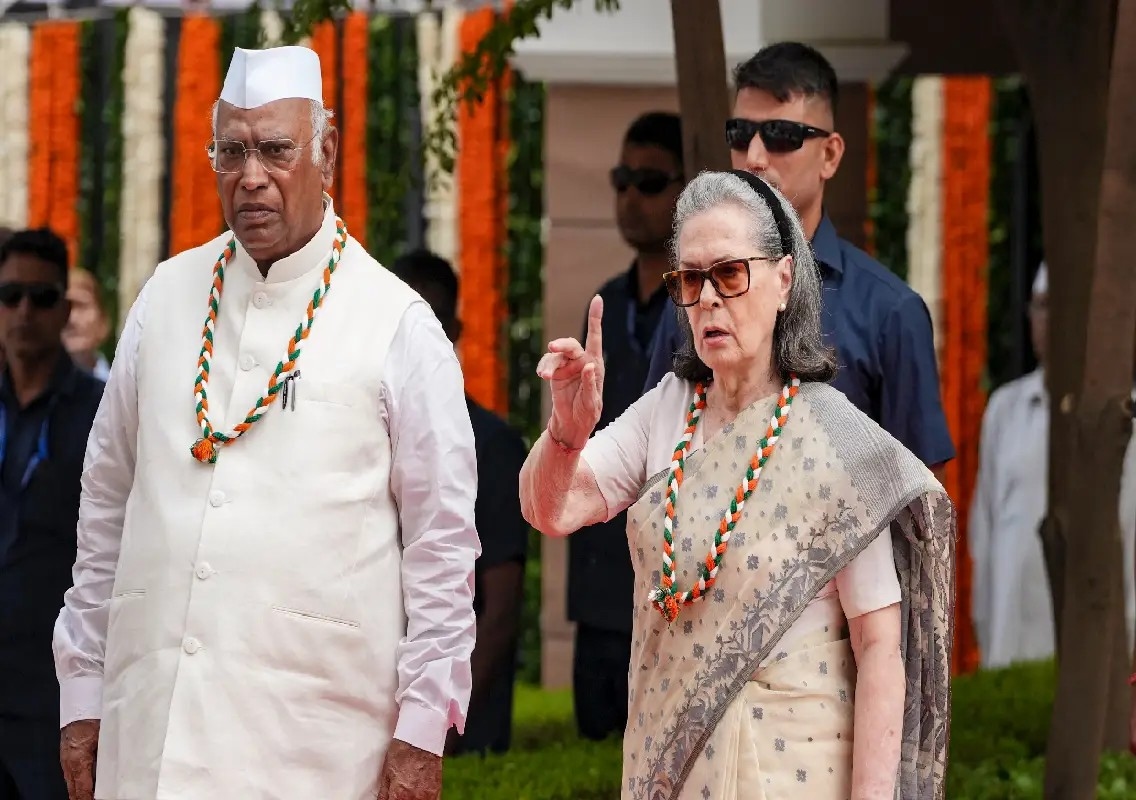


New Delhi: A fresh political controversy erupted on Saturday after a video from the Congress Independence Day programme at the party headquarters in New Delhi appeared to show Congress president Mallikarjun Kharge and Congress Parliamentary Party chairperson Sonia Gandhi making gestures that were interpreted as asking workers to stop the rendition of Vande Mataram.
Congress leader Rahul Gandhi was also seen making a similar gesture moments later. The footage has since circulated widely on social media, prompting sharp reactions from political opponents and accusations that the Congress leadership was uncomfortable with the national song.
The Congress, however, has sought to downplay the controversy, with senior leader Ashok Gehlot saying there was no controversy and indicating that the party’s high command or Jairam Ramesh would explain the party’s position.
Video triggers political controversy
The video was recorded during the Congress’s Independence Day celebrations at its headquarters in the national capital. Sonia Gandhi, Rahul Gandhi and Kharge were present at the event along with other senior leaders and party workers.
As Vande Mataram was being rendered, Sonia Gandhi and Kharge were seen making hand gestures towards people around them. The gestures were interpreted by critics as a request to stop the rendition.
Rahul Gandhi was subsequently seen making what appeared to be a similar gesture.
The footage quickly gained traction online, with political opponents accusing the Congress leadership of showing disrespect towards the National Song. However, the video alone does not establish the intention behind the gestures, and the Congress has not publicly offered a detailed explanation of what the leaders were signalling at the time.
Congress plays down allegations
Responding to questions from reporters, senior Congress leader Ashok Gehlot dismissed the controversy.
“There is no controversy,” Gehlot said, adding that the Congress high command or Jairam Ramesh would explain the party’s approach.
The response came amid heightened political attention surrounding Vande Mataram, with the BJP and Congress engaged in an increasingly sharp debate over the song’s history, rendition and place in official events.
The Congress leadership is yet to issue a detailed clarification specifically addressing the gestures visible in the video.
Kharge and Rahul Gandhi skip Red Fort event
The controversy also emerged against the backdrop of another political disagreement surrounding Independence Day.
Rahul Gandhi and Mallikarjun Kharge, who are the Leaders of Opposition in the Lok Sabha and Rajya Sabha respectively, did not attend the Independence Day programme led by Prime Minister Narendra Modi at the Red Fort.
The Congress leaders’ absence was attributed to what the party described as improper protocol.
The development added another layer to the political exchanges between the BJP and Congress on the occasion of Independence Day.
BJP and Congress clash over Vande Mataram
The latest controversy comes at a time when Vande Mataram has become a prominent subject of political debate.
Prime Minister Narendra Modi has repeatedly criticised the Congress over the historical treatment of the national song. He has alleged that the Congress shortened the song by retaining only its first two stanzas.
During a recent discussion in Parliament, Modi accused the Congress of having “cut” Vande Mataram and criticised the party’s historical handling of objections to certain portions of the song before Independence.
The BJP has used the issue to question the Congress’s position on the national song and its historical role in the freedom movement.
The Congress, meanwhile, has faced growing pressure to explain its position as Vande Mataram receives increased prominence in national events.
Historical significance of Vande Mataram
Vande Mataram was written by Bankim Chandra Chatterjee in the 19th century and later incorporated into his novel Anandamath. The song became an important symbol of India’s freedom movement and was widely used to inspire nationalist sentiment during the struggle against British rule.
The first two stanzas were subsequently adopted as India’s National Song.
The longer version contains additional passages featuring religious imagery and references to Hindu traditions. These portions have historically been the subject of debate, particularly in discussions about how the song should be presented in a religiously diverse country.
The distinction between the National Song and the National Anthem has also remained important in public discourse. Jana Gana Mana is India’s National Anthem, while Vande Mataram holds the status of the National Song.
Kerala instructions add to political debate
The debate has also extended to Kerala, where the Congress-led state government issued Independence Day instructions for schools focusing on flag hoisting and the singing of the National Anthem, Jana Gana Mana, without specifically directing institutions to sing Vande Mataram.
The instructions attracted criticism from the BJP amid a wider national debate over the Centre’s directions concerning the National Song.
The developments have kept the issue in the political spotlight, particularly as parties prepare to use questions of nationalism and national symbols in their wider political campaigns.
Vande Mataram featured prominently in celebrations
This year’s Independence Day celebrations have given Vande Mataram particular prominence.
At the Red Fort, Prime Minister Modi’s Independence Day ceremony featured the National Song before the National Anthem. The programme also highlighted the legacy of Vande Mataram as the country marked 150 years of the song.
The song was also played in Parliament on the final day of the Monsoon Session, with proceedings in both the Lok Sabha and Rajya Sabha concluding with Vande Mataram.
Against this backdrop, the footage from the Congress headquarters has provided fresh political ammunition to the BJP and other critics.
The controversy is now likely to remain in the spotlight until the Congress leadership gives a clear explanation of the gestures seen in the video. While critics have interpreted the footage as an indication of discomfort with Vande Mataram, the Congress has rejected the suggestion that there is a controversy and has yet to provide a detailed account of what prompted the gestures.