







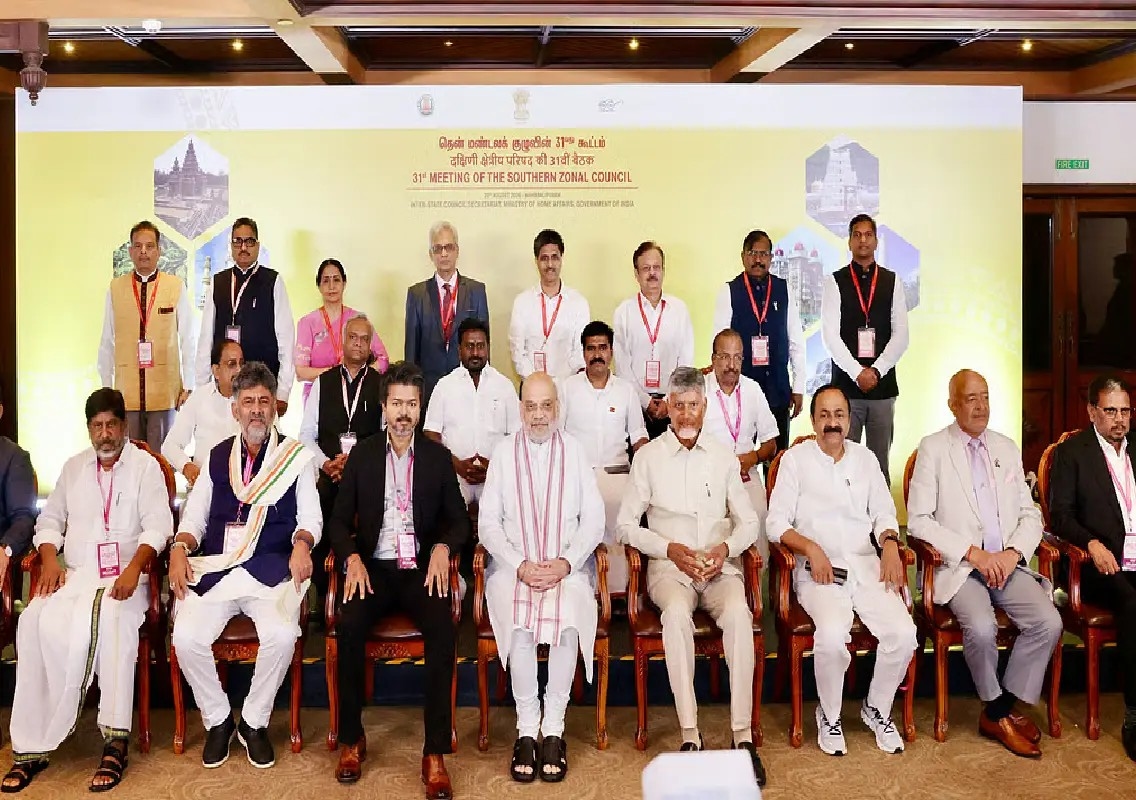


Chennai: Chief Minister C Joseph Vijay has called for stronger cooperation among the southern states to build common economic and infrastructure networks, highlighting the proposed extension of the Bengaluru Metro to Hosur as a model for inter-state development.
Addressing the 31st meeting of the Southern Zonal Council at Kovalam on Thursday, Vijay said southern states should work together to develop integrated economic and logistics networks that can strengthen manufacturing, improve connectivity and boost exports. The meeting was chaired by Union Home Minister Amit Shah and attended by leaders and representatives of the southern states and Union Territories.
The Tamil Nadu Chief Minister proposed that the Southern Zonal Council take the lead in promoting common economic and logistics clusters across the region. He suggested the creation of integrated manufacturing zones, shared multimodal logistics parks and seamless freight and industrial corridors linking major production centres with ports and global markets.
According to Vijay, a coordinated approach among the southern states could significantly reduce the cost of doing business while attracting greater investments and ensuring that industrial growth reaches smaller towns beyond major metropolitan centres.
Metro extension to Hosur in focus
Vijay specifically endorsed the proposed extension of the Bengaluru Metro from Bommasandra in Karnataka to Hosur in Tamil Nadu, describing the project as an important example of what neighbouring states can achieve through cooperative infrastructure planning.
He urged the Union government and the governments of Karnataka and Tamil Nadu to carry forward the proposal without delay. The proposed Metro connection could improve daily travel between Bengaluru’s expanding industrial belt and Hosur, which has emerged as an important manufacturing and economic centre.
“I urge that it be carried forward expeditiously with the support of the Union and both state governments. Let it be the first of many such connections across the south,” Vijay said.
The proposal is particularly significant because economic activity in southern India increasingly extends beyond state borders. Workers, businesses, supply chains and freight networks regularly move between Karnataka, Tamil Nadu, Kerala, Andhra Pradesh, Telangana and Puducherry. Vijay’s remarks focused on the need for infrastructure planning to reflect these growing regional connections.
A cross-border Metro link between Bengaluru and Hosur could serve as a model for other projects involving neighbouring states, especially in regions where urban expansion and industrial development have created strong economic links across administrative boundaries.
Call for common economic corridors
Vijay said the southern region could benefit from jointly planned manufacturing and logistics infrastructure rather than isolated projects developed by individual states.
He proposed common economic and logistics clusters comprising integrated manufacturing zones, multimodal logistics parks and freight corridors. Such infrastructure could improve the movement of raw materials and finished goods while providing industries with better access to ports and international markets.
“Such an integrated approach would reduce the cost of doing business, boost exports, attract investment and spread industrial growth to smaller towns,” the Chief Minister said.
The proposal also reflects the importance of strengthening connections between industrial hubs, transport networks and maritime gateways. Southern India has several major manufacturing centres and ports, and improved coordination could help create more efficient supply chains across the region.
Integrated infrastructure could also support the growth of smaller towns located along major industrial and freight corridors. By improving rail, road, Metro and logistics connectivity, industries could expand beyond congested urban centres and generate employment in emerging economic locations.
Vijay’s call was therefore aimed not only at improving infrastructure but also at ensuring that the benefits of economic growth are distributed more widely across the southern states.
Integrated approach to maritime economy
The Tamil Nadu Chief Minister also called for a common southern strategy for developing the maritime economy. He said cooperation could cover a wide range of sectors, including ports, coastal shipping, fisheries, marine industries, maritime services and coastal tourism.
With a coastline of 1,076 km, Tamil Nadu shares maritime boundaries with Andhra Pradesh, Puducherry and Kerala. Vijay said the state was ready to work with its neighbours to develop the region’s maritime potential through coordinated planning.
An integrated approach, he indicated, could help southern states make better use of their long coastlines and existing port infrastructure. Cooperation in coastal shipping could improve the movement of goods, while joint initiatives in fisheries and marine industries could strengthen livelihoods and economic opportunities associated with coastal communities.
Maritime tourism and related services could also benefit from better regional coordination. Southern India’s coastline includes diverse beaches, ports, fishing centres and tourism destinations, creating opportunities for interconnected development rather than state-specific planning.
Southern states urged to work together
The Southern Zonal Council meeting brought together representatives of the region to discuss issues requiring coordination between states and the Union government. Vijay used the platform to underline the need for cooperative federalism in areas where economic development and infrastructure cannot be confined within state boundaries.
The proposed Bengaluru Metro extension to Hosur emerged as the clearest example of this approach. If implemented through coordinated action by the Centre and the two state governments, the project could demonstrate how cross-border infrastructure can support urban mobility, industrial growth and regional economic integration.
Vijay’s broader proposals for shared manufacturing zones, logistics parks, freight corridors and maritime development similarly focused on building networks that connect southern India’s production centres with domestic and global markets.
As economic activity increasingly transcends state borders, the Chief Minister argued that infrastructure planning must also become more collaborative. Greater cooperation among the southern states, supported by the Union government, could help reduce logistical barriers, improve competitiveness and create new opportunities for investment and employment.
The Bengaluru Metro-Hosur proposal, if taken forward, could therefore become more than a transport project. It could serve as a test case for a wider model of regional cooperation, opening the way for more cross-border infrastructure connections and integrated economic development across southern India.