







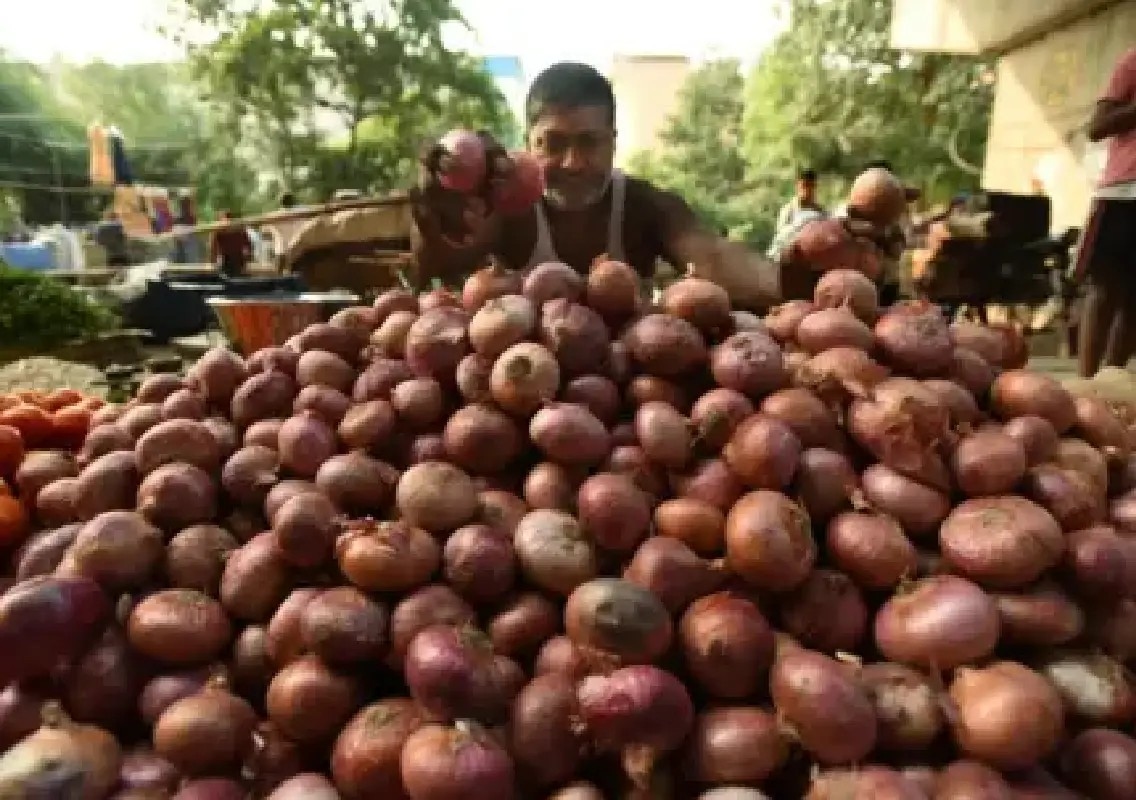


Chennai : Tamil Nadu has stepped in to provide relief to consumers as onion prices rise, announcing subsidized sales at ₹35 a kilogram through thousands of retail outlets. But the intervention has also highlighted a larger problem that has repeatedly troubled India: the difficulty of keeping onion prices affordable for consumers while ensuring farmers receive fair returns.
From September 3, onions have been made available at ₹35 a kg through 8,739 urban ration shops, cooperative outlets and Amudham stores. Open-market prices have reportedly climbed to around ₹56–₹60 a kg, with lower arrivals, adverse weather and increased transportation costs contributing to the rise.
Around 80 lakh family-card holders are expected to benefit from the state initiative, with each family allowed to purchase one kilogram.
However, the government’s first consignment raises questions about how widely the relief can actually reach.
1,000 tonnes against 80 lakh families
Tamil Nadu has initially procured 1,000 tonnes of onions through the National Agricultural Cooperative Marketing Federation of India (NAFED) and the National Cooperative Consumers’ Federation (NCCF).
One thousand tonnes is equivalent to 10 lakh kilograms.
At one kilogram per family, the initial stock can therefore serve approximately 10 lakh families. With around 80 lakh potential beneficiaries, the first consignment is sufficient for only one in eight families to receive one kilogram.
To provide one kilogram to all 80 lakh cardholders, the state would need approximately 8,000 tonnes.
The limited quantity does not necessarily mean the programme cannot be expanded. Further procurement could increase availability. But it demonstrates the scale of the challenge facing governments when onion prices rise sharply.
A subsidised sale can provide immediate relief to families who manage to purchase the cheaper onions. Whether a 1,000-tonne intervention can significantly influence prices across a state as large as Tamil Nadu is a separate question.
Why onion prices rise so quickly
India’s onion supply follows a seasonal cycle.
The rabi crop, harvested mainly between March and May, accounts for roughly 60 per cent of annual production. Rabi onions are particularly important because their lower moisture content allows them to be stored for several months.
They effectively act as a bridge between harvest seasons.
Kharif onions generally reach markets between October and December, while the late-kharif crop follows early in the year. These varieties contain more moisture and generally have shorter storage lives.
This creates a vulnerable period towards the end of the monsoon. If stored rabi onions deteriorate or stocks run low before fresh kharif arrivals increase, market supplies can tighten.
That can quickly translate into higher retail prices.
In 2026, delayed kharif arrivals, weather-related damage and deterioration of stored rabi onions have contributed to supply pressures. Onion prices at Lasalgaon in Maharashtra, one of India’s most important onion markets, reportedly rose by about 25 per cent within a week in August.
For states such as Tamil Nadu, which depend significantly on supplies arriving from major producing states including Maharashtra and Madhya Pradesh, developments in those markets can have a direct impact on consumers.
When fewer onions reach the market or transportation costs increase, the effect eventually reaches kitchens.
The farmer-consumer price divide
Perhaps the most striking feature of India’s onion cycle is the difference between the price received by farmers and the price paid by consumers.
Earlier in the year, onion farmers in parts of Maharashtra were reportedly struggling with extremely low wholesale prices. Late-kharif onions were selling below estimated production costs in some areas.
Farmers faced a difficult choice: sell immediately at weak prices or store their produce in the hope of obtaining better returns later.
Some chose to store better-quality onions.
Months later, the market situation had changed dramatically.
As supplies tightened and retail prices climbed, consumers were paying considerably more for the same basic commodity.
This creates a recurring paradox. When onion prices collapse, farmers demand government procurement, better prices, unrestricted exports and compensation. When prices surge, consumers want subsidised sales, export restrictions and rapid government releases from buffer stocks.
The government therefore has to respond to two groups whose immediate interests can point in opposite directions.
Storage remains a major weakness
India’s onion problem is not simply about how much the country produces.
The country is one of the world’s largest onion producers, yet substantial quantities can be lost between harvest and consumption.
Onions are semi-perishable and require appropriate curing, ventilation and humidity management. They cannot simply be placed into conventional cold storage and kept indefinitely.
According to the Indian Council of Agricultural Research, storage losses can reach around 30–40 per cent, while losses can be even higher following natural calamities.
Traditional storage structures can also experience considerable deterioration over several months.
Improved storage technologies can reduce these losses, but access to suitable infrastructure remains a challenge for many farmers.
Better storage could help smooth the gap between harvests, allowing farmers to avoid distress sales immediately after harvest while giving consumers a more stable supply during lean periods.
Why policy often arrives after the price rise
Onion prices have long had political significance in India.
Because onions are used in everyday cooking across the country, sharp increases can quickly become a household concern. Governments have therefore historically responded strongly to onion price movements through measures such as export restrictions, buffer-stock releases, procurement and subsidised retail sales.
The difficulty is timing.
When prices collapse at the farm gate, the consequences for farmers may not immediately receive the same public attention as a sudden rise in retail prices. By the time consumers begin paying substantially more, the underlying supply problem may already have developed over several months.
This makes onion policy particularly difficult. Governments must anticipate shortages rather than simply respond once prices have already risen.
Tamil Nadu’s move offers immediate relief
The ₹35-a-kg initiative nevertheless provides a direct benefit to consumers who can access the subsidised supply.
The network of 8,739 outlets gives the state a significant distribution mechanism, while the involvement of cooperative institutions provides a channel for bringing procured onions closer to consumers.
For households facing higher grocery bills, even a kilogram of onions at ₹35 instead of ₹56–₹60 can offer some immediate savings.
But the size of the first consignment means that availability will be limited unless additional stocks are procured.
The measure is therefore best viewed as short-term relief rather than a complete solution to the structural causes of onion price volatility.
A problem that needs a longer-term solution
India’s recurring onion crises point towards the need for better coordination between production, storage, procurement, transportation and retail distribution.
Improved storage facilities could reduce post-harvest losses. Better market information could help farmers make informed decisions about when to sell. More predictable procurement mechanisms could provide some protection when prices collapse.
At the same time, policy decisions affecting exports and imports need to balance consumer affordability with farmers’ need for stable and remunerative markets.
The challenge is particularly difficult because onion production is seasonal and weather-sensitive. A poor harvest, transportation disruption or unexpected storage loss can quickly affect supplies and prices.
Beyond the ₹35 onion
Tamil Nadu’s intervention demonstrates the immediate political and economic pressure created by rising onion prices. But the arithmetic behind the first 1,000-tonne consignment also illustrates why subsidised distribution alone cannot solve India’s onion problem.
The state has around 80 lakh potential beneficiaries but enough initial stock for only about 10 lakh kilograms of purchases. Even if further supplies are arranged, the underlying cycle of surplus, distress prices, storage losses and subsequent shortages will remain.
The long-term answer lies not merely in selling onions cheaply when prices rise, but in building a system that works for both sides of the market.
Farmers need to earn a sustainable return when prices are low. Consumers need protection when prices surge. Between the two lies India’s biggest challenge: reducing the losses and inefficiencies that turn a plentiful harvest into an expensive kitchen staple.
Until that gap between the farm and the kitchen is addressed, India’s onion story is likely to remain a familiar one — when prices fall, farmers worry; when prices rise, families worry.