







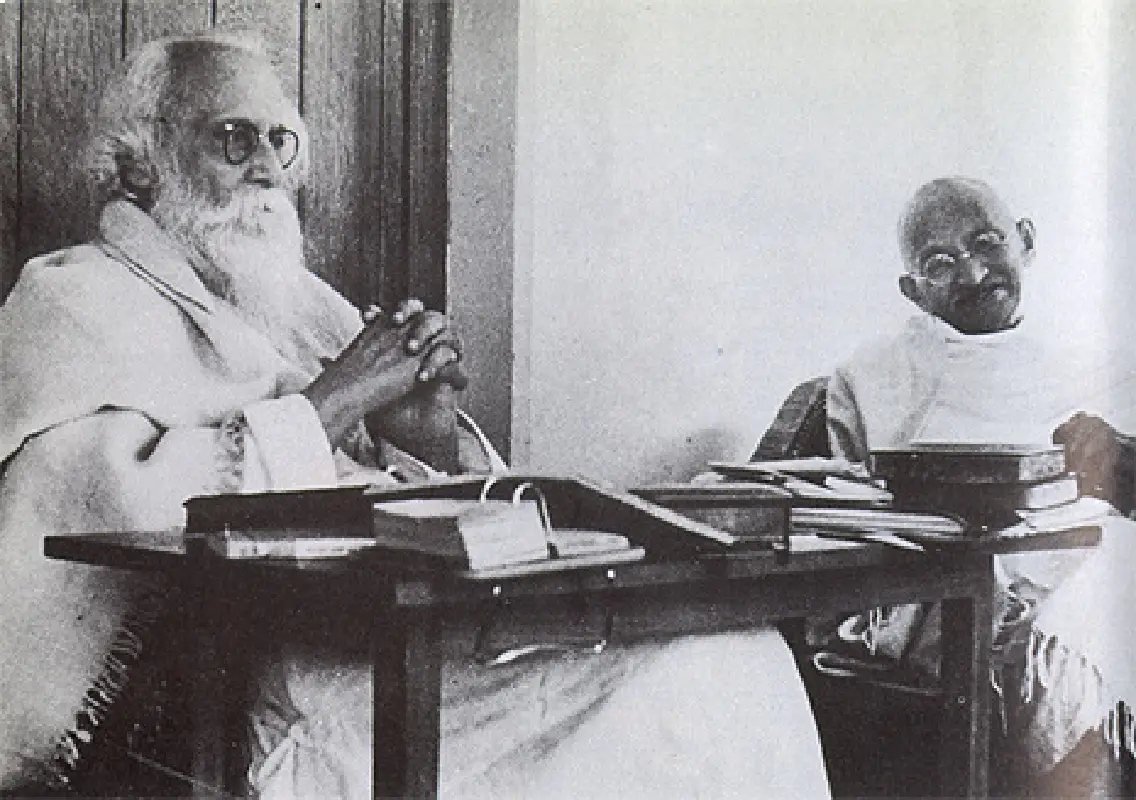


More than a century after Bankim Chandra Chatterjee first penned Vande Mataram, the song remains one of India’s most emotionally charged national symbols. While it stirred the imagination of the freedom movement and inspired generations of revolutionaries, it also triggered contestations that persist even today. Recent political statements—including Prime Minister Narendra Modi’s claim that “crucial verses” removed in 1937 sowed the “seeds of India’s division”—have once again brought the song, its origins, and its many interpretations back to the centre of public discourse. Understanding this history requires revisiting early 20th-century India, when nationalist aspirations collided with emerging communal anxieties.
Gandhi’s discomfort with slogans amid calls for unity
The debate began long before Independence. In 1920, during the Non Cooperation–Khilafat movement, MK Gandhi—then touring Madras—was struck by the irony of Hindu-Muslim unity being proclaimed while communities hurled “Vande Mataram” and “Allahu Akbar” at each other during riots. Gandhi felt that slogans meant to inspire became tools of provocation, revealing deep fractures within the society striving for freedom. For Muslims, Vande Mataram, derived from Bankim’s Anand Math, carried theological concerns. Its imagery of the motherland as a goddess—Durga, Lakshmi, or Saraswati—was perceived by some as incompatible with Islamic beliefs. This unease existed even within the Congress. Still, Gandhi, Jawaharlal Nehru, and Rajendra Prasad later endorsed Vande Mataram as the National Song, choosing only its first two stanzas due to their universal, non-idolatrous appeal.
The origins of Vande Mataram and the meaning of its early verses
Bankim Chandra Chatterjee first wrote the poem in 1875 during Akshaya Navami, drawing from Bengal’s landscape and the Shakti tradition. The original two stanzas, published in Bangadarshan, celebrated the natural beauty of the motherland—its waters, fields, and forests. These lines lacked militaristic or religious overtones and were embraced widely. Jawaharlal Nehru later described these verses as “tender” and “not offending the sentiments of any community.” Over subsequent years, Bankim expanded the poem to six stanzas, adding religious and martial imagery: a hundred-armed goddess, blazing fire, and divine weapons. These elements were influenced by the Sannyasi Rebellion and the broader struggle against colonial exploitation.
The song becomes a symbol of resistance
By 1886, Vande Mataram was sung at the Congress session for the first time, and by 1896, Rabindranath Tagore’s recital elevated it to national prominence. During the 1905 Swadeshi movement, it became the soundtrack of mass protests. Revolutionaries like Sri Aurobindo called it the “mantra of the new religion of patriotism.” Its widespread translation into several Indian languages helped cement it as the unofficial anthem of the freedom struggle. Yet alongside its growing popularity, tensions brewed. Historian Sabyasachi Bhattacharya documented early flashpoints, including communal clashes in East Bengal in 1906 where the slogan was used provocatively. In the following decades, these frictions intensified.
Why parts of the Muslim community opposed the song
From the 1920s onward, Indian politics saw sharper religious polarisation. The novel Anand Math, which depicted Hindu ascetics battling Muslim rulers, influenced perceptions of the song. By the 1930s, the Muslim League, led by Muhammad Ali Jinnah, strongly opposed its adoption as the national song. Jinnah argued that the Congress had turned it into “a hymn to spread hatred for Muslims.” Mohammad Ali Jauhar walked out of the 1923 Congress session when the song was sung. Over time, “Vande Mataram” acquired the reputation of a slogan used during communal confrontations, much like “Allahu Akbar” used by Muslim groups in retaliation. Gandhi repeatedly urged restraint, insisting that national symbols must be unifying rather than coercive.
Tagore’s intervention and the decision to adopt only two stanzas
By 1937, the issue needed resolution. Nehru sought Rabindranath Tagore’s advice. Tagore acknowledged the potential for hurt caused by the later stanzas but emphasised that the first two stood apart in tone and meaning. He wrote that these stanzas had “acquired a separate individuality and an inspiring significance” free of sectarian connotation. Following Tagore’s counsel, the Congress Working Committee—which included Gandhi, Nehru, Patel, Bose, Azad and Prasad—formally adopted Vande Mataram as the National Song, limited to its first two stanzas. This decision, recorded transparently, was not a “distortion,” contrary to later political claims. It was a deliberate effort to preserve unity while respecting diverse sentiments.
Political debate and the 1937 decision in contemporary context
In 2025, PM Modi argued that removing portions of the poem amounted to “severing the soul” of Vande Mataram. BJP spokespersons accused the Congress of altering the song for “appeasement.” Yet historical scholarship suggests the opposite: the exclusions were debated openly and motivated by a desire for harmony in a deeply polarised time. The rest of the poem was never banned; it remains intact in literary and cultural spheres. The division lay not in the words but in how slogans were employed during political strife. As Bhattacharya wrote, the song that united India also, at times, divided it.
Conclusion
Nearly 150 years after its composition, Vande Mataram is both a unifying hymn and a reminder of a history shaped by aspiration, resistance, and contestation. Its first two stanzas—enshrined in India’s official identity since 1950—continue to inspire millions. The broader debate over the full poem reflects not a distortion of heritage but the complex balancing act that shaped India’s national symbols. Ultimately, the power of Vande Mataram lies not in how many verses are sung, but in the spirit with which they are embraced.