







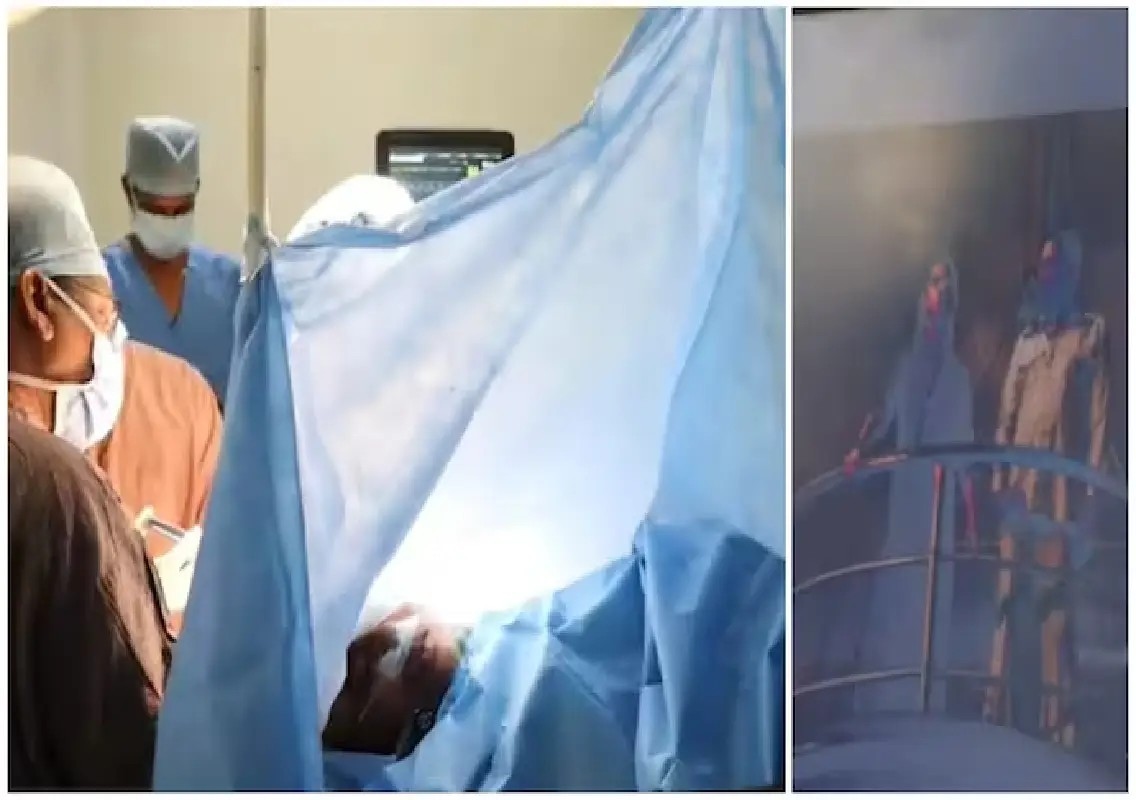


Guntur: In a remarkable blend of advanced medical care and patient-centred treatment, a 45-year-old woman remained awake and watched actor-politician Pawan Kalyan’s upcoming film OG while undergoing a complex brain tumour surgery at a hospital in Andhra Pradesh’s Guntur district.
The rare procedure was successfully performed at DVC Hospital and Research Centre in Vadlamudi village, where surgeons removed the tumour while the patient, Koteswaramma, remained conscious throughout the operation.
Tumour detected after seizures
Koteswaramma was admitted to the hospital after suffering episodes of unconsciousness and seizures.
Doctors conducted a series of medical examinations, including an MRI scan, which revealed a tumour located close to a critical area of the brain responsible for body movement and other essential neurological functions.
Given the tumour’s location, the medical team determined that conventional surgery carried a higher risk of affecting vital brain functions.
After evaluating the case, specialists decided to perform an Awake Craniotomy, a highly specialised neurosurgical procedure designed to minimise neurological damage during surgery.
Why doctors chose awake craniotomy
Awake Craniotomy is a procedure in which patients remain conscious during part of the surgery, allowing doctors to continuously monitor brain activity and neurological responses.
The technique is often used when tumours are located near areas of the brain that control speech, movement or other critical functions.
By interacting with the patient during the operation, surgeons can identify and preserve important brain regions while removing abnormal tissue.
Medical experts say the procedure significantly reduces the risk of long-term neurological complications in carefully selected cases.
Pawan Kalyan film played during surgery
Before the operation, doctors learnt that Koteswaramma was a devoted admirer of Pawan Kalyan.
To help her stay relaxed and comfortable during the surgery, the medical team arranged for OG to be played while the operation was underway.
As the film played, doctors regularly communicated with the patient, asking her to move her hands and legs and respond to simple instructions.
Her ability to respond helped surgeons continuously assess brain function in real time throughout the procedure.
The approach enabled the medical team to safely remove the tumour while ensuring that critical neurological functions remained unaffected.
Surgical team monitors patient throughout operation
During the surgery, doctors carefully observed Koteswaramma’s responses while carrying out the delicate procedure.
The continuous interaction allowed surgeons to identify any potential impact on movement or neurological activity immediately.
By maintaining direct communication with the patient, the team was able to navigate the complex operation with greater precision and confidence.
Medical professionals note that awake brain surgeries require extensive planning, coordination and patient cooperation to achieve successful outcomes.
Specialist team leads successful procedure
The surgery was led by neurosurgeon Dr Padmanabhuni Arun Kumar, who headed the team responsible for the highly specialised operation.
Hospital officials praised the efforts of the doctors and support staff involved in the procedure.
DVC Hospital and Research Centre Chairman Dhulipalla Narendra and Managing Director Dhulipalla Jyothirmayi congratulated the medical team for successfully carrying out the surgery and highlighted the institution’s commitment to advanced patient care.
The successful outcome has drawn attention to the growing adoption of sophisticated neurosurgical techniques in healthcare institutions across India.
Advanced healthcare with a personal touch
The case has also highlighted the importance of addressing a patient’s emotional comfort during complex medical procedures.
By incorporating something familiar and reassuring for the patient, the medical team helped create a calmer environment during a potentially stressful operation.
Healthcare professionals increasingly recognise that personalised care can play an important role in improving the overall patient experience and cooperation during treatment.
Conclusion
The successful awake brain tumour surgery performed on Koteswaramma stands as an example of modern neurosurgical expertise combined with compassionate patient care. With OG playing in the background and doctors monitoring her responses throughout the operation, the procedure demonstrated how advanced medical techniques can safely treat complex conditions while keeping patients comfortable and engaged.