







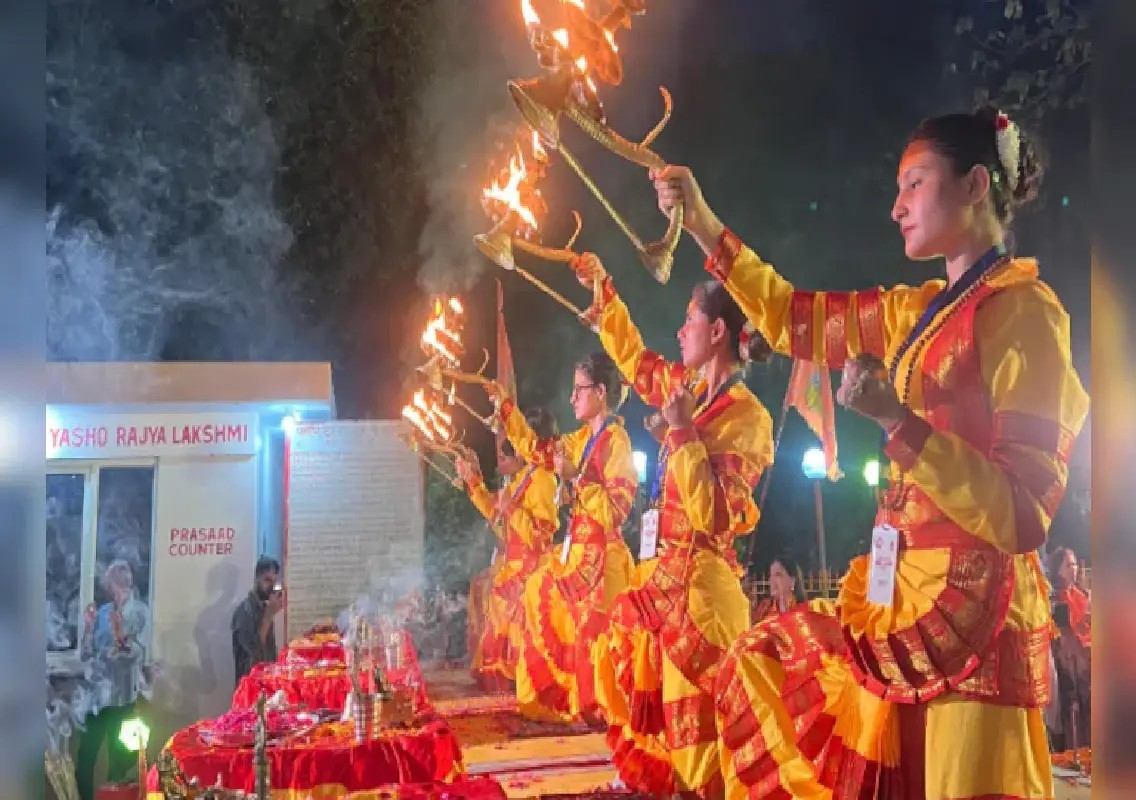


Jammu: In a landmark step towards greater inclusion in religious practices, women trainees have begun leading the evening aarti at the historic Raghunath Temple, breaking a centuries-old tradition that reserved priestly duties exclusively for men.
Dressed in saffron sarees and holding lamps during the ritual, the young women now chant hymns and perform aarti inside the temple’s sanctum sanctorum, marking a significant moment in the history of one of Jammu’s most revered temples.
Built in 1835, the temple has long been a symbol of faith and tradition. The latest development reflects a gradual transformation in how religious roles are viewed and assigned.
Initiative led by royal family member
The move was spearheaded by Kunwarani Ritu Singh, granddaughter-in-law of Maharaja Hari Singh, who played a key role in convincing stakeholders to support the inclusion of women in priestly training.
According to Ritu Singh, the initiative is aimed at promoting equality rather than replacing male priests.
She said the concept is rooted in the belief of Shiv and Shakti, where men and women are regarded as equal and complementary forces.
Questioning the exclusion of women from priestly roles, she pointed out that Hindu traditions already celebrate feminine divinity through practices such as Kanjak Puja and Devi Poojan.
Training programme gains momentum
The initiative began about a year ago with the training and induction of women into temple rituals traditionally performed by men.
Since then, participation has grown steadily.
According to Ritu Singh, around 150 girls are currently undergoing training, and the number is expected to increase further in the coming months.
The programme is designed not only to familiarise participants with daily temple rituals but also to prepare them for broader religious responsibilities.
Advanced training planned
Organisers are now preparing for the next phase of instruction, which will include training in conducting hawan ceremonies and reciting sacred mantras.
The goal is to enable the women to serve as pujarans in temples and religious institutions across the region.
Supporters of the initiative believe the programme will create new opportunities for women while preserving religious traditions through wider participation.
They describe it as a meaningful step towards empowerment within a cultural and spiritual framework.
Devotees welcome the change
The presence of women leading the aarti has received a positive response from many devotees visiting the temple.
Several worshippers described the experience as emotional and inspiring.
Devotee Mini Bagotra said she never imagined witnessing women leading the aarti during her lifetime and felt blessed to see the change unfold.
Another devotee, Rajni Sehgal, said the development was about more than performing rituals and represented a broader shift in who gets to carry forward religious traditions.
Blending tradition with inclusion
The initiative at Raghunath Temple is being viewed as an example of how religious institutions can embrace inclusion while maintaining their spiritual identity.
By training women to perform rituals traditionally reserved for men, the temple has opened a new chapter in its nearly two-century history.
As more women complete their training and take on religious responsibilities, supporters believe the programme could inspire similar initiatives at other temples across the country.
For many devotees, the sight of women leading prayers at one of Jammu’s most prominent temples symbolises both continuity and change within India’s rich religious traditions.