







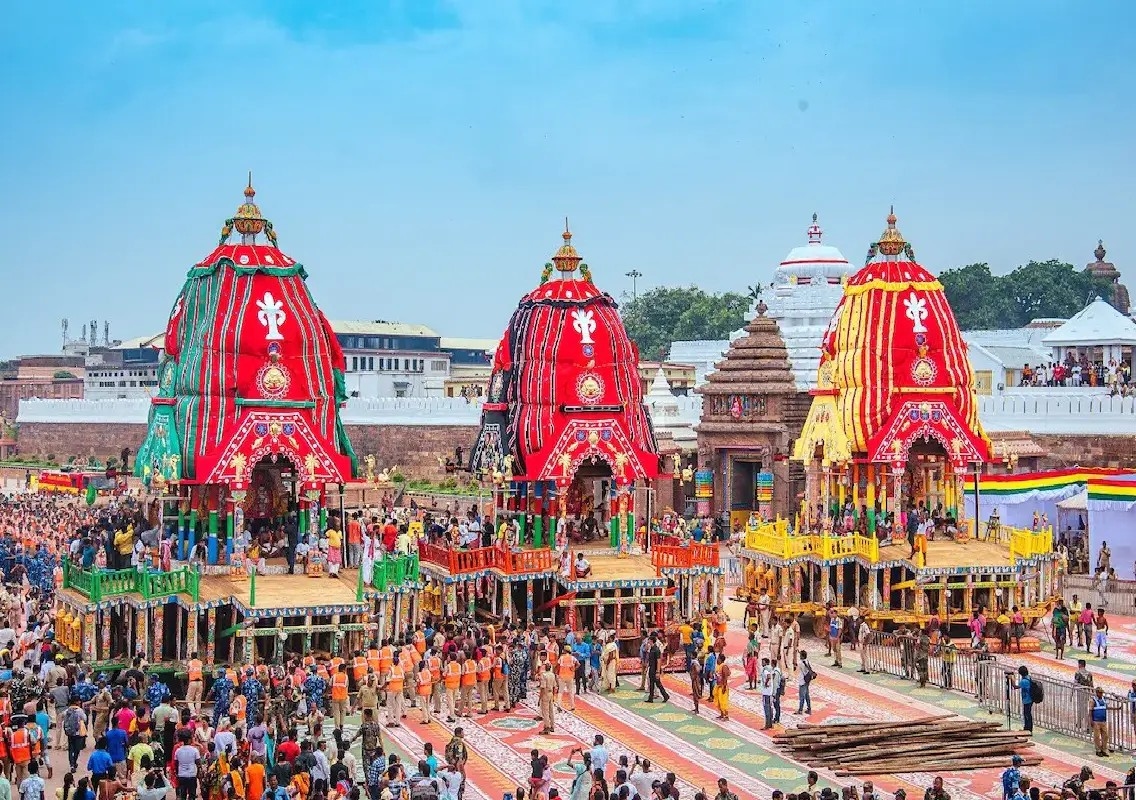


Bhubaneswar: While the Chhera Pahanra ritual at the Jagannath Temple in Puri is traditionally performed by the Gajapati Maharaja, three Jagannath temples in Odisha have preserved a unique hereditary custom where women from erstwhile royal families perform the sacred ritual in the absence of male heirs. The temples at Dharakote, Kujanga and Gadamadhupur continue to uphold this centuries-old tradition, reflecting the diversity of Odisha’s Jagannath culture.
Dharakote continues royal tradition
At the Jagannath Temple in Dharakote in Ganjam district, Princess Sulakhyana (Gitanjali) Devi has been performing the Chhera Pahanra ritual since 2010.
She succeeded her father, Raja Jayananda Jagadeva, as the head of the royal family after there was no male heir.
Along with assuming royal responsibilities, she also inherited the sacred duty of ceremonially sweeping Lord Jagannath’s chariot with the traditional golden broom during the annual Rath Yatra.
Women carry forward ritual at Kujanga
The Jagannath Temple at Kujanga in Jagatsinghpur district follows a similar hereditary practice.
In the absence of a male successor, women from the royal family have continued to perform Chhera Pahanra for several years.
For devotees in the region, the ritual is viewed as a continuation of hereditary responsibility rather than one determined by gender.
Queen leads ritual at Gadamadhupur
At Gadamadhupur in Jajpur district, Queen Aparna Dhir Singh Bharadwaj has been carrying out the Chhera Pahanra ritual since 2008.
She assumed the responsibility after succeeding her father as the head of the erstwhile royal family.
The Queen continues to perform the ceremonial service with devotion, preserving the traditions associated with the temple and her family.
A unique interpretation of tradition
Unlike the centuries-old custom at the Jagannath Temple in Puri, where the Chhera Pahanra ritual is performed exclusively by the Gajapati Maharaja, these three temples follow their own hereditary traditions.
In these temples, the responsibility of performing the ritual is entrusted to the rightful successor of the royal family, irrespective of whether the heir is a man or a woman.
The practice reflects the continuity of family traditions while recognising the role of women in preserving religious customs.
Spirit of devotion remains unchanged
Although the customs differ from those followed in Puri, the essence of Chhera Pahanra remains rooted in humility, devotion and selfless service to Lord Jagannath.
By entrusting the ritual to women successors when required, the temples at Dharakote, Kujanga and Gadamadhupur highlight the rich diversity of Odisha’s Jagannath traditions while preserving a unique cultural heritage that continues to inspire devotees across generations.