







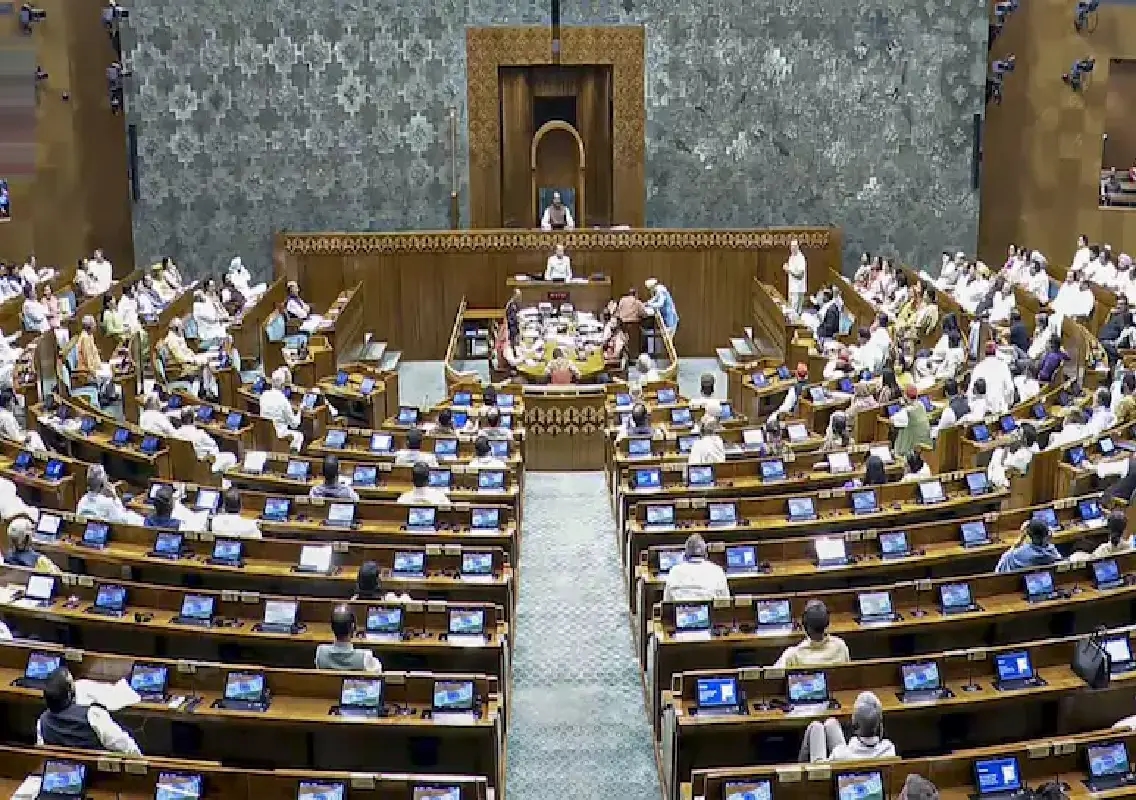


New Delhi: The Centre’s attempt to pass the Constitution (131st Amendment) Bill, 2026—linked to the Women’s Reservation framework—failed in the Lok Sabha on Friday after it fell short of the required two-thirds majority.
The bill secured 298 votes in favour and 230 against, missing the threshold needed for constitutional amendments. As a result, the legislation could not be passed, marking a major setback for the government’s push to implement 33% reservation for women in Parliament and state assemblies.
Linked bills not taken up
Following the failure of the primary bill, two other proposed legislations—relating to delimitation and increasing the number of Lok Sabha seats—were not put to vote.
Parliamentary Affairs Minister Kiren Rijiju stated that these bills were “intrinsically interrelated” with the women’s reservation amendment and could not proceed independently.
Government’s strong pitch
During the debate, Prime Minister Narendra Modi urged all parties to support the bill, emphasising its national importance.
“Let all of us not miss this important opportunity to give reservation to women. Do not see this from a political lens,” he appealed in the House.
Union Home Minister Amit Shah also assured members that the proposed increase in Lok Sabha seats—from 543 to around 816—would not adversely affect southern states’ representation.
The government maintained that the bill was aimed at empowering women and enhancing their participation in governance.
Opposition raises concerns
Leader of Opposition Rahul Gandhi strongly opposed the legislation, alleging that it was being used as a “smokescreen” to redraw India’s electoral map.
“This is not a women’s bill. It is an attempt to change the country’s electoral map using women as a cover,” he said during the debate.
Gandhi also raised concerns about the absence of a caste census component, claiming the move could dilute representation for Other Backward Classes (OBCs).
Congress MP Priyanka Gandhi Vadra echoed similar concerns, stating that linking women’s reservation to delimitation based on outdated census data was unacceptable.
Heated exchanges and political divide
The debate, which extended late into Thursday night and continued on Friday, saw sharp exchanges between the ruling party and the opposition.
While the government accused opposition parties of obstructing a historic reform, opposition leaders argued that the bill’s structure undermined constitutional principles and democratic balance.
Reactions after the vote
After the bill failed, Kiren Rijiju expressed regret, saying the opposition had “squandered” an opportunity to advance women’s representation.
Amit Shah criticised parties such as the Congress, Trinamool Congress, DMK, and Samajwadi Party, accusing them of blocking the bill and warning of political consequences.
He stated that women across the country would hold the opposition accountable in future elections.
Opposition claims victory
On the other hand, Rahul Gandhi described the outcome as a victory for democracy, asserting that the opposition had successfully resisted what he termed an “attack on the Constitution.”
He reiterated that the opposition would fully support the implementation of the original women’s reservation law passed in 2023, provided it was not linked to delimitation.
Gandhi also reached out to leaders within the INDIA alliance, including Trinamool Congress’s Abhishek Banerjee, acknowledging their role in defeating the bill.
Political implications ahead
The failure of the bill is expected to have significant political ramifications, especially with upcoming elections in key states. The issue of women’s reservation is likely to remain a major talking point in national politics.
Both the ruling party and the opposition are expected to take the debate to the electorate, framing the outcome in ways that align with their political narratives.
Conclusion
The defeat of the Women’s Reservation amendment bill in the Lok Sabha highlights deep political divisions over electoral reforms and representation. While the government has vowed to continue its efforts, the opposition has positioned the outcome as a safeguard for constitutional integrity. The issue is set to remain central in the run-up to future elections.