







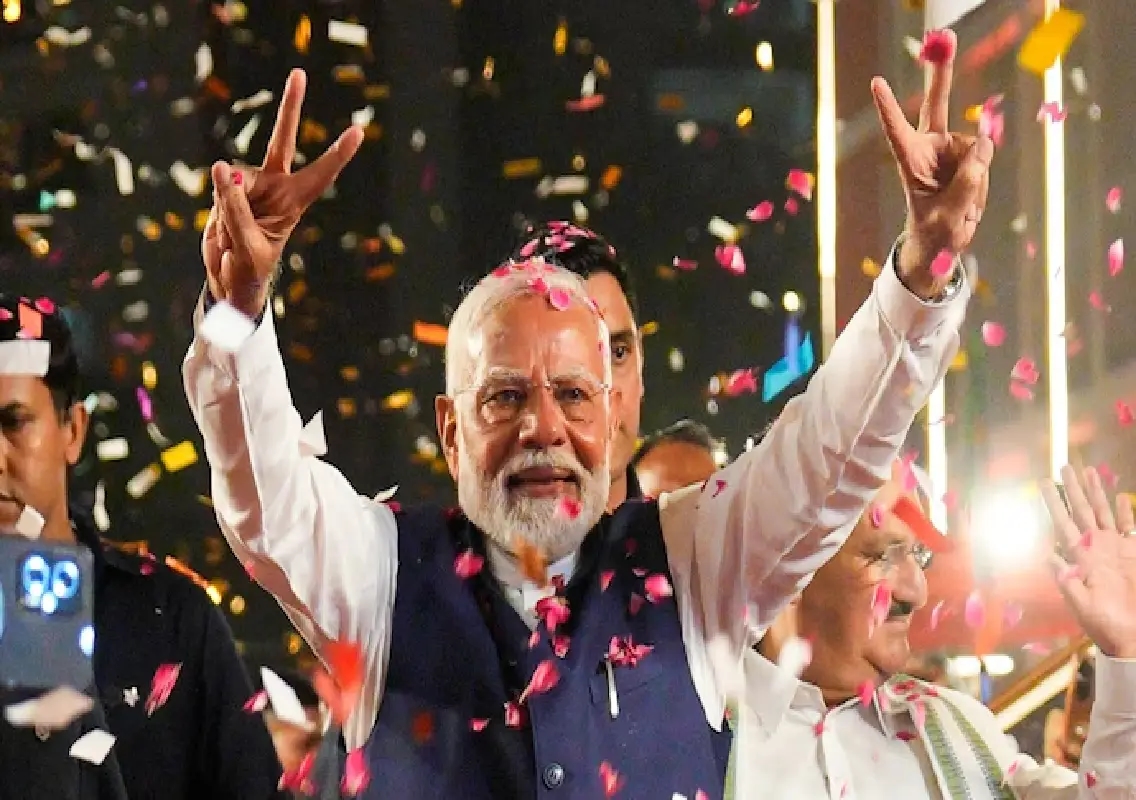


New Delhi: Prime Minister Narendra Modi has intensified the political pitch around women’s reservation, signalling that the debate over granting 33% quota in the Lok Sabha has evolved into a larger electoral and strategic battle ahead of the 2029 general elections.
Speaking in the Lok Sabha, Modi remarked, “Numbers ka game samay tay karega,” acknowledging the arithmetic challenge facing the government while underlining the political importance of the proposed reforms. The Bharatiya Janata Party (BJP) and its allies currently lack the two-thirds majority required to pass the set of three enabling bills linked to the women’s reservation framework.
Political gamble despite lack of majority
Despite the numerical disadvantage, the BJP appears determined to push forward with the legislation. Political observers note that the strategy offers a dual advantage: if the bills are passed, the government secures a landmark reform; if they fail, the party can shift the political narrative by holding the Opposition responsible for blocking women’s empowerment.
Modi’s remarks in Parliament reflected this approach. He warned Opposition parties that women voters may not forgive those perceived as opposing reservation, hinting that the issue could become a decisive factor during elections.
Historical context of women’s reservation
The debate over women’s reservation is not new. During the tenure of former Prime Minister Manmohan Singh, the UPA government attempted to introduce a similar bill in 2010. However, opposition from leaders like Mulayam Singh Yadav and Lalu Prasad Yadav stalled its progress.
The BJP is now seeking to revive and implement the long-pending reform, positioning itself as a champion of women’s political representation.
Opposition raises concerns over intent
Opposition leaders, however, have questioned both the timing and intent of the government’s move. Leader of Opposition Rahul Gandhi alleged that the proposed framework is less about women’s empowerment and more about altering the electoral landscape.
“This is not a women’s bill… it is an attempt to change the electoral map of India,” Rahul Gandhi said, expressing concerns over the linkage between reservation and delimitation.
Similarly, Priyanka Gandhi stated that while her party supports women’s reservation in principle, the current debate has shifted away from empowerment to broader political manoeuvring.
Her remarks, including a sharp comment likening the government’s strategy to political cunning, underscored the Opposition’s unease with the BJP’s approach.
Amit Shah escalates rhetoric
Union Home Minister Amit Shah further sharpened the political tone, accusing Opposition parties of denying women their rightful share in governance.
He warned that the electorate, particularly women voters, would respond strongly to any perceived obstruction when parties return to seek votes.
Regional parties wary of electoral impact
Regional parties, including the Trinamool Congress, have also expressed concerns. Leaders fear that the move could be aimed at consolidating women voters, especially in states like West Bengal where women-centric welfare schemes have played a key role in electoral outcomes.
Trinamool Congress MP Kakoli Ghosh Dastidar questioned the timing of the bills, pointing out that key states are heading into elections and suggesting that the initiative could be politically motivated.
Link to delimitation raises stakes
A critical aspect of the controversy is the linkage between the women’s reservation framework and the proposed delimitation exercise, which could alter the number and boundaries of parliamentary constituencies.
Opposition parties argue that this linkage changes the nature of the debate, transforming it from a social reform issue into a structural overhaul of India’s electoral system.
Strategic legislative move
The BJP’s decision to notify the Women’s Reservation Act 2023 has added another layer of complexity. According to Congress MP Manish Tewari, if the supporting bills fail, the notified Act could become ineffective.
This creates a high-stakes scenario where the success or failure of the legislation carries significant political consequences for both the government and the Opposition.
Women voters at the centre of politics
Women have emerged as a crucial voter base in recent elections, with parties increasingly focusing on targeted welfare schemes. The BJP has successfully leveraged such schemes in multiple states, strengthening its outreach among women voters.
Analysts believe that the current push for reservation could further consolidate this support, regardless of the legislative outcome.
Conclusion
The debate over women’s reservation has moved beyond policy into the realm of political strategy. While the government frames it as a historic step towards empowerment, the Opposition views it as a calculated move with electoral implications.
As Parliament deliberates on the bills, the outcome—whether passage or rejection—is likely to shape not just legislative history but also the political narrative leading up to the next general elections.