







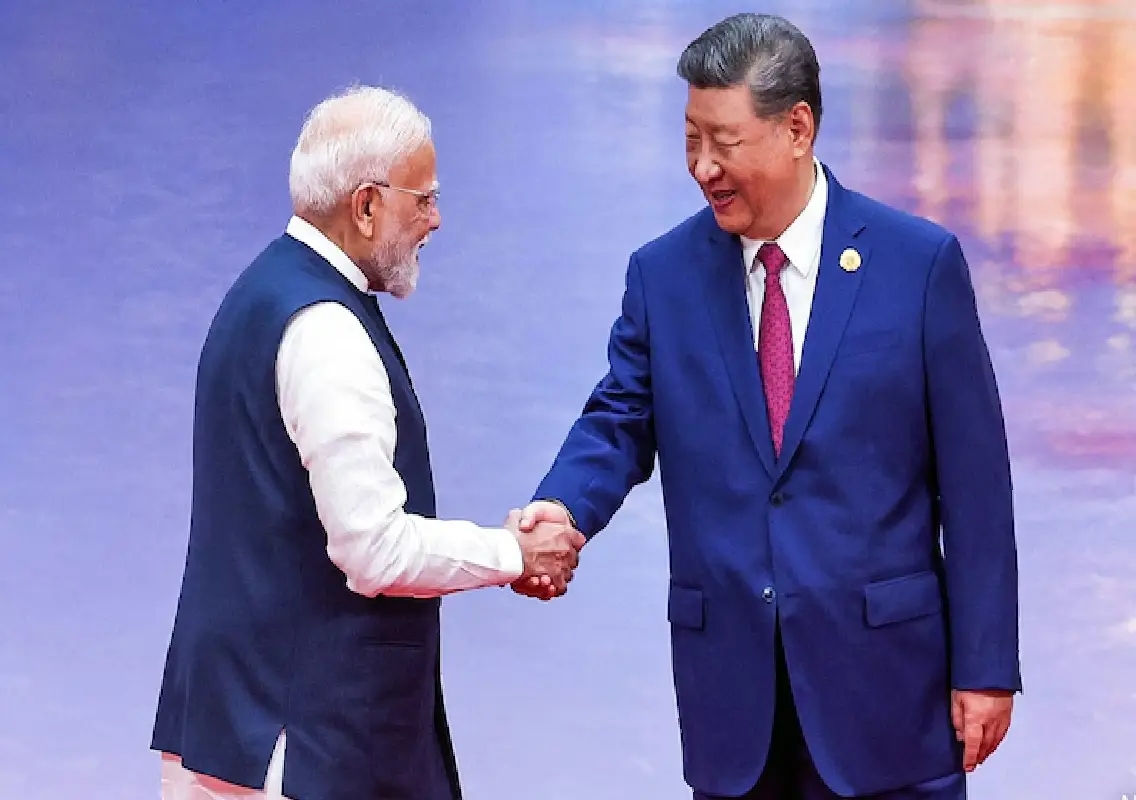


New Delhi: Chinese President Xi Jinping on Monday extended greetings to India on the occasion of its 77th Republic Day, describing India and China as “good neighbours, friends and partners” and stressing that stable and cooperative ties between the two countries are of great significance for global peace and prosperity.
In a message sent to President Droupadi Murmu, Xi said that over the past year, China-India relations have continued to improve and develop, according to China’s state-run Xinhua news agency. He emphasised that constructive engagement between the two Asian giants was not only beneficial to both countries but also vital for maintaining and promoting world peace and prosperity.
The Chinese President reiterated Beijing’s long-held view that the relationship between the two countries should be guided by mutual respect and cooperation. He used the metaphor of the “dragon and the elephant doing tango”, a phrase often employed by Chinese leaders to describe harmonious ties between the two nuclear-armed neighbours.
Emphasis on cooperation and dialogue
Xi said China believes that being “good neighbours, friends and partners” is the right choice for both sides. He expressed hope that India and China would continue to expand exchanges and cooperation across sectors, while also addressing each other’s concerns through dialogue to promote healthy and stable bilateral relations.
He added that sustained engagement and practical cooperation could help both countries manage differences and deepen mutual trust. According to Chinese officials, Beijing views improved relations with New Delhi as an important part of ensuring stability in the region and strengthening multilateral cooperation on global challenges.
The message comes at a time when both sides have taken cautious but visible steps to rebuild ties that were strained for several years following border tensions.
Background of strained relations
India-China relations came under severe strain after the Galwan Valley clash in eastern Ladakh in June 2020, in which 20 Indian soldiers and four Chinese soldiers were killed in violent hand-to-hand combat. The incident marked the most serious military confrontation between the two countries in decades.
Following the clash, both sides significantly reinforced their military presence along the 3,800-km-long Line of Actual Control (LAC), leading to prolonged standoffs at multiple friction points. Diplomatic and military talks were held regularly to disengage troops and prevent further escalation, but overall ties remained tense for nearly four years.
During this period, India imposed tighter scrutiny on Chinese investments and restricted several Chinese digital platforms on security grounds, while political engagement remained limited.
Gradual thaw since 2024
A noticeable improvement in ties began in 2024, when high-level bilateral contacts were resumed. A key moment in the thaw came in October 2024, when Xi Jinping met Prime Minister Narendra Modi on the sidelines of the BRICS Summit in Kazan, Russia. The meeting was seen as a reset effort, with both leaders agreeing to stabilise relations and maintain peace along the border.
Since then, India and China have engaged in sustained diplomatic dialogue and working-level talks to address pending issues. Confidence-building measures along the LAC have reportedly helped ease tensions at some friction points, though a comprehensive resolution remains a work in progress.
Officials from both sides have acknowledged that while differences persist, especially on the boundary question, relations are moving on a cautiously positive trajectory.
Economic and people-to-people engagement
As part of efforts to normalise ties, direct passenger flights between India and China were resumed in 2025 after a gap of nearly five years. The resumption was welcomed by business communities and students, as it facilitated travel, trade and educational exchanges.
Trade and investment flows have also seen a gradual uptick, despite ongoing strategic rivalry and global economic uncertainties. Analysts note that both countries recognise the importance of economic engagement, particularly in a changing global environment marked by geopolitical tensions and protectionist trends.
Chinese and Indian officials have indicated that cooperation in multilateral forums such as BRICS, the Shanghai Cooperation Organisation and the G20 remains an important pillar of the relationship.
Republic Day significance
India is celebrating its 77th Republic Day on Monday, marking the adoption of the Constitution of India, which came into force on January 26, 1950. The day symbolises the establishment of India as a sovereign, democratic republic and reflects the country’s commitment to justice, liberty, equality and fraternity.
Republic Day celebrations include a grand parade showcasing India’s military strength, cultural diversity and technological achievements, along with ceremonial events across the country.
Conclusion
Xi Jinping’s Republic Day message signals Beijing’s intent to sustain the recent momentum in India-China ties and underscores the shared responsibility of the two countries in shaping regional and global stability. While challenges rooted in history and strategic competition remain, continued dialogue, cooperation and mutual accommodation appear to be the preferred path forward for both sides as they navigate a complex geopolitical landscape.