







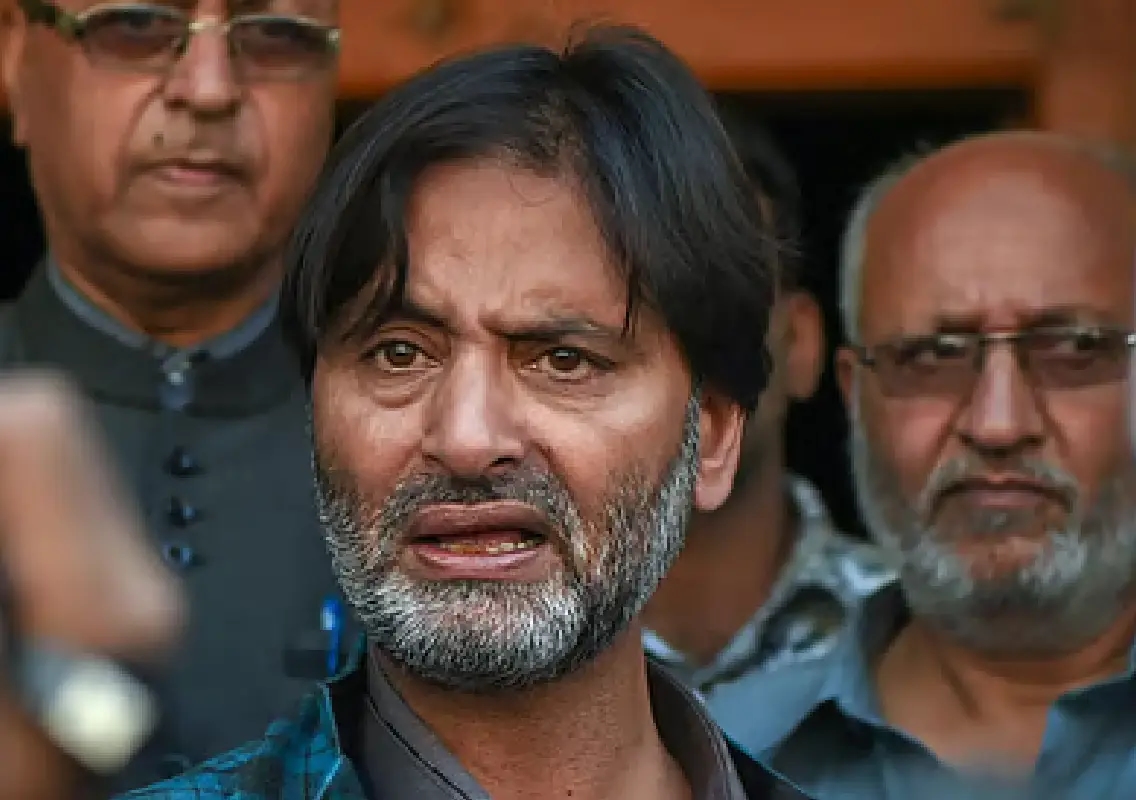


Separatist leader and Jammu and Kashmir Liberation Front (JKLF) chief Yasin Malik once pleaded for his life before Pakistan’s Inter-Services Intelligence (ISI) and terror outfit Lashkar-e-Taiba (LeT), intelligence sources have revealed. The episode, dating back to 2013, highlights the deep mistrust within Pakistan’s terror ecosystem during a turbulent phase of Kashmir’s separatist movement.
Plot to assassinate Malik in 2012
According to intelligence inputs accessed by NDTV, Lashkar operative Hilal Dar from Sopore had been assigned in 2012 to eliminate Malik. Acting under ISI’s instructions, Dar conducted a video reconnaissance of Malik’s residence at Maqbool Manzil in Srinagar’s Maisuma locality.
The plan was triggered after suspicions grew in Pakistan that Malik was secretly working with Indian agencies. The killing of Molvi Showkat, a close aide of Malik, in a bicycle IED blast had already fuelled Islamabad’s distrust of the JKLF leader.
Dar was later arrested in Srinagar in late 2012 after a Jammu and Kashmir Police tip-off. During interrogation, he confessed that ISI and Lashkar had jointly directed him to assassinate Malik, claiming the separatist leader was collaborating with India’s Intelligence Bureau.
Plea for mercy in 2013
The turning point came in 2013 after the hanging of Afzal Guru, convicted for the 2001 Parliament attack. Malik, who was in Pakistan at the time, led protests against India, joined by Lashkar founder Hafiz Saeed. Intelligence sources say Malik, fearing for his life, privately begged Saeed for mercy and promised never again to cooperate with Indian agencies. He assured the ISI that he would follow its orders faithfully.
Fallout of Malik’s Pakistan visit
Soon after Malik returned from Pakistan, the Indian government cancelled his passport, while his wife, Pakistani national Mushaal Malik, was denied a visa. Malik, alongside Syed Ali Shah Geelani and Mirwaiz Umar Farooq, later co-founded the Joint Resistance Leadership (JRL), which spearheaded mass protests, shutdowns, and stone-pelting campaigns across Kashmir. Schools were also targeted, pushing the Valley deeper into unrest.
Crackdown on separatists
In 2017, the National Investigation Agency (NIA) launched a major crackdown on separatist funding networks, arresting several leaders and operatives in Kashmir and Delhi. By 2019, the Centre banned the JKLF and Malik himself was arrested. He has since been lodged in Delhi’s Tihar Jail on terror funding charges.
A rare glimpse into separatist politics
The revelations offer a rare look into the vulnerability of one of Kashmir’s most prominent separatist figures, exposing the influence of Pakistan’s intelligence apparatus on the Valley’s long history of unrest. Malik’s desperate plea before Lashkar and the ISI underscores the fragile equations even among those aligned with Pakistan’s separatist agenda.