





Lucknow: Uttar Pradesh Chief Minister Yogi Adityanath has highlighted the expansion of the state’s cybersecurity and forensic science infrastructure since 2017, saying emerging technologies must serve public welfare, strengthen the justice system and create new opportunities for young people.
In a post on X on Saturday, ahead of his participation in TechSangam 2026 at the Uttar Pradesh State Institute of Forensic Science (UPSIFS) in Lucknow, Adityanath emphasised the importance of scientific research, modern technology and skilled human resources in addressing emerging challenges in cybersecurity and forensic investigations.
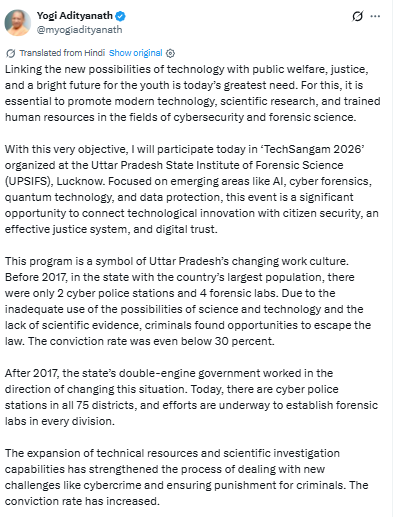
The Chief Minister said Uttar Pradesh had only two cyber police stations and four forensic laboratories before 2017. The state now has cyber police stations in all 75 districts, while efforts are underway to establish forensic laboratories in every division.
The expansion, according to Adityanath, reflects the state’s efforts to strengthen its capacity to investigate cybercrime, improve scientific evidence collection and respond to increasingly complex technological challenges.
He also referred to an improvement in the state’s conviction rate, which he said was below 30 per cent before 2017. However, he did not provide a current conviction rate or supporting figures in his post.
Uttar Pradesh expands cybersecurity infrastructure
Cybercrime has become a growing challenge for law enforcement agencies as more financial transactions, public services and personal interactions move online. Fraud involving digital payments, identity theft, phishing, account takeovers and other technology-enabled offences can require specialised investigative skills and digital evidence analysis.
The expansion of cyber police stations across all 75 districts is intended to strengthen the state’s ability to respond to such offences. Having dedicated police units at the district level can help bring specialised investigative resources closer to citizens and support coordination in cases involving digital platforms and electronic records.
The expansion of forensic science infrastructure is another part of this effort. Forensic laboratories can assist investigations by examining physical and digital evidence, depending on their facilities and areas of specialisation. Their work can help investigators establish facts and provide scientific material for consideration by courts.
Adityanath’s remarks place this infrastructure expansion within a broader effort to modernise policing and criminal investigations. The growing use of digital devices and online services has made technical expertise increasingly important for investigating offences and assessing the authenticity of electronic evidence.
However, the effectiveness of such infrastructure also depends on staffing, training, equipment, laboratory capacity and timely processing of evidence. The announcement of expanded facilities does not, by itself, establish how quickly investigations are completed or how much the new infrastructure has contributed to conviction rates.
AI and cyber forensics take centre stage at TechSangam 2026
TechSangam 2026 is expected to focus on several emerging technology areas, including artificial intelligence (AI), cyber forensics, quantum technology and data protection.
The event aims to bring together scientists, technical experts, policymakers, legal professionals and representatives of industry from India and abroad. Such interactions can provide a platform to discuss how technological advances can be applied to public services, security and the justice system.
AI is increasingly being explored across sectors, including cybersecurity, where it can help identify unusual patterns, analyse large volumes of information and support the detection of potential threats. At the same time, the use of AI in sensitive areas requires safeguards to address privacy, accuracy, accountability and the risk of incorrect conclusions.
Cyber forensics is another key area of discussion. It involves the identification, collection, preservation and examination of digital evidence from devices, networks and other electronic sources. Proper handling of such evidence is important because its integrity and reliability can affect the course of an investigation and its acceptance in legal proceedings.
Data protection is closely connected to these issues. As public and private institutions increasingly rely on digital systems, protecting personal information and preventing unauthorised access have become essential to maintaining public confidence in technology.
Quantum technology, meanwhile, is an emerging field with potential applications in computing, sensing and communications. Its long-term implications for cybersecurity, including the security of existing encryption systems, have made it an important subject for researchers and policymakers.
Adityanath said discussions on these subjects could encourage cooperation among research institutions, educational establishments, government agencies and industry. The objective, he indicated, is to connect technological innovation with citizen safety, stronger justice delivery and greater digital trust.
Scientific evidence and the justice system
The Chief Minister also linked the expansion of forensic capabilities with improvements in criminal investigations and the justice system.
Scientific evidence can play an important role in establishing facts in criminal cases, particularly when investigators need to examine digital records, verify documents or analyse other forms of evidence. Forensic analysis can support the investigation process, although the conclusions drawn from such evidence must be assessed alongside other material in a case.
The reliability of forensic evidence depends on appropriate collection procedures, trained personnel, validated methods and safeguards against contamination or tampering. Adequate laboratory capacity and coordination between investigators, forensic specialists and legal professionals are also important to ensure that evidence is examined and presented effectively.
Adityanath’s reference to the state’s conviction rate highlights the government’s stated emphasis on strengthening investigations. However, conviction rates are influenced by several factors, including the nature of cases, the quality of evidence, prosecution practices and judicial proceedings. Without comparable data and a clear time period, the precise contribution of forensic infrastructure to any change in conviction rates cannot be established.
The expansion of cyber police stations and forensic laboratories is therefore one part of a wider effort to improve the handling of technology-related offences and scientific evidence.
Technology investment could create opportunities for youth
Adityanath said the development of cybersecurity and forensic science capabilities could also create opportunities for young people in higher education, research and employment.
As government departments, businesses and individuals become more dependent on digital services, demand for expertise in cybersecurity, digital forensics, data protection and related fields is likely to remain an important consideration for education and workforce planning.
Universities, technical institutions and research centres can help prepare students for these areas by combining academic learning with practical training and industry exposure. Collaboration between such institutions and technology companies can also help students understand the requirements of emerging roles.
TechSangam 2026 could provide a forum for discussing these connections between research, education and employment. However, the scale of any future job creation will depend on investment, industry demand, training opportunities and the ability of institutions to develop relevant skills.
The Chief Minister stressed that technological progress should extend beyond innovation and deliver practical benefits to citizens. These include safer digital interactions, improved access to services and more effective systems for addressing cybercrime.
Linking Uttar Pradesh’s technology push with Viksit Bharat
Adityanath described TechSangam 2026 as part of Uttar Pradesh’s changing work culture and connected the state’s technology-related initiatives with the broader goals of self-reliance and national development.
The event’s focus on cybersecurity, AI, quantum technology and data protection reflects areas in which governments, research institutions and businesses are seeking to strengthen domestic capabilities. Building expertise in these fields can support the development of technology solutions suited to India’s requirements while reducing dependence on external systems in selected areas.
The Chief Minister said collaboration among scientists, policymakers, academia and industry could contribute to the government’s Viksit Bharat vision through Aatmanirbhar Bharat, which emphasises self-reliance.
For Uttar Pradesh, the expansion of cyber police stations and forensic facilities represents a significant change in the scale of its stated technological infrastructure since 2017. The next challenge will be to ensure that these resources are adequately staffed, accessible and equipped to deliver timely results.
As TechSangam 2026 brings emerging technologies and public-sector priorities into focus, the central question will be how research and infrastructure can translate into measurable improvements in citizen safety, evidence-based investigations and employment opportunities for young people.