







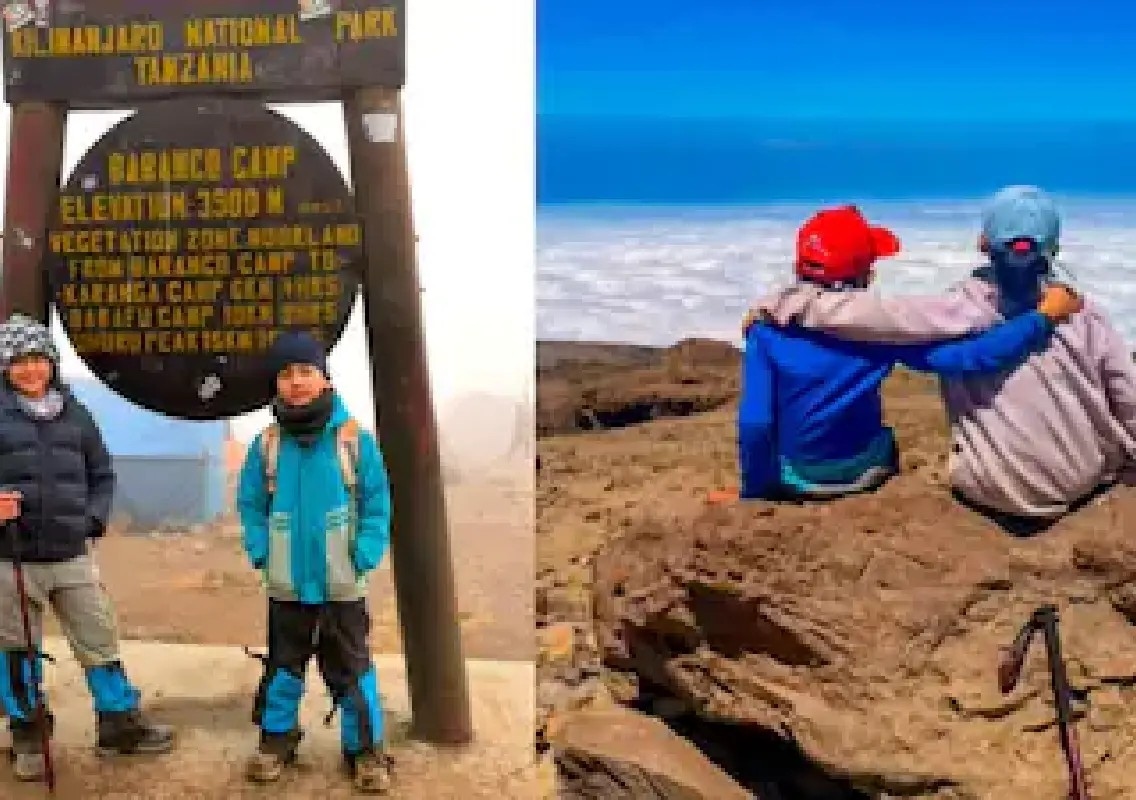


Uttarakhand: Two children from Uttarakhand have achieved a remarkable mountaineering feat after nine-year-old Reyansh Pant and 10-year-old Prisha Rawat successfully reached the summit of Mount Kilimanjaro, Africa’s highest mountain.
The young trekkers became the youngest climbers from Uttarakhand to accomplish the feat, completing a demanding high-altitude expedition that tested their endurance, determination and ability to cope with changing terrain.
Standing at 5,895 metres above sea level, Mount Kilimanjaro is the highest mountain in Africa. Although it does not require technical climbing on the commonly used routes, reaching its summit presents a significant physical and mental challenge because of the altitude, long trekking hours and rapidly changing environmental conditions.
For Reyansh and Prisha, the achievement came at an age when most children are occupied with school, sports and other everyday activities. Their successful expedition has drawn attention to the possibilities of introducing children to outdoor challenges while developing discipline, confidence and resilience.
Journey began through rainforest
According to Trek The Himalayas, which organised the expedition, the group began its climb on August 16.
The initial section of the trek took the participants through rainforest, providing a very different environment from the higher reaches of the mountain.
As the group gained altitude, the landscape gradually changed. The trekkers moved from dense vegetation into open moorlands and subsequently into high-altitude desert terrain.
The changing surroundings formed part of the challenge of climbing Kilimanjaro. Unlike a conventional trek at a relatively consistent elevation, an ascent of the mountain exposes trekkers to substantially different climatic and geographical conditions during the journey.
For the young climbers, maintaining their pace and stamina through these stages would have been essential to completing the expedition successfully.
Summit reached at 5,895 metres
The biggest milestone came on August 24, when Reyansh and Prisha reached Uhuru Peak, the highest point of Mount Kilimanjaro.
At an elevation of 5,895 metres, Uhuru Peak is also the highest point in Africa.
The summit represents the culmination of several days of trekking and is generally considered the most demanding stage of a Kilimanjaro expedition because of the altitude and physical exhaustion accumulated during the climb.
By reaching the summit, the two children completed a journey that had begun in the mountain’s lower rainforest and progressed through several distinct ecological zones.
Their accomplishment was part of an expedition involving 11 trekkers.
Kilimanjaro offers changing landscapes
Mount Kilimanjaro is distinctive not only because it is Africa’s highest mountain but also because of the dramatic changes in landscape encountered during an ascent.
The mountain is a giant dormant volcano rising above the surrounding plains of Tanzania.
Lower sections are characterised by vegetation and rainforest, while higher elevations become progressively colder and more barren.
The route described by the trekking group included rainforest, moorland and high-altitude desert before reaching the rocky and volcanic upper sections.
Near the summit, trekkers encounter a landscape shaped by volcanic rock and glaciers on the mountain’s upper slopes.
The transformation in terrain makes the climb both physically demanding and visually striking.
Mental strength as important as endurance
Climbing a high mountain is not simply a test of physical fitness. Long days of walking, altitude, cold temperatures and the psychological pressure of reaching the summit can all affect trekkers.
For children as young as Reyansh and Prisha, the expedition required persistence and careful attention to the demands of the trek.
The climb therefore represented more than reaching a geographical point.
The experience required them to continue moving forward despite fatigue and unfamiliar surroundings, making mental resilience an important part of the achievement.
Their success demonstrates the value of preparation and determination when attempting demanding outdoor challenges.
Youngest climbers from Uttarakhand
The expedition has given Reyansh and Prisha a special place among young mountaineering achievers from Uttarakhand.
The state has a strong association with mountaineering and trekking because of its Himalayan geography. It has produced and inspired generations of climbers and outdoor enthusiasts.
Against this backdrop, the achievement of two young residents adds another noteworthy chapter to the state’s mountaineering culture.
Their ages make the accomplishment particularly striking. Reyansh is nine, while Prisha is 10.
The feat also demonstrates how young people from India’s mountain states are increasingly participating in adventure activities beyond the Himalayas.
An achievement beyond age
The successful summit has also highlighted the role of age in setting personal goals.
While high-altitude mountaineering requires appropriate preparation, supervision and attention to safety, young adventurers can develop valuable qualities through structured outdoor experiences.
Trekking can encourage patience, teamwork and problem-solving while helping participants understand the importance of preparation and respect for nature.
For Reyansh and Prisha, the Kilimanjaro expedition provided an opportunity to experience an international mountain environment and test themselves against a demanding challenge.
Their achievement may also encourage other children to develop an interest in trekking and outdoor activities, provided such participation is undertaken with appropriate preparation and expert guidance.
Previous young achiever reached Kilimanjaro at five
The achievement does not mean Reyansh and Prisha are the youngest people ever to climb Mount Kilimanjaro.
A five-year-old boy from Punjab, Teghbir Singh, previously climbed Kilimanjaro in 2024 and was reported to have become the youngest Asian to achieve the feat.
Teghbir began his expedition on August 18, 2024, and reached Uhuru Peak on August 23, according to a Hindustan Times report cited by NDTV.
The earlier achievement places the Uttarakhand children’s accomplishment in a wider context of young Indian trekkers taking on major international mountain challenges.
However, Reyansh and Prisha’s achievement is significant because they have been identified as the youngest climbers from Uttarakhand to summit the African peak.
Expedition combines adventure and learning
For young participants, an expedition such as this can provide lessons that go beyond the physical achievement of reaching a summit.
The changing landscape of Kilimanjaro offers an opportunity to understand geography, climate and ecosystems in a practical setting.
The children also experienced the discipline required to follow a multi-day expedition schedule and remain committed to a common objective.
Being part of an 11-member group would have further exposed them to the importance of teamwork and cooperation in a challenging environment.
Such experiences can help children understand that major achievements are often built through smaller stages of preparation, persistence and collective effort.
A memorable milestone for Uttarakhand
Reaching Uhuru Peak on August 24 marked the culmination of the young trekkers’ journey.
From the rainforest at the start of the expedition to the rocky volcanic terrain near the summit, Reyansh and Prisha crossed several distinct landscapes before standing at Africa’s highest point.
Their achievement has brought attention to Uttarakhand’s young adventure enthusiasts and could inspire other children to explore outdoor activities and set ambitious personal goals.
At the same time, the feat serves as a reminder that high-altitude expeditions require careful planning, appropriate supervision and an understanding of the risks associated with mountain environments.
For Reyansh Pant and Prisha Rawat, however, the successful ascent is now a memorable milestone achieved well before their teenage years.
Their journey to 5,895 metres demonstrates the determination of two young trekkers who were willing to step outside their familiar surroundings and take on one of Africa’s most recognisable mountains.
As they return from the expedition, their Kilimanjaro achievement is likely to remain an early and inspiring chapter in what could become a lifelong connection with adventure, exploration and the outdoors.