







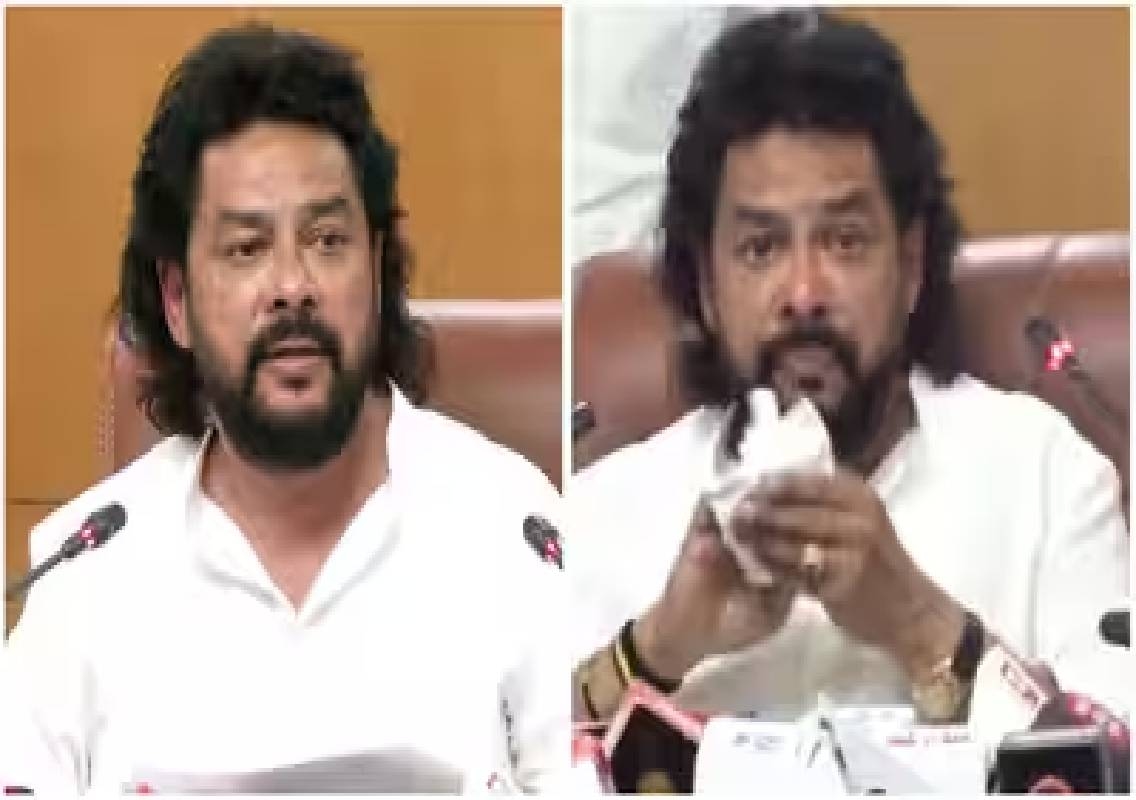


Bengaluru: Karnataka minister B. Nagendra has resigned from the State Cabinet for the second time in two years, with the same controversy surrounding the alleged irregularities in the Karnataka Maharshi Valmiki Scheduled Tribes Development Corporation. His latest resignation came amid sustained pressure from the Opposition over the case.
Nagendra, who had returned to the Cabinet earlier this month after being inducted into Deputy Chief Minister D.K. Shivakumar’s government, announced his resignation on Friday. He became emotional while making the announcement and maintained that he had been unfairly targeted.
His resignation has once again brought the Valmiki Corporation case to the centre of Karnataka’s political debate. The alleged financial irregularities, first reported in 2024, had already forced Nagendra to leave the Cabinet during the previous Siddaramaiah-led government.
Nagendra resigns for the second time
Nagendra’s latest resignation is significant because of its timing. He had only recently returned to the Karnataka Cabinet and had been given the Planning and Statistics portfolio under D.K. Shivakumar.
His re-induction had triggered strong criticism from the BJP and JD(S), which questioned the decision to bring him back despite the continuing controversy surrounding the Valmiki Corporation case. The Opposition repeatedly demanded his removal from the Cabinet and intensified its protests during the State legislature’s proceedings.
The pressure eventually culminated in Nagendra announcing his resignation.
The Congress leader has denied wrongdoing and has maintained that the allegations against him are politically motivated.
What is the Valmiki Corporation case?
The controversy centres on the Karnataka Maharshi Valmiki Scheduled Tribes Development Corporation, an organisation intended to support the economic development of members of Scheduled Tribe communities.
The issue came to light in May 2024 after the corporation’s accounts superintendent, P. Chandrasekharan, died by suicide. A note attributed to him alleged unauthorised transfers of funds from the corporation’s accounts.
Subsequent investigations found that large amounts of money had been transferred from the corporation’s accounts to other accounts, triggering a major political and legal controversy.
The Opposition subsequently accused the then Congress government and its ministers of failing to prevent the alleged financial irregularities.
Rs 89 crore allegation dominates politics
The BJP has repeatedly referred to alleged irregularities involving around Rs 89 crore in connection with the corporation.
The issue became a major political weapon against the Congress government, with the BJP demanding accountability from those responsible for the alleged diversion of funds.
Different investigations and reports have referred to varying amounts in connection with the broader case, but the Rs 89-crore figure has remained central to the current political debate.
The Opposition has argued that Nagendra’s return to the Cabinet was inappropriate while the controversy remained unresolved.
Nagendra had resigned in 2024
This is not the first time the controversy has cost Nagendra his ministerial position.
In June 2024, Nagendra resigned from the Cabinet following allegations linked to the Valmiki Corporation’s financial irregularities.
At that time, he was serving as the Minister for Youth Services and Sports and also held the Scheduled Tribes Welfare portfolio.
His resignation was followed by investigations into the alleged diversion of corporation funds.
The controversy subsequently developed into a wider money-laundering investigation, with the Enforcement Directorate also examining the case.
Return to Cabinet sparks Opposition anger
After leaving the Cabinet in 2024, Nagendra remained politically active and continued to represent Ballari Rural.
His return to the State Cabinet in August 2026 was therefore closely watched.
However, the BJP immediately renewed its attacks on the Congress government, arguing that the same allegations that had earlier resulted in Nagendra’s resignation had not disappeared.
The Opposition intensified its campaign and demanded that the government reverse the decision to re-induct him.
The issue eventually became one of the major points of confrontation during the Karnataka legislature’s monsoon session.
BJP had stepped up protests
The BJP’s campaign against Nagendra had intensified in the days before his resignation.
On August 24, senior BJP leaders, including State BJP president B.Y. Vijayendra and Leader of the Opposition R. Ashoka, were detained while attempting to march towards Vidhana Soudha in Bengaluru.
The protest was aimed at demanding Nagendra’s removal over the Valmiki Corporation case.
The Opposition also threatened further protests inside the legislature.
The continuing political pressure made Nagendra’s position increasingly difficult despite his return to the Cabinet only weeks earlier.
Nagendra says he was targeted
While announcing his resignation, Nagendra maintained that he was being targeted.
He has consistently denied involvement in the alleged financial wrongdoing and has argued that political opponents were using the case against him.
Reports from his resignation announcement said he became emotional while addressing the media.
His supporters have also described the renewed controversy as politically motivated.
The Congress leadership, meanwhile, has indicated support for Nagendra and said the party would stand by him.
Same controversy, two resignations
Nagendra’s political situation is unusual because the same case has now resulted in his departure from two Cabinets.
His first resignation came under the Siddaramaiah government in 2024.
His second resignation has come after his return under the government led by D.K. Shivakumar.
This has made the Valmiki Corporation case one of the most persistent controversies of Nagendra’s political career.
It has also raised questions about the political consequences of ongoing corruption allegations even when a minister denies wrongdoing.
Investigation remains important
The political controversy is closely linked to the ongoing legal investigations into the alleged financial irregularities.
The initial allegations emerged after the death of Chandrasekharan, who was working as an accounts officer at the corporation.
Investigators subsequently examined the movement of funds and the role of officials and other individuals connected to the corporation.
The case has involved multiple agencies and arrests, making it considerably broader than a political dispute over one minister.
Nagendra’s resignation does not itself determine guilt or innocence.
The allegations will ultimately have to be established through the legal process.
Opposition says resignation is a victory
The BJP has presented Nagendra’s resignation as a result of its sustained campaign.
The Opposition had repeatedly demanded that he be removed from the Cabinet, arguing that his continuation in government undermined public confidence.
With Nagendra now stepping down, BJP leaders have described the development as a political victory.
However, BJP State president B.Y. Vijayendra has also argued that Nagendra is only a “small fish” in the alleged scam and that larger questions surrounding the case remain unanswered.
Questions remain for the Congress government
Nagendra’s resignation also creates questions for the Congress government.
The minister had only recently been brought back into the Cabinet, making his second exit particularly embarrassing for the administration.
The Government will now have to respond to Opposition demands for greater accountability while dealing with the continuing legal proceedings.
The episode may also fuel renewed political debate over the government’s decision to re-induct Nagendra despite the unresolved controversy.
Impact on D.K. Shivakumar’s Cabinet
The resignation comes at a politically sensitive time for D.K. Shivakumar, who recently took over as Karnataka Chief Minister.
Shivakumar’s Cabinet has already faced criticism over ministerial portfolios and internal political disagreements.
Nagendra’s departure adds another challenge for the new administration.
The Chief Minister will now have to manage the vacant portfolio while also responding to the Opposition’s continuing attacks over the Valmiki case.
Nagendra’s political future
Despite resigning from the Cabinet, Nagendra remains an elected MLA.
His resignation from the ministerial post does not mean that he has automatically lost his Assembly membership.
The political future of the Ballari Rural legislator will depend partly on how the legal proceedings develop and how the Congress leadership responds to the continuing controversy.
For now, his immediate position is that of a legislator outside the State Cabinet.
A setback for the government
The resignation also represents a setback for the government’s attempt to move beyond the Valmiki Corporation controversy.
The decision to bring Nagendra back into the Cabinet had indicated that the Congress leadership was prepared to give him another opportunity in government.
His resignation within weeks of returning shows that the controversy remained politically potent.
The BJP’s sustained campaign ensured that the issue continued to dominate discussions in the State legislature and public sphere.
The larger issue of accountability
Beyond Nagendra’s individual political position, the case has raised broader questions about financial controls within government-run corporations.
Development corporations are responsible for implementing welfare and economic programmes for specific communities.
Any alleged diversion of funds can therefore have consequences for the intended beneficiaries.
The case has increased calls for stronger financial oversight, transparent procedures and greater accountability within such institutions.
What happens next?
The legal proceedings related to the alleged financial irregularities are expected to continue.
Investigating agencies will determine the role of different individuals based on the evidence collected.
Nagendra’s resignation may reduce some of the immediate political pressure on the Congress government, but it is unlikely to end the controversy.
The BJP and JD(S) are expected to continue raising questions about the alleged financial irregularities and demanding accountability from the government.
Conclusion
Bengaluru: B. Nagendra has resigned from the Karnataka Cabinet for the second time in two years, once again amid controversy surrounding the alleged irregularities in the Valmiki Scheduled Tribes Development Corporation.
Nagendra had returned to the Cabinet earlier in August under Chief Minister D.K. Shivakumar but faced renewed pressure from the BJP over the same case that had forced him to resign in 2024.
The controversy began after the death of corporation accounts superintendent P. Chandrasekharan and allegations of unauthorised fund transfers. The BJP has repeatedly cited alleged irregularities of around Rs 89 crore and demanded Nagendra’s removal.
Nagendra has denied wrongdoing and said he was being politically targeted. His latest resignation may temporarily ease pressure on the Congress government, but the legal and political questions surrounding the Valmiki Corporation case are likely to continue.