







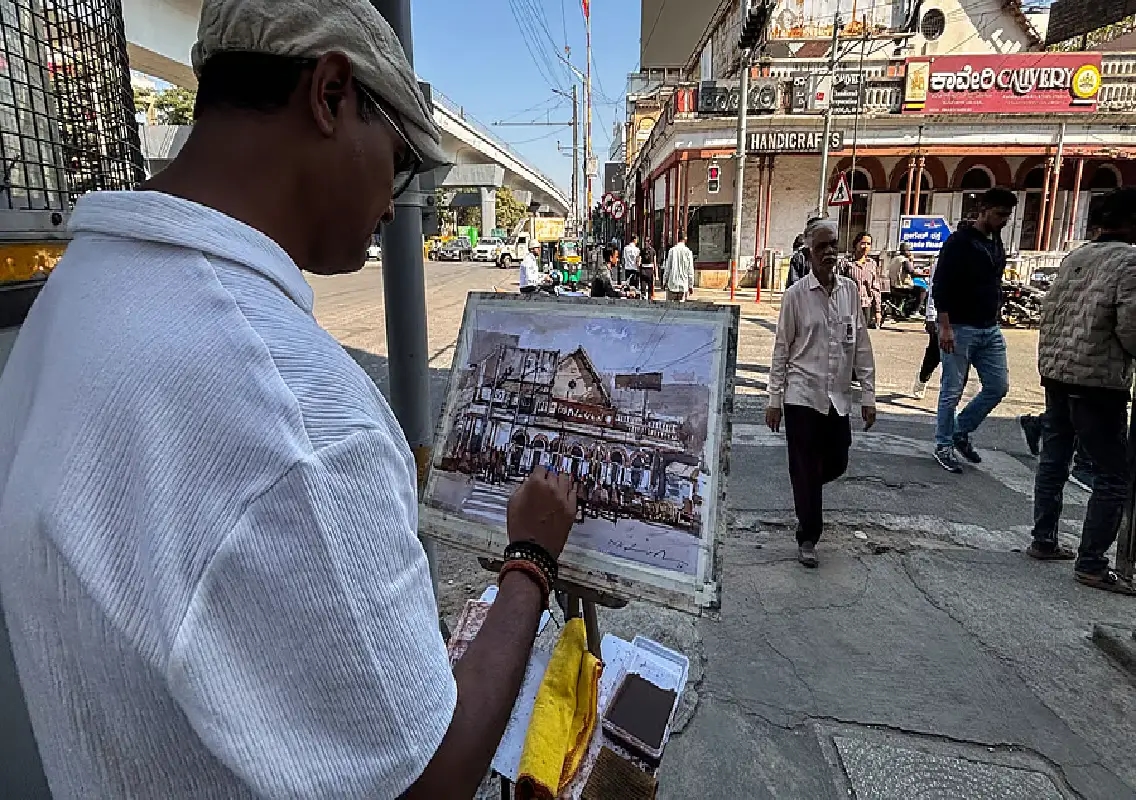


Bengaluru: Amid honking vehicles, rushing crowds and the constant churn of urban life, a 46-year-old artist has been quietly documenting the city’s iconic buildings and everyday spaces using nothing more than watercolours, paper and patience. Nitin Singh, a former IT designer, has been capturing Bengaluru’s architectural and cultural essence through on-the-spot watercolour paintings, turning busy street corners into living canvases.
On a weekday afternoon, Singh was recently spotted at the bustling M G Road–Brigade Road junction, painting the century-old Cauvery Emporium. Seated beside a tall easel, he worked on a 15×22 inch cotton-based cold-press watercolour sheet, attempting to absorb and reflect the character of the space as it unfolded around him. With no digital tools, filters or artificial intelligence involved, Singh relied solely on watercolours to translate the chaos, colour and rhythm of the city onto paper.
From fine arts to IT and back to art
A graduate of fine arts from Patna University in 2003, Singh moved to Bengaluru soon after to pursue a professional career. Like many artists navigating practical realities, he found work as a designer in the IT sector. Despite long working hours, he continued to paint almost every day, holding on to his artistic practice alongside a demanding corporate routine.
In 2025, after years of balancing two worlds, Singh took a decisive step and quit his IT job. “Now I am free,” he said, describing the shift not as an escape but as a conscious choice to reconnect fully with art. “I take things one day at a time. Typically, I try to paint one location in a day and on the spot. I want to capture the environment and immerse myself in the essence of the place.”
For Singh, painting outdoors is essential. He believes the sounds, smells and movement of a location seep into the artwork, lending it an energy that studio work cannot replicate. “That reflects in the painting and it looks lively,” he said.
Loose strokes and lived-in spaces
Stylistically, Singh draws inspiration from impressionist masters such as Claude Monet and Edgar Degas. His approach favours loose, fluid strokes and minimal detailing rather than photographic realism. The emphasis is on mood, movement and memory rather than architectural precision.
One of his notable works depicts K R Market, one of the city’s oldest and most vibrant trading hubs. The painting captures the chaos of the market through bold red and yellow strokes representing flowers, vegetable baskets placed against colonial arches, and the implied hum of vendors calling out to customers. Singh typically spends two to three hours on each piece, allowing instinct and observation to guide his brush.
Overcoming the fear of public gaze
Painting in public spaces has not always been easy. Singh admitted that he initially struggled with self-consciousness while working outdoors. “I feel so judged when I’m painting,” he said, recalling how passersby would whisper and wonder why someone was painting in the middle of a busy street.
Earlier, the awareness of public attention made him freeze. Over time, however, he learned to overcome the discomfort by fully immersing himself in the process. “I cut the distraction mentally, commit to what’s in front of me. The interaction with people is part of the experience,” he explained. He now views the surrounding chaos not as a hindrance but as fuel for creativity.
Preserving stories amid rapid change
At the heart of Singh’s work lies a deeper mission — storytelling and preservation. As Bengaluru undergoes rapid development, many historic buildings and familiar neighbourhood spaces are being altered or erased. Through his paintings, Singh hopes to document these sites and introduce their stories to those unfamiliar with them.
He has set himself an ambitious goal of painting 100 historic buildings in the city as part of his ongoing project titled India on My Easel. Beyond architecture, he also plans to focus on the people who inhabit these spaces — vendors, commuters and everyday city dwellers who give life to these locations.
Recognition beyond the city
Singh’s work has begun to gain recognition beyond Bengaluru as well. One of his recent works, When We Parted, has been selected to be showcased at London’s Royal Watercolour Society this year. The piece, inspired by the tragic train journeys during the Partition, is rendered in fiery reds and adopts a modern abstract style, marking a departure from his cityscapes while retaining emotional intensity.
Conclusion
By choosing watercolours and working directly within the city’s streets, Nitin Singh is quietly archiving Bengaluru’s evolving identity. His paintings stand as visual narratives of spaces caught between history and change, inviting viewers to pause, observe and reconnect with the city beyond its traffic and technology. In doing so, Singh is not just painting buildings — he is preserving memories before they fade.