







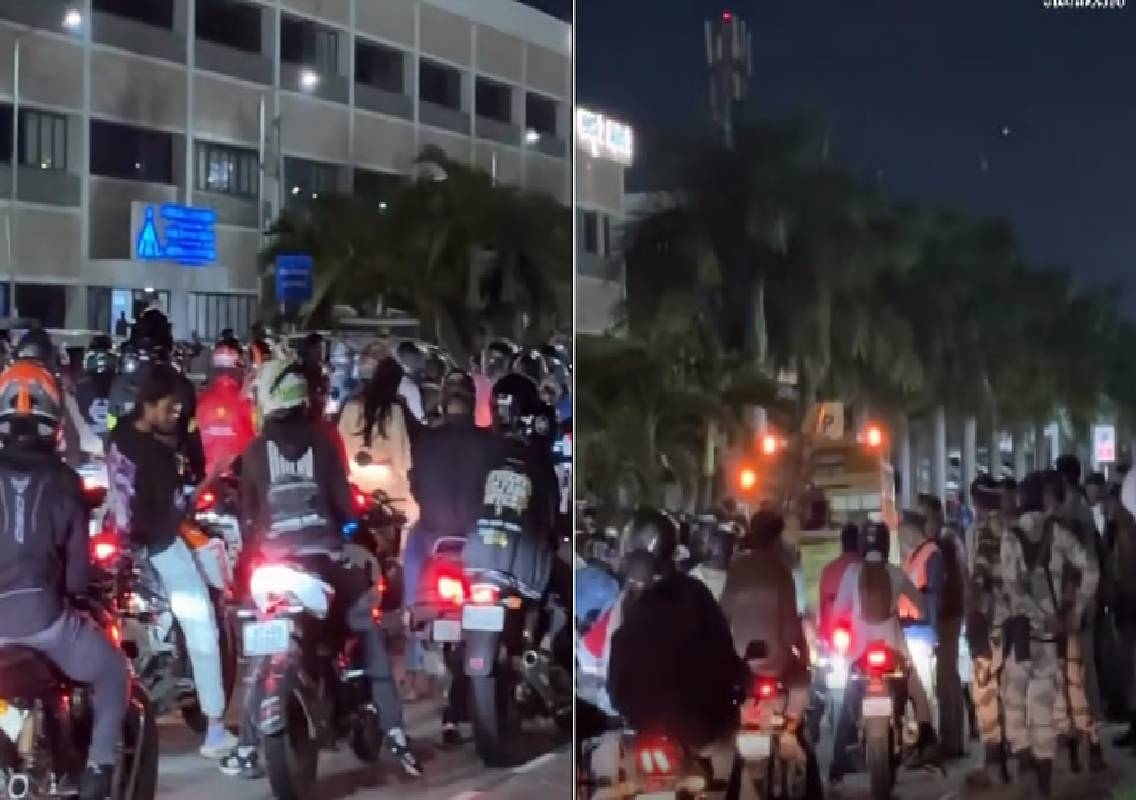


Bengaluru: Bengaluru’s two-wheeler riders took to the city’s Airport Road elevated corridor on Thursday, September 3, in what many described as a “last ride” before new restrictions on motorcycles and passenger autorickshaws came into force.
The ride came amid confusion and frustration over the Bengaluru Traffic Police’s new restrictions on two-wheelers using major elevated corridors. The rules for the International Airport Road Elevated Corridor take effect from September 4, while similar restrictions on the Electronics City Elevated Corridor are scheduled to begin from September 11.
The restrictions have triggered a debate among Bengaluru’s bikers and daily commuters, many of whom depend on these elevated roads to avoid slower surface routes.
Bikers take a final ride before restrictions
With the Airport Road flyover restrictions set to begin, groups of bikers gathered to ride along the corridor before motorcycles were prohibited.
For many riders, the outing was more than a recreational ride. It was a symbolic response to the new traffic rules and the uncertainty surrounding how they would affect everyday travel across the city.
The Airport Road corridor is one of Bengaluru’s important high-speed routes, connecting the city towards Kempegowda International Airport. Two-wheeler riders have traditionally used the elevated section to make quicker journeys between northern Bengaluru and other parts of the city.
The new restrictions mean that commuters who previously relied on motorcycles on the elevated corridor will have to use alternative routes.
Why has Bengaluru restricted two-wheelers?
Bengaluru Traffic Police have cited road safety, traffic management and vehicle breakdowns as reasons for introducing restrictions on selected elevated roads.
Authorities have argued that the combination of high speeds and mixed traffic can create safety risks, particularly for smaller and more vulnerable vehicles such as motorcycles and autorickshaws. The restrictions are also aimed at improving traffic flow and reducing disruptions caused by vehicle breakdowns on elevated corridors.
The new rules are not a blanket ban on two-wheelers across all flyovers in Bengaluru. Different restrictions apply to different corridors.
The International Airport Road and Electronics City elevated corridors are the two major stretches where two-wheelers face complete restrictions.
Other flyovers and elevated corridors have more specific restrictions covering autorickshaws and different categories of goods vehicles.
Airport Road restrictions begin on September 4
The International Airport Road Elevated Corridor is the first of the two major corridors where the new restrictions take effect.
From September 4, two-wheelers and passenger autorickshaws will not be permitted on the elevated corridor. The move is expected to force regular motorcycle commuters to shift to alternative routes.
The timing has caused concern among commuters who use the route to travel towards the airport and northern parts of Bengaluru.
The road’s high-speed nature has made it an important time-saving route for motorists. With motorcycles now being diverted to other roads, commuters fear that traffic volumes could increase on surface-level alternatives.
Electronics City ban follows on September 11
A similar restriction is scheduled for the Electronics City Elevated Corridor from September 11.
The Electronics City flyover is particularly important for thousands of employees travelling towards Bengaluru’s major technology and business hubs.
A latest report estimates that around 20,000 to 25,000 daily commuters could be affected by the Electronics City two-wheeler ban. Many of them are technology professionals who have depended on the signal-free elevated route for years.
The scale of the potential impact has intensified the debate over whether sufficient alternatives are available for two-wheeler users.
Bikers question impact on daily commuters
While authorities have emphasised safety, many bikers have questioned the practicality of the restrictions.
For motorcycle users, the elevated corridors provide a faster alternative to congested surface roads. Removing two-wheelers from these routes could increase travel time and force riders onto roads that may already experience heavy traffic.
Some bikers have also argued that restricting motorcycles while allowing other vehicles to use the infrastructure places an additional burden on commuters who rely on two-wheelers because they are cheaper and more convenient for daily travel.
The restrictions have consequently become a larger discussion about Bengaluru’s transport planning, road safety and equitable access to public infrastructure.
Road tax refund demand emerges
The opposition to the flyover restrictions has also taken another turn, with some Bengaluru bikers demanding a refund of road tax.
Their argument is that two-wheeler owners pay road-related taxes but are now being prevented from using certain major road infrastructure.
The demand reflects the level of dissatisfaction among sections of the city’s motorcycle community following the announcement. Authorities, however, have maintained that the restrictions are being introduced for traffic management and safety reasons.
The road-tax argument is likely to remain part of the broader public debate as commuters experience the new restrictions.
Not all Bengaluru flyovers face the same rules
The new regulations cover multiple elevated corridors, but the restrictions differ depending on the road.
At the Peenya Elevated Corridor, for example, passenger autorickshaws and three-wheeler goods autos face restrictions, while heavy and medium goods vehicles have peak-hour restrictions.
The BGS Flyover on Mysuru Road and the Double-Decker Flyover are also covered by specific restrictions on certain categories of vehicles.
This means motorists need to understand the rules applicable to individual corridors rather than assuming that motorcycles have been banned from every flyover in Bengaluru.
Safety versus convenience
The controversy ultimately comes down to a difficult balance between safety and commuter convenience.
Authorities are concerned about accidents and disruptions on high-speed elevated roads. Bikers, meanwhile, argue that restrictions without sufficient alternatives could worsen congestion on surface roads and increase travel times.
The issue is particularly significant in Bengaluru, where a large section of the workforce depends on two-wheelers for daily commuting.
The latest restrictions are therefore being closely watched as they are implemented. Their eventual impact will depend not only on compliance but also on how traffic shifts to alternative roads.
Bengaluru commuters face a new road reality
The “one last ride” by bikers on Airport Road captures the mood among a section of Bengaluru’s two-wheeler community as the new rules take effect.
From September 4, motorcycles and passenger autorickshaws will no longer be allowed on the International Airport Road elevated corridor, followed by restrictions on the Electronics City elevated corridor from September 11.
For authorities, the objective is to make high-speed elevated roads safer and more manageable. For commuters, however, the immediate concern is how much longer and more difficult their daily journeys may become.
As Bengaluru adjusts to the new restrictions, the coming weeks will show whether alternative routes can absorb the additional traffic without creating another set of congestion and mobility problems.