







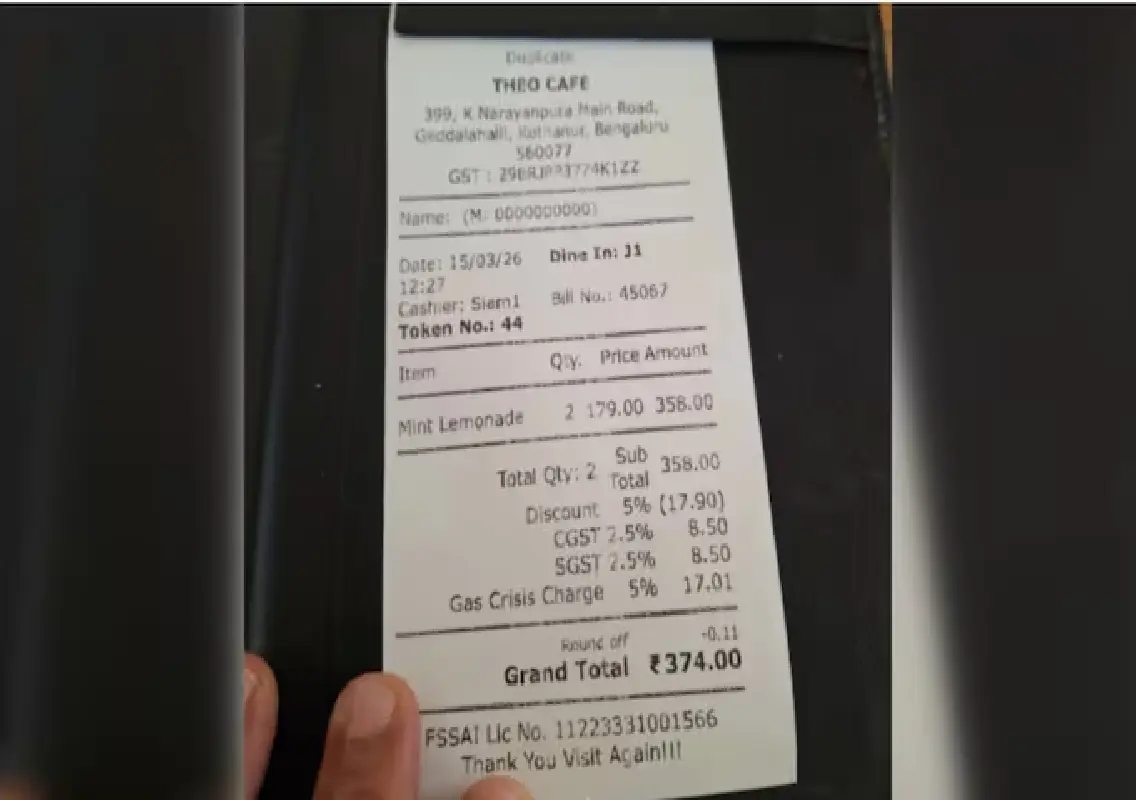


Bengaluru: A bill issued by a Bengaluru-based café has gone viral on social media after it included an unusual surcharge labelled as a “Gas Crisis Charge” amid the ongoing LPG shortage affecting parts of India.
The incident came to light after a user shared a photograph of the receipt on social media platform X. The bill, reportedly issued by Theo Cafe in Bengaluru, showed a 5 per cent “gas crisis charge” added to a customer’s order of two mint lemonades.
The post quickly attracted widespread attention online, triggering both humorous reactions and discussions about the impact of the LPG shortage on restaurants and food businesses.
Viral receipt shows extra charge
According to the receipt shared online, the customer ordered two mint lemonades priced at ₹179 each, bringing the total cost of the beverages to ₹358.
Before taxes and additional charges were applied, the café offered a 5 per cent discount amounting to ₹17.90.
After the discount, the bill included standard Goods and Services Tax components — Central GST (CGST) at 2.5 per cent and State GST (SGST) at 2.5 per cent.
However, what drew the most attention was an additional 5 per cent surcharge labelled “Gas Crisis Charge,” amounting to ₹17.01.
With all the charges included, the final bill totalled ₹374.
The unusual entry on the receipt quickly went viral after it was posted online, prompting a wave of reactions from social media users.
Social media reacts with humour
The post gained significant traction, with users sharing humorous and sarcastic comments about the surcharge.
Many social media users joked about the idea of cafés introducing new charges linked to ongoing economic challenges.
Others used the post to highlight how businesses are coping with rising operational costs during the LPG supply disruption.
Despite the light-hearted reactions, the incident also sparked broader conversations about the challenges faced by restaurants and cafés during the current fuel shortage.
LPG shortage affecting restaurants
The viral receipt comes at a time when hotels, restaurants and public canteens in several parts of the country are facing disruptions in LPG supply.
Commercial LPG cylinders are widely used by eateries for cooking, and shortages have forced many establishments to adjust their operations.
Some restaurants have reportedly reduced menu items, suspended certain dishes or switched to alternative cooking methods in order to continue serving customers.
In several places, eateries have temporarily halted operations due to the lack of cooking fuel.
Long queues reported at LPG distribution centres
The LPG shortage has also affected domestic consumers in some regions.
Long queues have been reported outside LPG distribution centres in several states including Delhi NCR, Bihar, West Bengal and Odisha, where residents are attempting to secure domestic gas cylinders.
Authorities have also received reports of hoarding in certain areas, prompting concerns about supply management.
Industry observers say that the shortage is particularly affecting urban eateries, which depend heavily on commercial LPG cylinders for daily operations.
Global supply disruptions cited as cause
The supply disruption has been linked to ongoing geopolitical tensions affecting global energy routes.
Reports suggest that the closure of the Strait of Hormuz — a key maritime passage for oil and liquefied natural gas shipments — has affected the movement of energy supplies worldwide.
The strait is considered one of the most important shipping routes for global energy trade, and disruptions there can quickly influence fuel supply chains across multiple countries.
Experts say such disruptions can lead to short-term shortages and rising operational costs for industries that depend heavily on gas supplies.
Conclusion
While the “Gas Crisis Charge” on the Bengaluru café bill has sparked amusement online, it also reflects the wider challenges faced by businesses during the ongoing LPG supply disruption.
As the situation continues to evolve, restaurants and cafés across the country are exploring different ways to manage rising costs and ensure that operations continue despite the fuel shortage.