







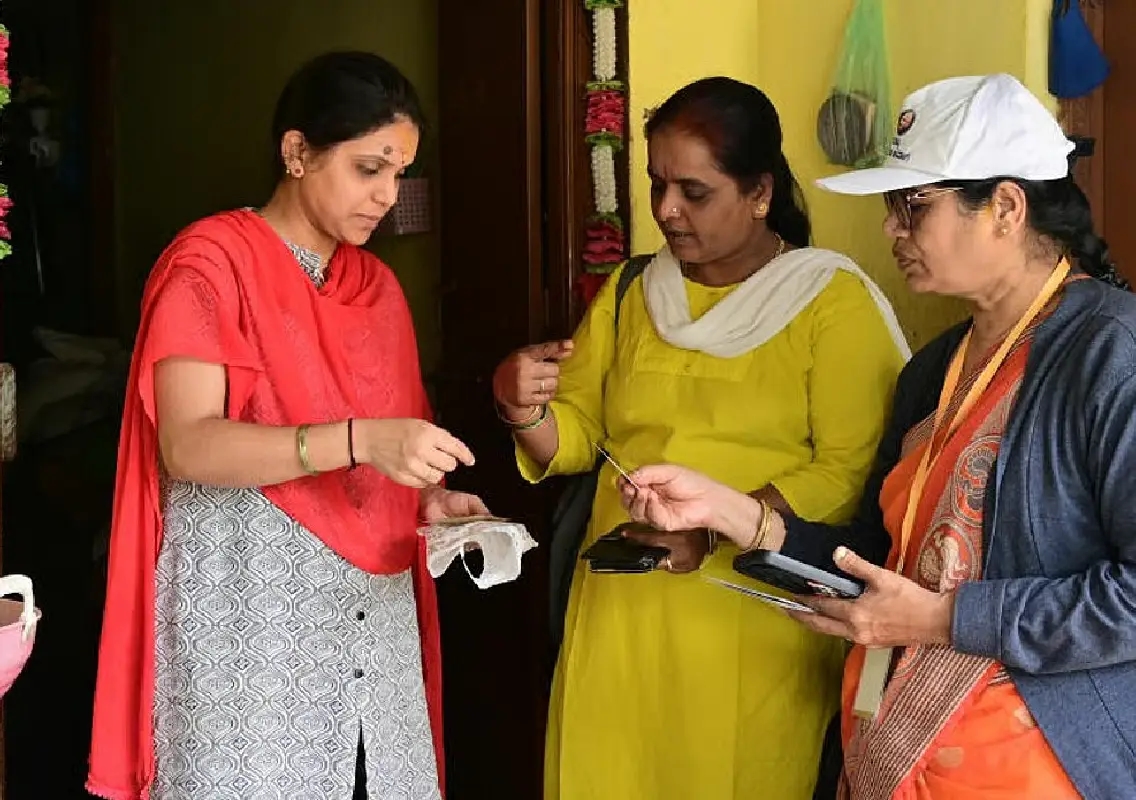


Enumerators across Greater Bengaluru have abandoned the use of the Unique Household Identification (UHID) system and are now conducting the socio-educational survey (caste census) via a direct house-to-house approach. The decision comes after repeated complaints that UHID lists, often lacking phone numbers and containing inaccurately mapped addresses, made it nearly impossible to trace households.
“At first, we were told to go by UHID but most of these IDs are not working or list houses far apart — 900 metres, sometimes 2km away. It’s just unpractical,” said an enumerator from Bengaluru city.
Under the new approach, enumerators cover all houses ward-wise, recording data manually before later entering UHIDs themselves. While this method has improved enumeration, the process remains slow.
“Each house takes at least 45 minutes. I completed only 16 of the 176 houses allotted to me. Some citizens simply refuse to give details. Four out of 10 people say, ‘Why should we tell you?’ and shut the door,” the enumerator added.
Operational challenges
In areas like Doddakammanahalli, confusion marked the first day as teachers and enumerators arrived without supervision or proper instructions.
“Yesterday we didn’t even get our area allotment because the supervisor never turned up. Today it’s smoother, but we could only survey two houses. Many of us weren’t trained, so we learned by watching others,” said one enumerator from the southern city limits.
Enumerators also highlighted that having contact numbers would have eased the survey process, especially in areas where households are widely spaced.
“Without them, we’re just guessing,” said a teacher from Mangaluru assisting in the survey.
Survey delays likely
Despite hard work, enumerators warn that pace and coordination issues could push the survey beyond its initial deadline. Workdays run from 9 am to 4.30 pm, but fieldworkers are struggling to complete their allotted houses.
“We’re managing somehow—with hard work and a bit of guesswork,” the Bengaluru enumerator said.