







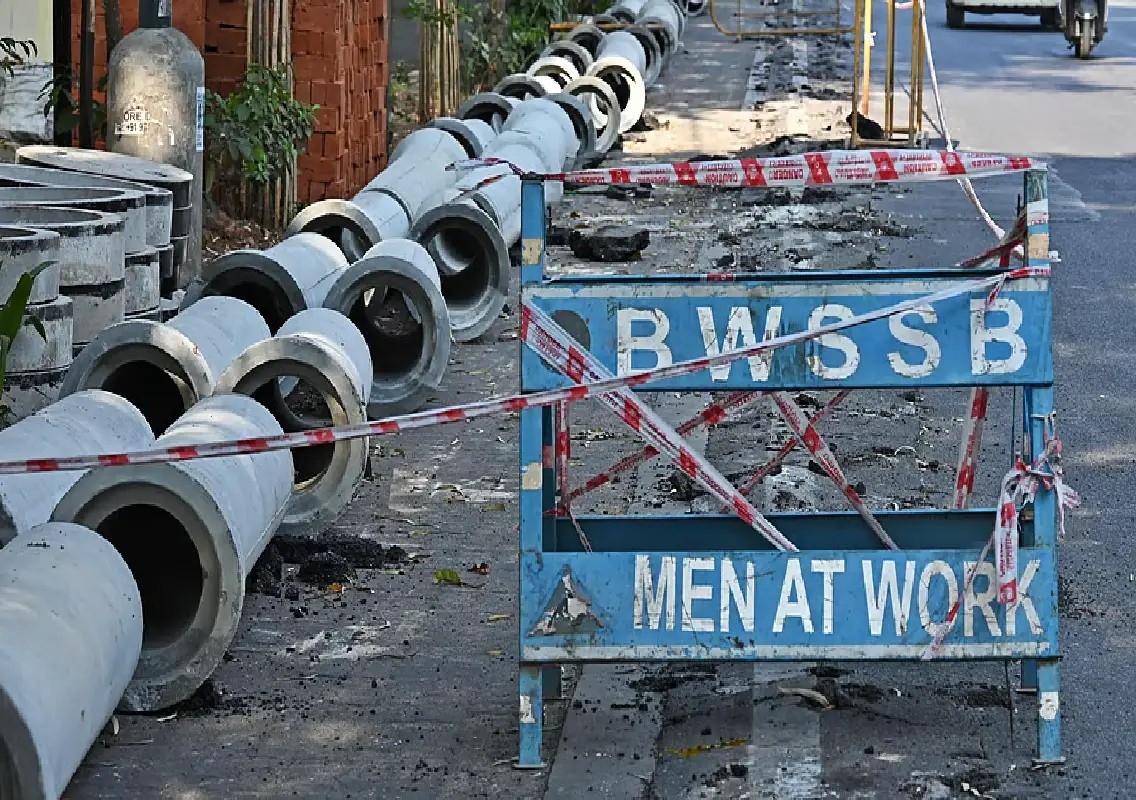


Bengaluru: Nearly half of Bengaluru’s water supply pipeline network comprises infrastructure that is between 50 and 80 years old, raising concerns over frequent leakages, water contamination and damage to roads across the city.
Of the approximately 10,000 km of water supply pipelines in Bengaluru, around 4,800 km were laid nearly 50 to 80 years ago. The city also has 83 Ground Level Reservoirs (GLRs), of which 57 are between 40 and 70 years old.
The ageing infrastructure has become a growing challenge for the Bengaluru Water Supply and Sewerage Board (BWSSB), with old pipelines requiring repeated repairs and contributing to disruptions in water supply and road infrastructure.
Old pipelines linked to leakages and contamination
According to a senior BWSSB official, some of the pipelines in the city are as old as 80 years and are responsible for recurring leakage complaints.
The problem is particularly concerning in areas where old cast iron pipelines remain in use. Leaks in such pipelines can potentially allow sewage to enter the damaged sections and mix with the drinking water, resulting in contamination.
The ageing network has also been linked to instances of roads caving in when water leaking from underground pipelines weakens the surface and surrounding soil.
Frequent repairs further add to the pressure on the city’s road network, particularly because many of the old pipelines are located in Bengaluru’s core areas.
Around 1,000 km of pipelines already replaced
Over the years, the BWSSB has undertaken work to replace at least 1,000 km of old water supply pipelines.
However, officials said replacing the entire ageing network at once would require substantial financial resources. A phased approach is therefore being considered to ensure that the work can be undertaken according to priority.
Simultaneously replacing thousands of kilometres of pipelines would also create significant disruption to traffic, as much of the network requiring replacement is located in densely developed parts of the city.
The board is therefore prioritising pipelines that pose a greater risk of leakage and contamination.
Robotics being used to detect leaks
BWSSB is turning to technology to improve the detection and management of pipeline leakages.
BWSSB Chairperson Dr Manjula N said robotics are being used to identify leaks and pinpoint their locations. This is expected to help officials locate damaged sections more accurately before undertaking repair or replacement work.
She said the board was prioritising the replacement of cast iron pipelines, given the concerns associated with their age and the possibility of contamination through leaks.
The BWSSB is also exploring the use of artificial intelligence and other technologies to develop a predictive model.
Such a system could potentially help identify pipelines that are more likely to develop leaks and determine which sections should be given priority for replacement.
57 GLRs to undergo assessment
The ageing water infrastructure is not limited to underground pipelines. The BWSSB is also conducting a comprehensive inspection of Bengaluru’s Ground Level Reservoirs.
Of the city’s 83 GLRs, 57 are reportedly between 40 and 70 years old. The assessment is intended to establish their present condition and identify reservoirs that may require major repairs or reconstruction.
The board is preparing a proposal to rebuild some of the older reservoirs based on the findings of the inspection.
Manjula said a complete assessment of the GLRs had been ordered and that reservoirs found to be in need of reconstruction would have to be rebuilt.
Distribution network remains major concern
The BWSSB has maintained that there is no significant water loss at the transmission level. Instead, a major share of the losses occurs within the distribution network.
This makes the condition of local pipelines and GLRs particularly important in reducing water losses.
Bengaluru’s Unaccounted for Water (UfW) has remained at around 30 to 35% for several years. This means that roughly one-third of the water supplied to the city from the Cauvery system may not reach consumers because of leakages and other losses in the distribution network.
Reducing these losses could help improve the efficiency of the city’s water supply system without requiring an equivalent increase in the volume of water brought into Bengaluru.
Phased modernisation seen as long-term solution
The scale and age of Bengaluru’s water infrastructure mean that modernisation is likely to be a long-term exercise.
Replacing ageing pipelines, particularly in heavily populated areas, requires careful planning to minimise disruption to traffic and residents. At the same time, continued reliance on deteriorating infrastructure could increase the risks of water loss, contamination and road damage.
The BWSSB’s proposed combination of phased pipeline replacement, priority replacement of cast iron lines, robotic leak detection and technology-based prediction could help the city address some of these challenges.
The assessment of old GLRs will provide another component of the exercise, potentially identifying reservoirs that need reconstruction before structural or operational problems become more serious.
With nearly 4,800 km of the city’s water pipeline network estimated to be 50 to 80 years old, the scale of the challenge remains considerable. Officials are now looking at technology and phased infrastructure renewal to make Bengaluru’s water distribution system more reliable and reduce the significant volume of water currently lost before it reaches consumers.