


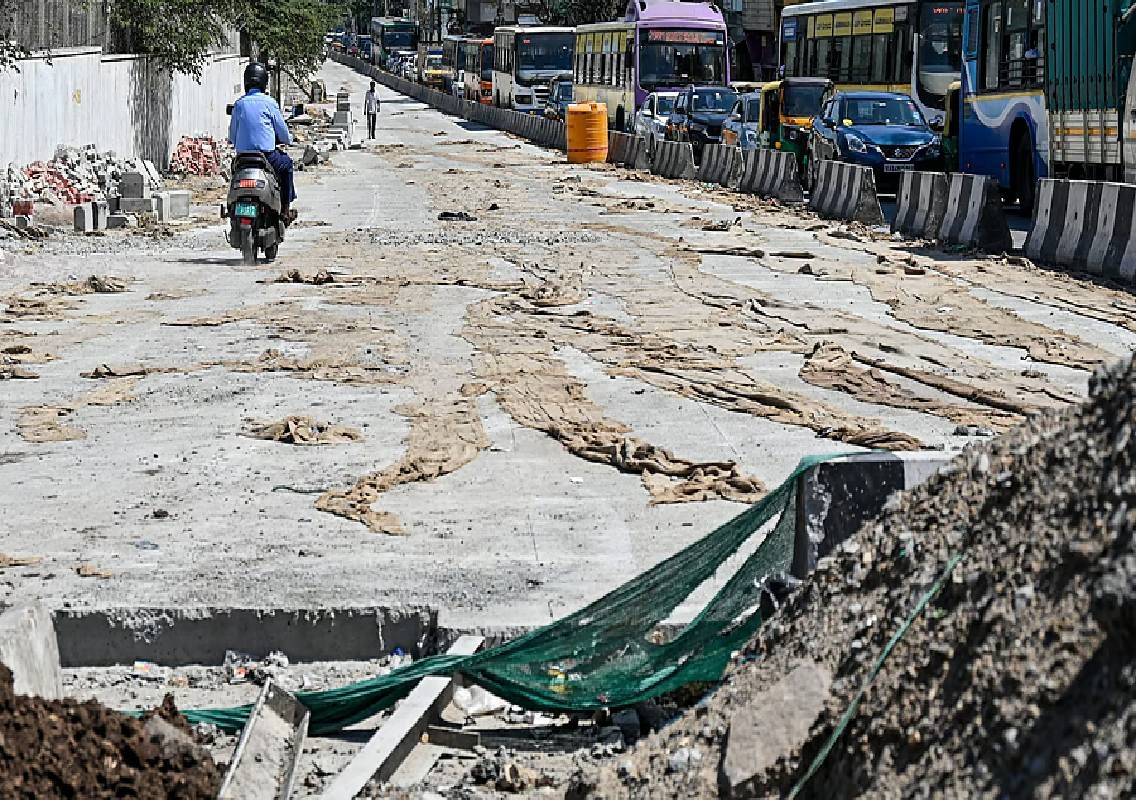


Bengaluru: The Karnataka Cabinet has approved ₹2,321.17 crore for white-topping 130.85 km of roads across Bengaluru, covering 88 roads under the fourth phase of the city’s road development programme. The project will be implemented through 12 execution packages and aims to provide more durable road surfaces while improving pedestrian infrastructure and junction design.
The approval is part of the State government’s broader efforts to improve Bengaluru’s road network and address recurring pothole problems. Greater Bengaluru Development Minister Krishna Byre Gowda said the selected roads had been prioritised based on factors such as road width and traffic-carrying capacity.
The funds will be distributed equally between the city’s core areas and its outskirts, ensuring that both central and peripheral parts of Bengaluru are covered under the programme.
88 roads to be covered in fourth phase
The fourth phase will cover 130.85 km of roads across the city, divided into 12 packages for execution. The project is intended to improve road durability and reduce the need for frequent resurfacing.
White-topping involves laying a concrete layer over an existing road surface. Compared with conventional bituminous roads, the method is intended to offer a longer service life and reduce recurring maintenance requirements.
The proposed works will go beyond road surfacing. They will also include walkable footpaths, redesigned junctions, street furniture and improved street lighting. The project plans to incorporate utility infrastructure wherever required, including water and sewage networks, cable ducts and rainwater drainage systems. This is intended to reduce repeated road excavation after the upgraded roads are completed.
Bannerghatta Road gets major allocation
Bannerghatta Road is among the important corridors identified for the white-topping programme. A 10-km stretch of the road has been allocated approximately ₹222 crore.
The corridor experiences heavy vehicular traffic as well as significant pedestrian movement. It has also faced repeated road damage, making it one of the priority stretches under the project.
The government has identified the road for a comprehensive upgrade, with the aim of improving its durability and addressing long-standing road maintenance issues.
Earlier phases of white-topping programme
The newly approved project forms the fourth phase of Bengaluru’s white-topping programme. The civic authorities have completed the first two phases, while work under the third phase is at various stages of implementation.
The earlier phases were taken up to improve major roads and reduce recurring damage caused by heavy traffic and weather conditions. The latest approval will extend the programme to additional roads across the city.
However, the government has not announced a specific completion deadline for the newly approved fourth phase. The project will be executed through the 12 packages, with implementation details expected to emerge as the work progresses.
Outer Ring Road project revised to ₹487 crore
Separately, the Cabinet has approved a revised project cost of ₹487 crore for upgrading the Outer Ring Road (ORR) stretch between Central Silk Board and K.R. Puram.
The corridor is an important route connecting major residential and commercial areas, including several office complexes. It carries heavy traffic and plays a significant role in Bengaluru’s daily commute.
An important feature of the revised arrangement is that payments to the contractor will be linked to the quality of road maintenance over a 10-year period. The government intends to ensure that the road remains in good condition after redevelopment rather than focusing only on completing the construction work.
Focus on long-term road infrastructure
The approval of the ₹2,321.17-crore white-topping project marks another major investment in Bengaluru’s road infrastructure. Along with the separate ORR redevelopment, the initiatives aim to improve road quality, pedestrian facilities and traffic movement.
The inclusion of utility networks, drainage systems and footpaths in the white-topping packages is also intended to address some of the recurring problems associated with road excavation and incomplete civic infrastructure.
The success of the programme will depend on timely execution, coordination among civic agencies and the quality of construction and maintenance. With 88 roads included in the fourth phase, residents across several parts of Bengaluru can expect road infrastructure upgrades as the project moves towards implementation.