







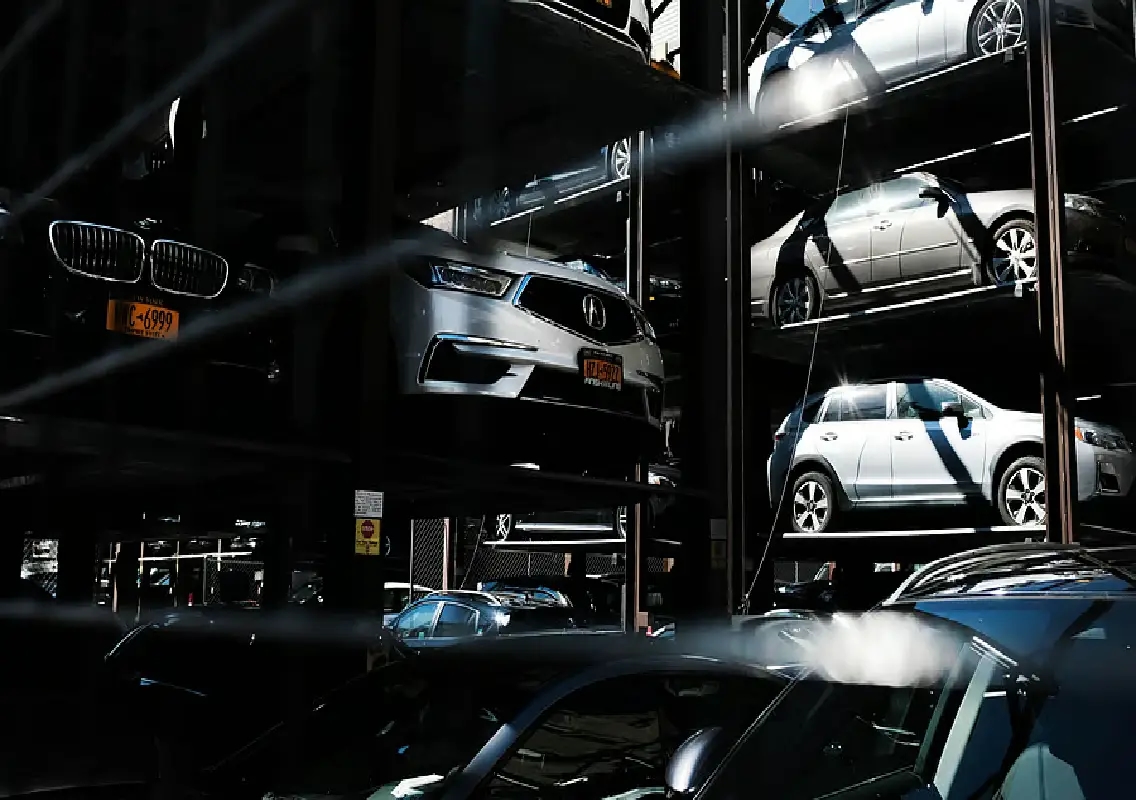


Bengaluru: In a significant move to address the city’s chronic parking crunch, the Bengaluru traffic police have identified 66 locations across high footfall and commercial zones for the construction of multi-level car parking (MLCP) facilities. These proposed sites include metro parking plots, junction-adjacent areas, and government-owned roadside land, marking a major shift in the city’s approach to solving its long-standing mobility challenges.
Smart automated parking to maximise space
The new MLCPs will use automated or semi-automated technology to optimise parking capacity. These facilities will feature lifts, hydraulic platforms and robotic systems capable of stacking vehicles both vertically and horizontally. Each structure will follow a ground-plus-nine floor design and accommodate up to 485 cars with seven lifts.
Greater Bengaluru Authority Chief Commissioner M Maheshwar Rao confirmed that the smart system eliminates the need for traditional ramps and driveways, allowing maximum utility of limited land. Motorists will leave their vehicles at an entry bay, after which sensors and a computerised tracking system will handle vehicle storage and retrieval. This reduces waiting time, manpower requirements and operational inefficiencies.
Rao emphasised that Bengaluru’s growing congestion demands advanced solutions, adding that the MLCP project is among several measures being designed to improve mobility in the city.
Project to be built under PPP model
The Greater Bengaluru Authority will fund the estimated project cost, while execution will take place under a public-private partnership (PPP) model. This structure is expected to accelerate implementation, bring in modern parking technologies and ensure efficient facility management.
The initiative comes at a time when the traffic police plan more stringent action against illegal parking. The police recently wrote to the GBA Chief Commissioner seeking structured parking systems to curb violations. Despite declaring 1,194 roads as ‘no-parking’ zones, Bengaluru continues to struggle with haphazard parking caused by a shortage of designated spaces.
Bengaluru follows Hyderabad’s successful model
Joint commissioner of police (Traffic) Karthik Reddy noted that similar automated MLCP systems have been successfully implemented in Hyderabad, improving traffic flow and reducing roadside clutter. He said Bengaluru needs an immediate intervention to prevent further congestion on arterial and sub-arterial routes.
The proposed MLCPs aim to ensure smoother vehicular movement, reduce bottlenecks caused by roadside parking, and reform the overall urban transport ecosystem.
Conclusion
With 66 targeted locations and cutting-edge automated technology, Bengaluru’s MLCP plan represents a major urban mobility reform. Once implemented, it is expected to reduce illegal parking, ease traffic flow and provide a sustainable solution to the city’s escalating parking demands.