







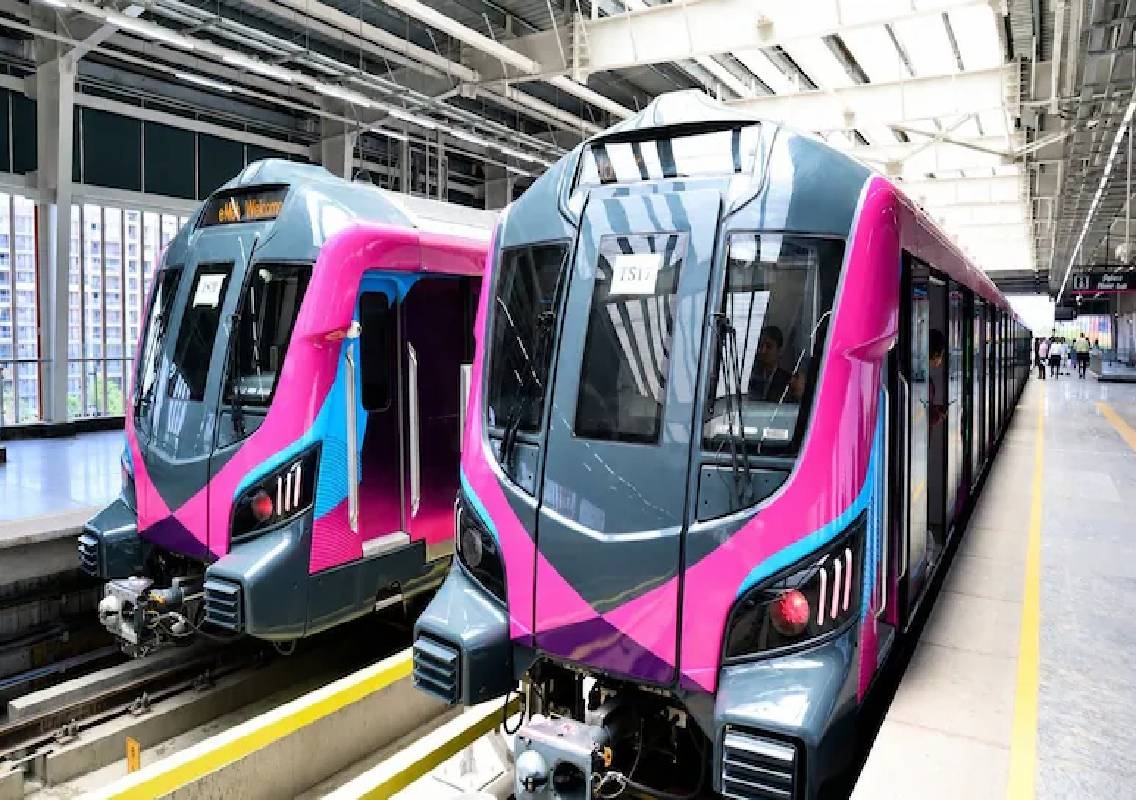


Bengaluru: The much-awaited Pink Line of Namma Metro is moving closer to opening for passengers, with its first 7.5-km stretch between Kalena Agrahara and Tavarekere expected to become operational in September 2026. The elevated section, which runs along the busy Bannerghatta Road corridor, is ready for inauguration, subject to the completion of mandatory approvals and safety procedures.
The first phase will cover six stations and is expected to provide a major public transport boost to residents and commuters in south Bengaluru. The opening is particularly significant for those travelling along Bannerghatta Road, where traffic congestion has long been a major concern.
Six stations to open in the first phase
The first operational section of the Pink Line will run from Kalena Agrahara to Tavarekere, covering 7.5 km. The six stations on this stretch are Kalena Agrahara, Hulimavu, IIM Bangalore, JP Nagar 4th Phase, Jayadeva Hospital and Tavarekere.
Among these, Jayadeva Hospital will be particularly important for Metro users because it will provide an interchange with the existing Yellow Line. This will allow passengers to switch between the two corridors and improve connectivity between parts of south Bengaluru and the Yellow Line network.
The six-station stretch is the elevated portion of the larger Pink Line project. The route has been designed to improve connectivity for several densely populated residential and institutional areas along Bannerghatta Road.
September opening awaits final approvals
Although construction and trial activities on the first stretch are substantially complete, passenger services cannot begin until the remaining statutory requirements are met.
Karnataka Greater Bengaluru Development Minister Krishna Byre Gowda recently inspected the corridor during a trial run along with Bengaluru South MP Tejasvi Surya, Bengaluru Metro Rail Corporation Limited (BMRCL) Managing Director P C Jaffer and other officials. Gowda said the section was ready for inauguration and expressed hope that an inauguration date would be finalised during September.
The Metro is also awaiting the necessary approvals related to the trains that will operate on the stretch. According to NDTV, the trains have to complete a mandatory 750-km test run before they can carry passengers.
The remaining safety and regulatory clearances are therefore crucial to determining when commercial operations can actually begin. Reports indicate that the opening is targeted for September, but the exact date depends on the completion of these procedures and the Centre’s approval.
Full Pink Line will connect south and north Bengaluru
The six-station stretch is only the first part of the larger Pink Line. Once fully completed, the corridor will extend for about 21.25 km, connecting Kalena Agrahara in south Bengaluru with Nagawara in the north.
The complete line will have 18 stations, comprising a 7.5-km elevated section and a much longer underground section of about 13.76 km.
The underground portion will extend from the Tavarekere side towards Nagawara and pass through several important parts of central and northern Bengaluru. The full corridor is expected to create additional interchange opportunities with other Metro lines and strengthen north-south connectivity.
The Pink Line will eventually serve areas including Bannerghatta Road, JP Nagar, central Bengaluru and Nagawara. Its network of interchanges is expected to make it easier for passengers to travel between different parts of the city without depending entirely on road transport.
Relief expected for Bannerghatta Road commuters
The first phase is expected to be particularly useful for commuters travelling on Bannerghatta Road. The road is one of Bengaluru’s heavily congested corridors, with substantial daily traffic from residential neighbourhoods, educational institutions, hospitals and commercial areas.
The Metro’s elevated section could provide commuters with an alternative to buses, private cars and two-wheelers for journeys between Kalena Agrahara and the central portions of the city accessible through interchange stations.
The Jayadeva Hospital interchange is also expected to improve connectivity for passengers using the Yellow Line. The Yellow Line currently provides an important east-west connection towards Bommasandra, making the interchange strategically significant for commuters from southern Bengaluru.
However, the impact of the first phase will initially remain limited because only six stations will be operational. The larger benefits of the Pink Line are expected once the underground section is completed and the entire corridor becomes operational.
Trial runs mark key milestone
Trial operations have been an important part of preparations for the opening. During the September 2 inspection, officials travelled on the 7.5-km stretch to assess the readiness of the corridor and its systems.
The trial run followed earlier testing and safety-related processes aimed at ensuring that the new corridor meets the requirements for passenger operations. The focus is now shifting from construction to regulatory approval, train certification and inauguration arrangements.
Recent reports also indicate that the elevated section is targeted for commercial operations by the end of September, subject to the remaining regulatory clearances.
What the Pink Line could mean for Bengaluru
The Pink Line is one of the major additions to Bengaluru’s expanding Metro network. The existing system already serves large commuter volumes on the Purple, Green and Yellow lines, while new corridors are being developed to improve connectivity across the city.
The first six stations of the Pink Line will offer a new rapid-transit option to people living and working around Bannerghatta Road, Hulimavu, IIM Bangalore and JP Nagar. Once the full corridor is operational, the line will provide a much broader north-south connection between Kalena Agrahara and Nagawara.
For now, commuters will have to wait for the final safety approvals and the official inauguration announcement. If the remaining clearances are completed as expected, the first six stations could begin passenger services in September, marking the start of a new phase in Bengaluru’s Metro expansion.