







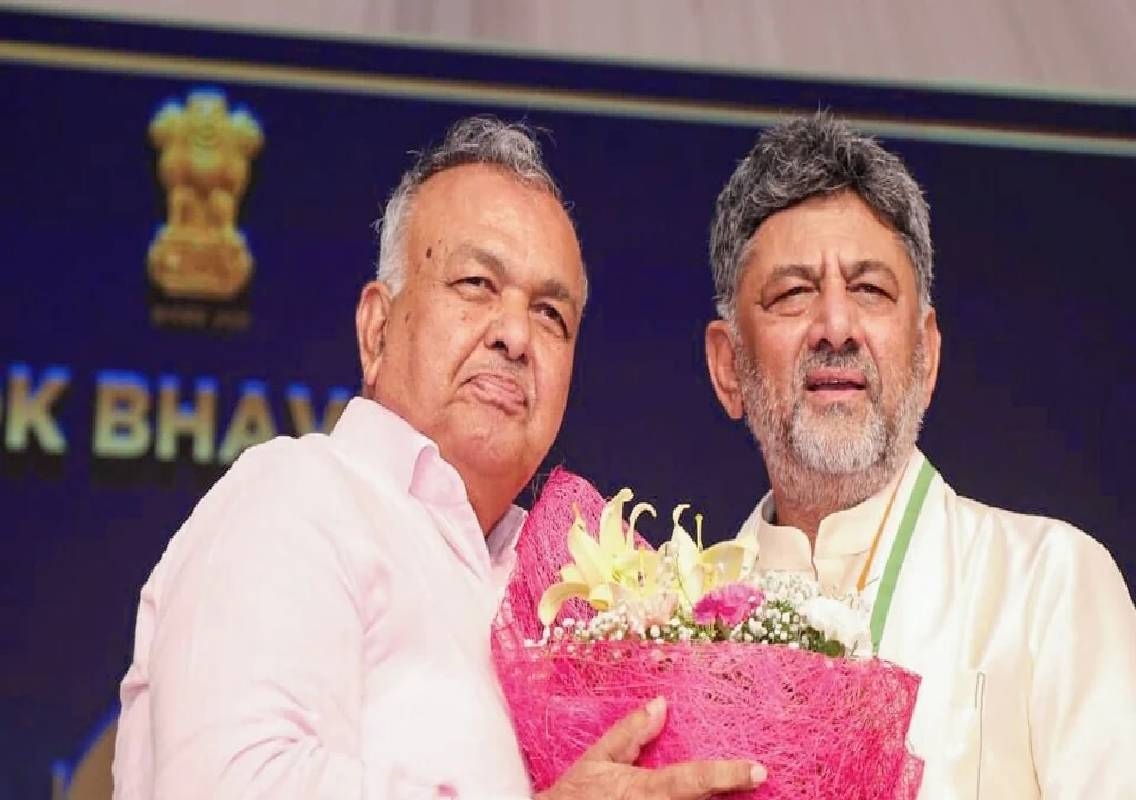


Bengaluru: Karnataka Minister Ramalinga Reddy has asked Chief Minister D K Shivakumar to reconsider the proposed annual parking fee for vehicles parked on public roads outside homes in Bengaluru, saying charges of up to ₹25,000 could put an additional financial burden on middle-class and ordinary families. The proposal is part of the draft Greater Bengaluru Authority (GBA) Parking Rules, 2026, which seek to regulate roadside parking in the city.
Reddy, who is also an MLA from Bengaluru, acknowledged that the city’s growing vehicle population and worsening traffic situation have made parking regulation necessary. However, in a letter dated August 24, he said the economic circumstances of ordinary residents should also be considered before the proposed charges are introduced.
Under the draft rules, the annual residential parking permit could cost ₹15,000 for hatchbacks, ₹20,000 for sedans and ₹25,000 for sports utility vehicles (SUVs). The proposal has triggered concerns over the affordability of parking for families who do not have adequate space within their residential premises.
Proposed Bengaluru parking fee explained
The draft GBA Parking Rules, 2026, seek to regulate the use of public roads for vehicle parking outside residential properties.
Under the proposed system, residents who do not have sufficient private parking space and need to park vehicles on public roads outside their homes could be required to obtain an annual residential parking permit.
The proposed fee would vary according to the type of vehicle. Hatchback owners could pay ₹15,000 a year, while sedan owners could face an annual charge of ₹20,000. For SUVs, the proposed fee is ₹25,000 a year.
The proposal is aimed at addressing a longstanding problem in Bengaluru, where limited parking space, a rapidly increasing number of vehicles and narrow residential roads have contributed to congestion.
However, the proposed fee is not yet a final charge being collected from residents. It is part of the draft rules and has become the subject of discussion within the Karnataka government.
Reddy’s intervention indicates that the proposal could undergo further consideration before any final decision is taken.
Ramalinga Reddy asks Shivakumar to reconsider
Reddy has not opposed parking regulation itself. Instead, his objection centres on the proposed financial burden on families.
In his letter to Chief Minister D K Shivakumar, Reddy said regulating roadside parking through appropriate fees and penalties was necessary. At the same time, he urged the government to consider exemptions for ordinary families who do not have adequate parking facilities and may not regularly use their vehicles.
He also suggested consulting Bengaluru legislators, civil society organisations and concerned officials before taking a final decision.
According to Reddy, such consultations would help the government understand the practical difficulties faced by residents in different parts of Bengaluru.
The minister’s position therefore seeks a balance between parking regulation and affordability.
Why the ₹25,000 parking fee has raised concerns
Reddy pointed out that many middle-class families already face substantial household expenses.
He referred to rising costs of essential commodities and higher expenditure on cooking gas, petrol, diesel, GST and tolls. Adding an annual parking charge of ₹15,000 to ₹25,000, he argued, could create another unavoidable expense for families that have limited alternatives.
For an SUV owner, a ₹25,000 annual parking fee would amount to more than ₹2,000 a month when spread across 12 months. A sedan owner paying ₹20,000 would face an equivalent monthly cost of about ₹1,667, while the proposed hatchback fee of ₹15,000 works out to ₹1,250 a month.
The annual nature of the proposed fee is particularly significant for households that may already be paying vehicle loans, home loans, school fees and other regular expenses.
Reddy has argued that the government should account for these financial realities while framing the final parking policy.
Older buildings create parking problems
One of the major challenges in Bengaluru is that a large number of existing residential buildings were constructed when the city’s vehicle ownership was significantly lower.
Reddy noted that new building regulations place greater emphasis on parking arrangements. However, older houses, apartment complexes and residential neighbourhoods may not have parking capacity that matches the current number of vehicles.
Residents of independent houses with large plots may have the option of keeping their vehicles within their premises.
The situation is different for families living in older buildings, smaller houses and apartments where parking space is limited or unavailable.
For such residents, roadside parking can sometimes become a practical necessity rather than a choice.
This is one of the key issues the government will have to consider if the draft rules are eventually implemented.
Parking regulation is linked to Bengaluru’s traffic crisis
Bengaluru’s parking problem is closely connected to the city’s wider traffic challenges.
The number of private vehicles on the city’s roads has increased significantly over the years. At the same time, road space in many established neighbourhoods cannot easily be expanded.
Vehicles parked along roads reduce the effective width available for moving traffic. In busy areas, roadside parking can also obstruct buses, emergency vehicles and pedestrians.
Regulating such parking could therefore help improve road capacity and traffic movement.
Reddy has acknowledged this need, making it clear that his objection is not against parking management itself. His concern is whether the proposed pricing structure is appropriate for ordinary residents.
Government wants to address illegal and long-term parking
The proposed parking rules are intended to address problems associated with long-term and unregulated roadside parking.
A system of permits and fees could allow authorities to identify vehicles that are legitimately using designated roadside spaces while discouraging indiscriminate parking.
Parking charges can also be used as a policy tool to encourage residents to use private parking facilities or alternative modes of transport where available.
However, the success of such a policy depends on whether residents have realistic alternatives.
If an apartment building has no adequate parking facility, simply imposing a fee for roadside parking may not solve the underlying problem. Instead, it could shift the financial burden to residents without creating additional parking capacity.
This is why Reddy has called for the proposal to be examined in the context of Bengaluru’s existing housing and parking infrastructure.
Possible exemptions suggested for ordinary families
Reddy has suggested that exemptions could be considered for certain categories of residents.
In particular, he referred to ordinary families who do not have parking facilities within their buildings and those who do not regularly use their vehicles.
Such exemptions could potentially reduce the impact of the proposed rules on households that have limited financial capacity or limited alternatives.
However, the exact structure of any exemption has not been finalised.
The government would need to establish clear eligibility criteria if exemptions are introduced. It would also need a system to verify residential addresses, vehicle ownership, private parking availability and usage patterns.
Difference between parking fee and vehicle ownership
An important aspect of the proposal is that the fee is linked to the use of public road space for residential parking rather than simply being a general tax on vehicle ownership.
Under the draft rules, residents seeking to park vehicles on public roads outside their homes could be required to pay an annual permit fee based on the vehicle category.
This distinction matters because the policy is aimed at regulating limited public road space.
The government could argue that residents using public roads for long-term parking are occupying a shared civic resource and that a permit system is necessary to manage that space.
On the other hand, residents may argue that where private parking is unavailable, the fee becomes an additional cost imposed on people because of inadequate parking infrastructure.
The final policy will need to address this tension.
Public consultation could shape final rules
Reddy has called for consultations with Bengaluru legislators, civil society groups and officials before the government takes a final decision.
Public consultation could help identify differences between neighbourhoods.
Parking conditions vary significantly across Bengaluru. Some newer apartment complexes have dedicated parking facilities, while older areas may have narrow streets and limited private parking.
Commercial areas also have different requirements compared with purely residential neighbourhoods.
A uniform fee structure may therefore not address every locality’s specific needs.
The government could consider factors such as neighbourhood type, availability of public parking, road width and public transport connectivity while finalising the policy.
Impact on middle-class households
The proposed parking fee has particular significance for middle-class households because vehicle ownership is increasingly common among working families.
For many residents, a car or two-wheeler is necessary for commuting, school travel, family responsibilities and other daily activities.
At the same time, apartment prices and rents in Bengaluru have made larger homes with dedicated parking increasingly expensive in many parts of the city.
If residents are required to pay an additional annual fee simply because their homes do not have adequate parking space, the cost of vehicle ownership could rise further.
Reddy has specifically highlighted this concern in his appeal to the Chief Minister.
Parking policy could also influence housing
The introduction of a structured residential parking fee could have implications beyond vehicle owners.
Parking availability is already an important consideration for people looking to rent or purchase homes in Bengaluru.
If roadside parking becomes regulated and priced, properties with dedicated parking could become more attractive.
There could also be changes in how apartment developers and housing societies approach parking requirements.
At the same time, concerns have already emerged over whether a parking fee could indirectly affect rents or property prices in areas where parking is scarce.
The broader impact will depend on how the final rules are designed and implemented.
Need for better public parking infrastructure
The debate over parking fees also brings attention to Bengaluru’s shortage of organised public parking.
A fee-based system is more likely to gain acceptance when residents have access to safe, convenient and reasonably priced alternatives.
Multi-level parking facilities, structured street parking and better enforcement could form part of a broader parking strategy.
Public transport also has a role to play. Better connectivity can reduce dependence on private vehicles and consequently ease pressure on parking spaces.
A parking policy that focuses only on fees without expanding alternatives may face resistance from residents.
What happens next?
The proposed parking charges are still under consideration, and Reddy’s letter has asked the Chief Minister to reconsider the proposed amounts.
The government may review the draft rules and consider suggestions before deciding whether to retain, modify or restructure the charges.
Possible changes could include lower fees, exemptions, different rates based on location or vehicle usage, or a revised permit system.
The consultation process will be important because the policy affects residents across Bengaluru and could have a direct impact on household expenses.
Until the rules are formally approved and implemented, residents should not treat the proposed ₹15,000 to ₹25,000 annual charges as a confirmed fee.
Balancing parking management and affordability
Bengaluru’s parking problem requires a long-term solution. Unregulated roadside parking can contribute to congestion, but residents also need practical alternatives.
The government’s challenge is to create a system that encourages responsible parking without disproportionately affecting families that lack private parking facilities.
Reddy’s intervention has brought this affordability issue into the policy debate.
His proposal for consultation and possible exemptions could lead to a more nuanced parking system, particularly for residents of older buildings and areas where dedicated parking is unavailable.
At the same time, effective enforcement will be necessary if the city wants to prevent public roads from becoming permanent parking spaces.
Conclusion
Bengaluru’s proposed residential parking fee of ₹15,000 to ₹25,000 a year has faced pushback from Karnataka Minister Ramalinga Reddy, who has asked Chief Minister D K Shivakumar to reconsider the charges. Under the draft GBA Parking Rules, hatchbacks could attract a ₹15,000 annual fee, sedans ₹20,000 and SUVs ₹25,000 for parking on public roads outside homes.
Reddy has acknowledged the need to regulate roadside parking amid Bengaluru’s growing vehicle population and traffic problems. However, he has argued that many middle-class families live in older homes and apartments without sufficient parking and are already managing significant household expenses.
He has suggested considering exemptions for families without adequate parking facilities and called for consultations with Bengaluru legislators, civil society organisations and officials before a final decision is taken.
The proposed charges are not yet a final fee, and the government’s next steps will determine whether the rates are retained, revised or replaced with a different parking framework.