


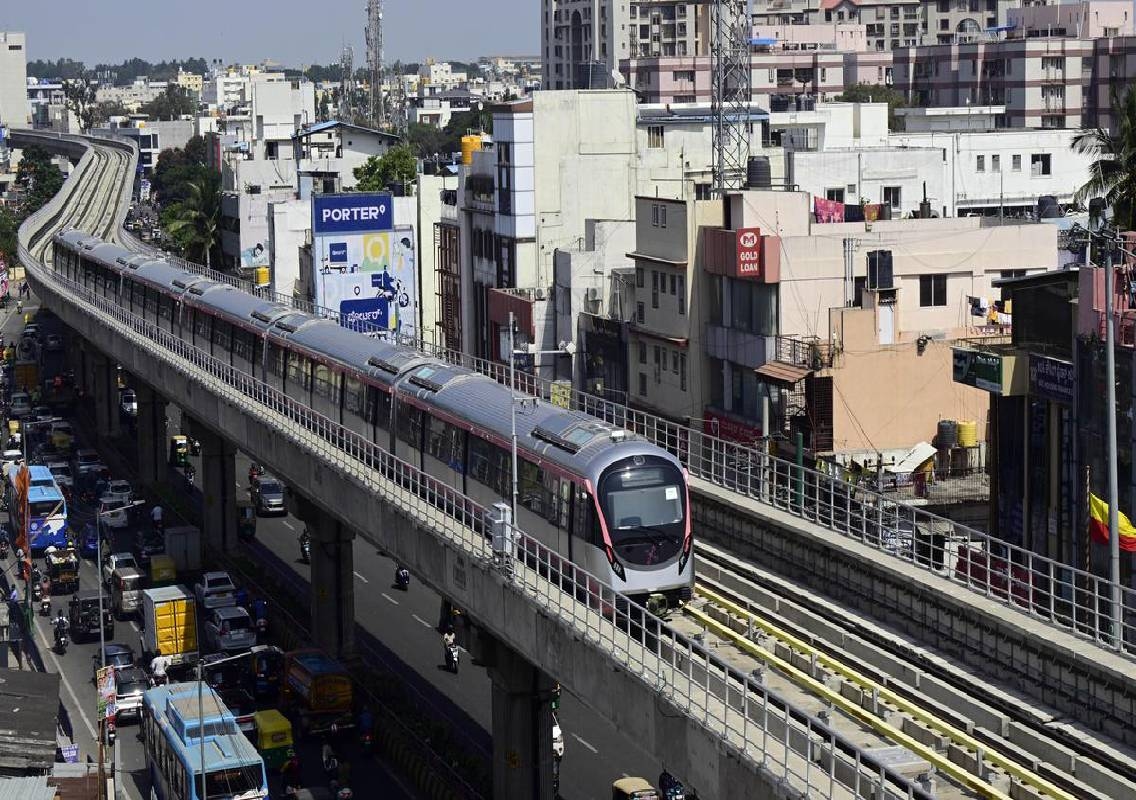


Bengaluru: The partial opening of Namma Metro’s Pink Line is expected to improve connectivity in south Bengaluru, but commuters have raised concerns that the incomplete corridor could make some journeys longer and increase congestion at existing interchange stations.
The 7.5-km elevated stretch, connecting Kalena Agrahara to Tavarekere, is scheduled to be inaugurated by Prime Minister Narendra Modi on November 13, with passenger services beginning at 6 am on November 14. However, the remaining 13.7-km underground section, extending towards Nagawara, is still under construction and is targeted for completion in 2027.
Multiple interchanges could inconvenience commuters
With only the elevated section becoming operational initially, passengers travelling from south Bengaluru to central and eastern parts of the city may have to change between several Metro lines.
Commuters heading towards Whitefield and other eastern areas could need to use the Pink, Yellow, Green and Purple lines, depending on their starting point and destination. This could increase journey time and require passengers to navigate multiple interchange stations.
For instance, passengers travelling from Hulimavu towards Whitefield may have to change from the Pink Line to the Yellow Line at Jayadeva Hospital, then move to the Green Line at RV Road and finally board the Purple Line at Majestic.
Once the complete Pink Line is operational, passengers from south Bengaluru will be able to travel directly towards central Bengaluru before connecting to the Purple Line at MG Road for destinations such as Whitefield. This is expected to reduce the number of changes required for several journeys.
RV Road interchange faces congestion concerns
The RV Road interchange has emerged as a particular concern among commuters. Passengers fear that additional movement between the Pink and Green lines could put pressure on the station’s existing infrastructure, especially during peak hours.
Sunitha K., a commuter from Bilekahalli, expressed concern that the station’s limited platform space could make passenger movement difficult after the partial opening. She feared that congestion could become comparable to the crowding experienced at Majestic Metro station.
She also pointed out that reaching MG Road from her area could involve several changes under the temporary arrangement. Given the additional travel time and inconvenience, she felt that taking an auto or cab could sometimes be a more practical option.
Commuters question the benefits of partial operations
Advaith Raj, a resident of Hulimavu, said the underground section would make a significant difference to passengers travelling between south Bengaluru and the central business district.
He noted that commuters heading towards Whitefield would have to make multiple changes until the complete corridor becomes operational. The additional interchanges could reduce the convenience of Metro travel for passengers whose destinations are not directly connected to the elevated stretch.
Manoj Kumar, a resident of BTM Layout, also expressed concern that longer journeys and repeated changes could discourage some passengers from using the new service. He suggested that some commuters might continue relying on buses, autos and cabs.
However, he also felt that the new stretch could attract passengers travelling towards Majestic and other destinations, making effective management of interchange stations important.
BMRCL to monitor passenger movement
A Bangalore Metro Rail Corporation Limited (BMRCL) official said passenger movement and crowd levels at RV Road would be monitored after the elevated section becomes operational.
The corporation will assess passenger volumes, interchange movement and peak-hour congestion. Depending on the situation, measures such as regulating passenger movement and deploying additional staff could be introduced.
The initial train frequency is expected to be around eight minutes, with five trains allocated to the elevated section, including four for regular operations and one reserve train. The frequency may be reviewed after signalling operations stabilise and passenger demand is assessed.
Complete Pink Line remains crucial
The full Pink Line will extend approximately 21.26 km between Kalena Agrahara and Nagawara, with six elevated stations and 12 underground stations. The elevated section will provide an interchange with the Yellow Line at Jayadeva Hospital, while the underground section will eventually connect passengers to the Purple Line through MG Road.
The six elevated stations are Kalena Agrahara, Hulimavu, IIMB, JP Nagar 4th Phase, Jayadeva Hospital and Tavarekere.
While the initial opening marks an important expansion of Bengaluru’s Metro network, commuters’ concerns underline the importance of completing the underground stretch. Until then, the convenience of the new corridor will depend partly on how efficiently interchange stations manage additional passenger movement.